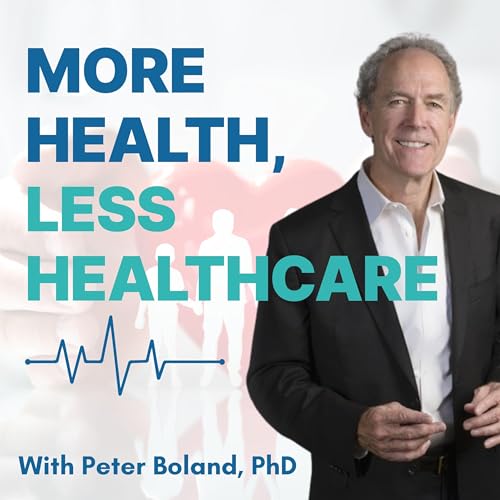
More Health, Less Healthcare Podcast Por Peter Boland PhD arte de portada

More Health, Less Healthcare

More Health, Less Healthcare

De: Peter Boland PhD
Escúchala gratis

Are you ready to rethink what health really means—and what it takes for us to achieve it? Welcome to the “More Health. Less Healthcare” Podcast, your front-row seat to a revolution in American healthcare, inspired by the game-changing book by Peter Boland.

Healthcare doesn’t have to be defined by endless bills, mounting debt, and a system that prioritizes profits over people. What if there’s a better way that means more health for everyone, fewer unnecessary costs, and a renewed sense of fairness in how care is delivered?

The “More Health. Less Healthcare” podcast takes you inside the heart of a growing movement: one that values equity, transparency, collaboration, and, above all, real outcomes for real people. Hosted by thought leaders committed to making a difference, each episode starts with a bold question: Are we ready to do the right thing, for the right reasons, at the right price?

Drawing from over 100 real-life case examples and interviews, this podcast isn’t just another critique of what’s broken. It’s your practical playbook for solutions that work—proof of concept that eradicating health disparities and cutting out waste can lead to healthier communities, a stronger economy, and a more ethical society.

Learn how the hidden cost of inequity in American healthcare is draining hundreds of billions of dollars from our economy every year, and how millions of Americans endure the crushing burden of medical debt. Discover why up to a third of all healthcare spending in the U.S.—a staggering $1.4 trillion each year—has no benefit for patients and only adds to the harm. The “More Health. Less Healthcare” podcast uncovers these hard truths and turns them into a call for accountability and courage.

We face a crucial choice: keep overspending on sickness care or rebalance our priorities to invest in real health creation. COVID-19 revealed the glaring gaps in our system and the disproportionate impact on minority communities, bringing discrimination and broken incentives to the forefront. The podcast tackles these issues head-on, with stories and strategies from those leading the way on public health, end-to-end care coordination, and the rebuilding of trust in our healthcare institutions.

Why do traditional healthcare financing models fail us? How can we redirect wasted resources to programs that create health? What can individuals, practitioners, and policymakers do right now to drive systemic change, eliminate unnecessary care, and refocus on community-based solutions?

Each episode is a masterclass in what it means to be accountable for the health of our communities. We draw on the wisdom of healthcare’s past, rooted in Hippocrates’ timeless principle—first do no harm, then try to prevent it—and update it for the 21st century. Our guests bring you groundbreaking ideas and proven methods to advance equity, commit to health creation, and embrace transparency and fairness as the guiding values of a new era.

Don’t miss the conversations that matter from how to slash 26-46% of healthcare waste, to making public health programs robust statewide and nationwide, to amplifying voices that have turned health equity from an ideal into a reality.

Whether you’re a patient, a clinician, a policymaker, or someone who simply cares about the future of health in America, “More Health. Less Healthcare” is your go-to resource for hope, honest dialogue, and practical steps toward a fairer, healthier tomorrow. Subscribe now and join the national conversation about how we value health, the urgent reforms we need, and how—with the right leadership and commitment—we can all experience more health and less healthcare.

Enfermedades Físicas Higiene y Vida Saludable
Episodios
  • How to Improve SDOH Screening Why Quality is More Important Than Quantity
    Apr 1 2026

    We’re excited to share a brand new episode of "More Health, Less Healthcare" with you! This week, host Peter Boland sits down with two incredible voices from the SIREN group: Andy Quiñones-Rivera and Danielle Hessler Jones. If you care about what makes social care truly effective (it’s more than just paperwork), this episode is a must-listen.


    Episode Sneak Peek: What You’ll Learn

    We packed this episode with actionable insights—here are 5 keys you’ll take away:

    1. The True Mission of SIREN
    2. SIREN stands for Social Intervention Research Evaluation Network—get the inside scoop on how they’re reshaping the way we think about social determinants of health.
    3. It’s Not Just the Data—It’s the Interaction
    4. Andy Quiñones-Rivera shares why the way social needs screenings are conducted can be as important—sometimes more important—than what’s actually asked.
    5. Patient Experience: More Than a Number
    6. Diving into real patient interviews, you’ll hear what makes social care a positive or negative experience, and why just checking a box isn’t enough.
    7. Racism and Stigma in Social Care
    8. The team bravely discusses how issues of race and stigma shape patient trust and engagement, with powerful patient quotes to bring these realities to life.
    9. New Tools for Real Change
    10. Danielle Hessler Jones unveils a new patient experience measure—designed not just to count how many screenings happen, but to help improve the quality of care across the board.


    Fun Fact from the Episode!

    Even when patients received material help (like a referral or resource), many said the feeling of the interaction—whether they were listened to, respected, and approached with cultural sensitivity—sometimes mattered even more than the help itself!

    Listen & Be Inspired

    This conversation is a reminder: social care is not about ticking boxes, but about making real, human connections that have the power to heal and build trust. Whether you’re a healthcare pro, patient, or just passionate about health equity, you’ll come away with practical ideas on how to make a difference.


    Your Turn!

    Ready to dive deeper? 🎧 Check out the episode and explore the full slide deck available in our show notes for even more insight. After listening, reply to this email and let us know your biggest takeaway—or tell us how YOU think we can improve social care!


    Dr. Andy Quiñones-Rivera is an emergency medicine physician and the Medical Director of Acute Care Outcomes at Alameda Health System. Their work is focused on health care quality, population health, and social determinants of health. Dr. Quiñones-Rivera earned their medical degree from the UCSF School of Medicine (UCSF PRIME-US) and completed their emergency medicine residency at the Los Angeles County–University of Southern California Medical Center.


    Dr. Hessler Jones is co-Director of the Social Interventions Research and Evaluation Network (SIREN) and a Professor and Vice Chair for Research in the Department of Family and Community Medicine at the University of California, San Francisco. Her research focuses on social care delivery in the health care sector; including understanding the impact and implementation of programs aimed at screening and addressing social risks alongside programs that seek to adjust care to fit an individual’s social context. As a health psychologist Dr. Hessler Jones also brings experience in health behaviors and engagement and intersections with mental health.

    Más Menos
    41 m
  • Making Chronic Illness Visible: Reflections on Accountability and Building Trust After COVID-19
    Mar 25 2026

    We’re excited to announce the release of Part 2 of our conversation with Jason Gale on the More Health, Less Healthcare podcast! This episode is packed with honest insights, global perspectives, and a healthy dose of optimism for tackling the chronic aftermath of COVID-19 and future pandemics.


    Introduction

    In this episode, Peter Boland welcomes back Jason Gale, a Bloomberg News journalist with decades of experience in pandemic preparedness. Together, they dive into the controversial and often overlooked realities of Long COVID, chronic illness, and how we can build better systems (and trust!) for the future.

    5 Keys You’ll Learn:

    1. Who’s Been Seen—and Who’s Been Invisible: Discover how essential workers, nursing home residents, and communities with health inequalities were disproportionately impacted, and why chronic illness still flies under the radar.

    2. Why Chronic Conditions Remain in the Shadows: Learn the surprising reasons chronic care doesn’t get the funding, media, or public interest it deserves—even as it grows.

    3. The Importance of Trust in Public Health: See how fractured trust in institutions and science became a major roadblock, and explore inspiring examples from Denmark and grassroots messengers.

    4. Lessons from Around the World: What did other countries do right? Understand Jason’s take on countries like South Korea, Denmark, and Vietnam, and why separating politics from science matters.

    5. What’s Next? Preparing for Future Pandemics: Hear Jason’s candid thoughts on why another pandemic is inevitable—and what actionable steps we can take to respond smarter, measure chronic impacts, and build unified, consistent public health funding.


    Fun Fact from the Episode

    Did you know the trusted messenger for health information might be your hair salon—not your clinic? Peter Boland and Jason Gale discuss how trust can be found in unexpected places, and how grassroots communication makes all the difference!


    Más Menos
    31 m
  • Generational Consequences of Long COVID and Why Our Healthcare System Is Unprepared
    Mar 18 2026

    We’re excited to share our latest episode from More Health, Less Healthcare , and this is one you don’t want to miss. We had the absolute pleasure of hosting the award-winning journalist and senior Bloomberg News editor, Jason Gale, who’s here to talk about his new book, “After COVID: Health Impacts That Last Generations.”


    In this first part of our two-part series, Peter Boland and Jason Gale dive deep into the generational consequences of COVID, exploring how the story isn’t just about the acute crisis, but the long tail — Long COVID and its ripple effects on health systems and everyday lives.


    Here are 5 key takeaways you’ll learn from this episode:

    1. Long COVID is a Global Challenge: No country has truly “solved” the Long COVID problem. Most health systems, from the US to Australia, are struggling to provide coordinated, effective care (Peter Boland, Jackie Lapin, and Jason Gale agree—patients are often left being their own care quarterbacks!).

    2. The Data We Don’t See: While dashboards during the pandemic tracked deaths and hospitalizations, we’re behind on tracking long-term disability, organ damage, and chronic symptoms — the “hidden pandemic” that continues for millions (Peter Boland).

    3. Mental Health & Misunderstanding: Long COVID has significant behavioral and psychiatric impacts. Many patients are wrongly told “it’s all in your head”—even though the data says otherwise!

    4. Staggering Numbers: Recent CDC estimates suggest about 7% of US adults (that’s around 18-19 million people!) may be living with Long COVID. And that number can fluctuate as definitions of Long COVID evolve.

    5. Vaccines Help, But Aren’t a Cure-All: Vaccination reduces the risk of developing Long COVID, but it’s not a silver bullet. Preventing infection remains crucial, and even vaccinated folks can experience persistent symptoms.


    Fun Fact from the Episode:

    Did you know some of the most insightful research about COVID’s lingering effects comes from the US Veterans Affairs Health System? Jason Gale mentions how scientists like Ziyad Al-Ali are digging through VA databases to uncover links between COVID and chronic diseases like diabetes and cardiovascular problems—sometimes even years after infection!


    Más Menos
    31 m
Todavía no hay opiniones