

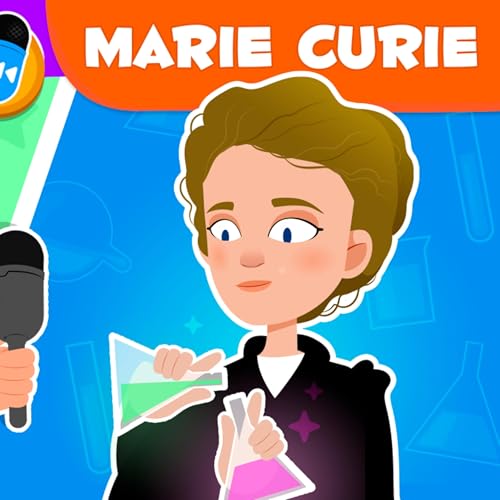
Marie Curie 🧪 History for Kids 🎙️ Episode 11
No se pudo agregar al carrito
Add to Cart failed.
Error al Agregar a Lista de Deseos.
Error al eliminar de la lista de deseos.
Error al añadir a tu biblioteca
Error al seguir el podcast
Error al dejar de seguir el podcast

Marie Curie 🧪 History for Kids 🎙️ Episode 11
-
Narrado por:
-
De:
Funded by the Spanish Ministry of Culture - European Union - NextGenerationEU.
An educational podcast for children in which we travel back in time to 1920, to a laboratory full of formulas and test tubes, to meet the most important scientist in history: Marie Curie. In this episode of “History Has a Voice,” we'll put on our white coats to discover how her brilliant mind revolutionized physics and chemistry.
Marie Curie, born Maria Skłodowska in Poland, had to face great injustices, as women in her country were not allowed to go to university. She will tell us how she studied in secret at a “clandestine university” and the pact she made with her sister to be able to travel to Paris, where she finally graduated from the Sorbonne and met Pierre Curie.
Together with her husband, she researched mysterious minerals and discovered two new elements: polonium and radium, coining the term “radioactivity.” She was the first woman to win a Nobel Prize (and the first person to win two in different disciplines!), although her unprotected experiments put her health at risk.
In this episode, we will learn what radioactivity is, discover the legacy of her daughter Irène (also a Nobel Prize winner), and reflect on her famous quote: “Nothing in this world should be feared, only understood.” An inspiring journey to encourage boundless curiosity.
A very useful and interesting resource for children. It is perfect for introducing modern science in primary education, encouraging STEM vocations (especially in girls), and working on values such as effort, perseverance, and equality.