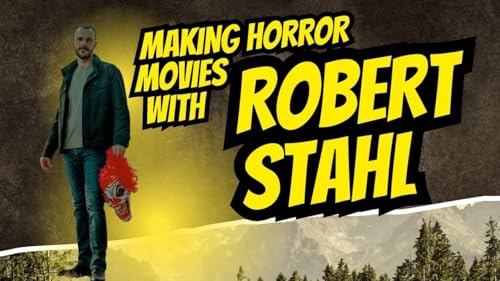
Making Horror Movies with Robert Stahl Podcast Por  arte de portada

Making Horror Movies with Robert Stahl

Making Horror Movies with Robert Stahl

Escúchala gratis

Ver detalles del espectáculo

OFERTA POR TIEMPO LIMITADO | Obtén 3 meses por US$0.99 al mes

$14.95/mes despues- se aplican términos.
Prefer to WATCH this interview? CLICK HERERobert Stahl is a long-time writing friend of mine and we met because he follows my monthly short story call lists. This Texan native also makes the most blood-chilling (and fun) little horror movies.Check them out! You Better Watch Out (trigger warning: gory)Trick (trigger warning: really spicy and gory)Think Robert Rodriguez.I saw his latest Christmas horror short on YouTube and decided a catch-up in 2026 was a must-do. Learn more about Robert at www.robertestahl.com.We also talk about his recent anthology Show Me Where It HurtsAngelique: One thing that really stands out about you is that you’ve actually made horror movies—something many writers dream about. Can you tell us about your short films?Robert: I’ve done two short horror films, both under ten minutes. I wrote and produced them and worked with a very talented local director. The first was a gay slasher short called Trick, and the second was You Better Watch Out. The second one won Audience Choice at a local film competition, which I’m very proud of.Angelique: Is filmmaking something you see as profitable, or is it more of a passion project?Robert: Those films were definitely passion projects. They’re more expensive to make than they are profitable. For me, they were a way to learn the process and train myself. I do have ideas for full-length screenplays, but with a full-time job, it’s all about finding the time.Angelique: Your production quality is impressive. It feels like the industry should be snapping this kind of work up.Robert: Thank you. I think it’s possible to get there eventually, but I have to focus on one project at a time. Right now, that focus is writing fiction.Angelique: Let’s talk about your short story collection. Why did you choose to work with JournalStone instead of self-publishing?Robert: I wanted the experience of working with a publisher. I liked the reputability and the extra validation. I shopped the collection around for about a year and a half, got plenty of rejections, and eventually connected with JournalStone after seeing other authors I respected working with them.Angelique: What did that publishing process look like?Robert: They handled formatting, cover art, ebook versions, and distribution. It was a very smooth process, and I’d recommend them to other writers.Angelique: Was it financially worthwhile?Robert: I’m not retiring anytime soon, but it did reasonably well. It’s a profit-split model, not an advance, and everything was very transparent. I’d happily work with them again.Angelique: There’s a lot of talk online about big numbers and writing income, but not much honesty about expenses. What’s your take?Robert: Exactly. There are many ways to lose money in publishing. My experience with JournalStone was straightforward and fair, but writing—especially short fiction—is rarely career-changing income.Angelique: Do you see novels or novellas as the next step?Robert: Definitely. When you go to conventions, authors with more books have more opportunities. I want to build my inventory—novels, novellas, maybe comics or screenplays.Angelique: Are you aiming to make writing your full-time career?Robert: I made peace with the fact that I do this for love, not money. If something big happens, great—but that’s not my focus. Having a day job lets me create without pressure.Angelique: I think we write horror for similar reasons—processing difficult things in the world. Is that true for you?Robert: Absolutely. I’ve had a dark inner world since childhood. Writing horror helps me channel it. My mother had dementia, and that experience directly inspired one of my stories, Family Time. Writing gives me a way to work through those emotions.Angelique: That comes through in your work. Your film You Better Watch Out barely has dialogue, which I didn’t even notice when watching.Robert: That was intentional. We wanted to challenge ourselves and rely on visual storytelling. There are maybe a couple of spoken lines, but it’s mostly pure action and atmosphere.Angelique: What’s your main focus going into 2026?Robert: Building more work—hopefully another short story collection, a novel or novella, and continuing to explore screenplays and comics. I just want to keep getting better.Angelique: And where can people find you?Robert: I’m on all the socials, and my website is robertstahl.com, where people can also sign up for email updates.If you want to hear my ORIGINAL interview with Robert, check it out here. He also reads his short story “Treats.” This is a public episode. If you'd like to discuss this with other subscribers or get access to bonus episodes, visit angeliquemfawns.substack.com/subscribe
Todavía no hay opiniones