Life Talk with Craig Lounsbrough Podcast Por Craig Lounsbrough arte de portada

Life Talk with Craig Lounsbrough

Life Talk with Craig Lounsbrough

De: Craig Lounsbrough
Escúchala gratis

Life Talk is a podcast intentionally designed to enrich your life, deepen your marriage, enhance your parenting, maximize your work life, and dramatically embolden this journey that we call life.Copyright 2016 . All rights reserved. Cristianismo Desarrollo Personal Espiritualidad Higiene y Vida Saludable Ministerio y Evangelismo Psicología Psicología y Salud Mental Éxito Personal
Episodios
  • ”LifeTalk’s” Thought for Life - Ignoring Our Conscience
    Apr 18 2026

    LifeTalk's "Thought for Life" is a weekly one-minute thought that touches on one of today's pressing issues. Each of these brief presentations is centered on one of Craig's personal quotes. All of his quotes are specifically written to challenge, inform, and inspire. Today's thought is:

    “Disabling your conscience is like disabling your smoke detector. It doesn’t stop a fire. It just leaves you ignorant of the fact that there is one.”

    Follow all of Craig's daily quotes on Facebook, Pinterest, Twitter, Linkedin and Instagram.

    Más Menos
    1 m
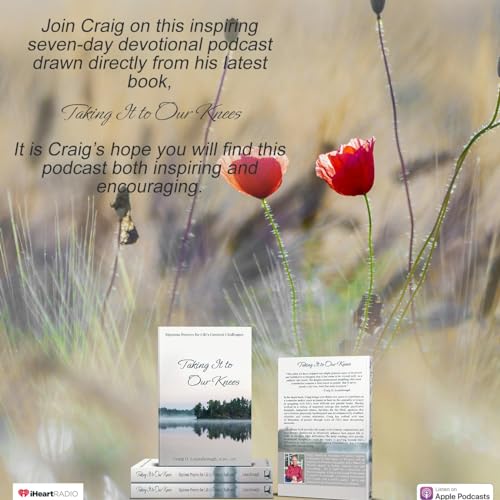
  • Taking It to Our Knees Daily Devotional - Day Seven
    Apr 15 2026

    "Like a city whose walls are broken through is a person who lacks self-control."

    • Proverbs 25:28

    Life is filled with pain. Or maybe more accurately, our lives are engulfed in pain. We’ve all run into it, or have had it run into us, or have had it run over us. That pain can be physical, emotional, mental, or spiritual. It can be a product of the people around us, or the person within us. It can come to us in the form of circumstances beyond our control, or circumstances that we should have controlled. We might have had nothing to do with it, or everything to do with it. In whatever way it comes, pain comes to all of us.

    The perpetually debilitating nature of our pain gradually weakens our resolve to fight it. Our belief that we can somehow beat it dissolves into some sort of mythical fantasy that becomes dimmer with each passing day. Desperate to have even a moment of relief from the pain that dogs our steps, we turn to self-medication. Self-medication can take on any number of forms, but the desire to seek relief is what drives them all. If these methods of self-medication deliver the desired relief, our decision to use them is reinforced. In time, we can begin to develop a gradually increasing dependency upon them that is far beyond their intended use or actual benefit.

    These means of self-medication soothe our emotional state, grant us a sense of control over our pain, and become so thoroughly integrated into our daily lifestyle that to remove them would cause a disruption in our lives that we perceive as far greater than the disruption of the dependency that we have now created. We soon discover that the means of self-medication has created its own pain. And in time that pain replaces the pain that we were originally self-medicating against, leaving us in the perpetually debilitating state that is certain to be our fate if we decide to swap one kind of pain for another in order to somehow remedy our pain.

    The longer the dependency, the tighter its grip. We fear the seemingly insurmountable challenge of breaking the addiction. This fear is compounded by our concern that what we medicated ourselves against will return in force if we forsake our addiction. In essence, we are held hostage to a something that numbs but never cures.

    You will find "Taking It to Our Knees - Rigorous Prayers for Life's Greatest Challenges" in paperback or hardcover at Amazon, Barnes and Noble, or wherever books are sold.

    Más Menos
    6 m
  • I Heard a Robin - Hope in the Dark
    Apr 13 2026
    I Heard a Robin - Hope in the Dark We all create expectations. But how often are our expectations a wholesale surrendering of ‘what could be’ to ‘what is?’ How often are they borne of a discouraged soul and a frightened heart that cannot see beyond the realities of the moment so as to envision a brighter reality standing at-the-ready in the next moment? How many times have we taken the darkness of today and handily projected it onto the landscape of a tomorrow that is in fact full of light? How many times have we expected that failure will be our lot, disappointment our bedfellow, and that this curse is somehow our due? We create expectations because that’s what we do, so we’d better be very careful as to how we create them. What Shapes Our Expectations There are an innumerable array of elements that mold and craft our expectations. However, there are several that seem to directly impact most, if not all of the rest. In and of themselves, these three are certain to kill our vision and utterly convince us that tomorrow will surely embody the darkness of today. Left unchecked to bleed into the other areas of our lives, they can leave us destitute. First, we have a tendency to focus on the negative experiences that we have had for fear that the positive ones weren’t authentic, or if perchance they were, they’re unlikely to come our way again. Second, we build a faith that’s safe, which means that it’s ‘faith’ in name only and therefore it holds no power. Third, our vision is limited by the walls that we’ve meticulously constructed all around ourselves in order to protect us against imaginary enemies, or at least enemies that are not nearly as gigantic as we’ve given them permission to become. And while it’s obvious that far more goes into the creation of our expectations than these three ingredients alone, these would appear to be inordinately impacting. Making ‘What Is,’ ‘What Will Be’ Because these appear to be an inherent part of us, we gather up the sum total of our negative experiences, we fall victim to them because the lackluster nature of our purported faith can do no other, and we hold them hostage to these incessantly compressing walls of ours. And in this ever-weary concoction of negativity, faithless faith and massive walls, everything coalesces to shape a distorted observation of ‘what is,’ which then goes on to shape these rather dark expectations of ‘what will be.’ Therefore, our expectations are constricted to what will ‘not’ happen verses being exuberantly expanded to embrace what actually might. We project the misery of the present onto the landscape of the future and render it such before we even get there to better ascertain what it might actually be. We live with this morbid expectation that nothing will get better, that the future is eternally doomed to be nothing more than the past in redress, and that any hope of something better would be yet another expectation disappointed when we feel far too fragile to bear yet another disappointment of any sort at all. Hope Deferred The morning was yet dark as if the darkness was purposefully lingering in spite of a morning that should have long been well on its way. The cold of a winter in retreat somehow remained fiercely undiminished, casting a biting edge across what was supposed to be a warming spring. The snow had secretly begun falling under the cover of a night now lifting, leaving a world elated by spring’s flowers laying helplessly encased in winter’s white. It was as if the coming of spring was a promise disappointed; a hope fallen prey to a winter that spring was supposed to be advancing against. That days tenderly warmed at the edges with hints of green breathing new life into winter’s impossible cold were a hope ripped away. Sometimes we let circumstances of the moment create our expectations of the future. We altogether lose the vision of being able to see beyond what besets us at the moment. What we see is the ‘what is’ that our minds have interpreted as ‘what will be.’ And we throw the ‘what could be’ of a future yet unwritten into the straitjacket of a ‘what is’ that has all but consumed us. The ‘now’ is projected forward and the future is subsequently cast in its unforgiving mold. We create the shackles that bind us to the present and we fashion the blindfold that keeps us from seeing the future as anything but the present. Our expectations of ‘what will be’ are crafted entirely by ‘what is,’ and yet it is highly likely that neither are correct. I Heard a Robin Suddenly and without warning, out of snow and darkness I heard a robin. I heard the harbinger of spring call out into the dead of winter. I heard a single song that raised itself up against the dark and the cold and the anger of a winter being forced into retreat. It sat entirely at odds with everything that made ...
    Más Menos
    11 m
Todavía no hay opiniones