Learning Bayesian Statistics Podcast Por Alexandre Andorra arte de portada

Learning Bayesian Statistics

Learning Bayesian Statistics

De: Alexandre Andorra
Escúchala gratis

Are you a researcher or data scientist / analyst / ninja? Do you want to learn Bayesian inference, stay up to date or simply want to understand what Bayesian inference is?

Then this podcast is for you! You'll hear from researchers and practitioners of all fields about how they use Bayesian statistics, and how in turn YOU can apply these methods in your modeling workflow.

When I started learning Bayesian methods, I really wished there were a podcast out there that could introduce me to the methods, the projects and the people who make all that possible.

So I created "Learning Bayesian Statistics", where you'll get to hear how Bayesian statistics are used to detect black matter in outer space, forecast elections or understand how diseases spread and can ultimately be stopped. But this show is not only about successes -- it's also about failures, because that's how we learn best.

So you'll often hear the guests talking about what *didn't* work in their projects, why, and how they overcame these challenges. Because, in the end, we're all lifelong learners!

My name is Alex Andorra by the way. By day, I'm a Senior data scientist. By night, I don't (yet) fight crime, but I'm an open-source enthusiast and core contributor to the python packages PyMC and ArviZ. I also love Nutella, but I don't like talking about it – I prefer eating it.

So, whether you want to learn Bayesian statistics or hear about the latest libraries, books and applications, this podcast is for you -- just subscribe! You can also support the show and unlock exclusive Bayesian swag on Patreon!

2025 Alexandre Andorra
Ciencia
Episodios
  • Bitesize | "What Would Have Happened?" - Bayesian Synthetic Control Explained
    Apr 2 2026

    Today's clip is from Episode 154 of the podcast, with Thomas Pinder.

    In this conversation, Thomas Pinder explains how Bayesian methods naturally lend themselves to causal modeling, and why that matters for real-world business decisions. The key insight is that causal questions in industry are rarely black and white: instead of a single treatment effect, you get a full posterior distribution, credible intervals, and the ability to communicate the probability that an effect is positive, which is far more useful to stakeholders than a p-value.

    Thomas then dives into Bayesian Synthetic Control, a reframing of the classic synthetic control method from a constrained optimization problem into a Bayesian regression problem. Rather than optimizing weights on a simplex, you place a Dirichlet prior on the regression coefficients, which turns out to be not just mathematically elegant but practically richer: you can express prior beliefs about how many control units are informative, set the concentration parameter accordingly, or let a gamma hyperprior on that parameter let the data decide. The result is a more flexible, less fragile counterfactual, implemented cleanly in PyMC or NumPyro.

    Get the full discussion here

    Support & Resources
    → Support the show on Patreon: https://www.patreon.com/c/learnbayesstats
    → Bayesian Modeling Course (first 2 lessons free): https://topmate.io/alex_andorra/1011122

    Our theme music is « Good Bayesian », by Baba Brinkman (feat MC Lars and Mega Ran). Check out his awesome work at https://bababrinkman.com/ !

    Más Menos
    5 m
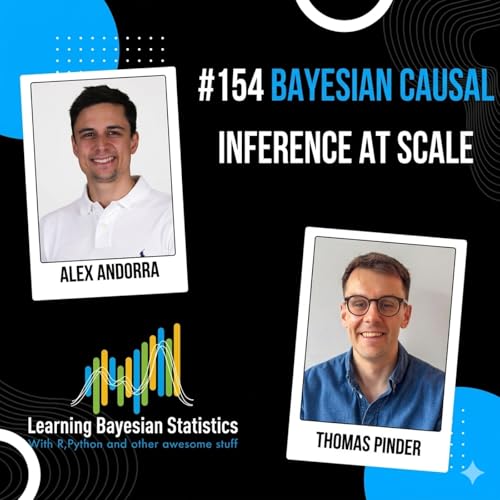
  • #154 Bayesian Causal Inference at Scale, with Thomas Pinder
    Mar 25 2026

    • Support & get perks!

    Bayesian Modeling course (first 2 lessons free)

    Our theme music is « Good Bayesian », by Baba Brinkman (feat MC Lars and Mega Ran). Check out his awesome work!

    Takeaways:


    Q: Why was GPJax created and how does it benefit researchers?
    A: GPJax was developed to provide a high-performance, flexible framework for Gaussian processes (GPs) within the JAX ecosystem. It allows researchers to move beyond black-box implementations and easily experiment with custom kernels and model structures while leveraging JAX’s automatic differentiation and GPU acceleration.

    Q: What are the primary advantages of using Gaussian processes for data modeling?
    A: Gaussian processes are highly effective at modeling complex, nonlinear relationships in data. Unlike many machine learning methods that only provide a point estimate, GPs offer built-in uncertainty quantification, which is essential for understanding the reliability of predictions in research and industry.

    Q: How does the GPJax and NumPyro integration enhance probabilistic modeling?
    A: The integration allows users to treat GPJax models as components within a larger NumPyro probabilistic program. This combination enables the use of advanced sampling techniques like NUTS (No-U-Turn Sampler), making it easier to build and fit complex hierarchical models that include Gaussian processes.

    Q: What are the main challenges when applying Gaussian processes to high-dimensional data?
    A: High-dimensional data significantly complicates GP modeling due to the curse of dimensionality and the cubic scaling of computational costs. In high dimensions, defining meaningful distance metrics for kernels becomes harder, often requiring specialized techniques like sparse GPs or dimensionality reduction to remain tractable.

    Full takeaways here!

    Chapters:


    11:40 What is GPJax and how does it simplify Gaussian Process modeling?
    15:48 How are Bayesian methods used for experimentation and causal inference in industry?
    18:40 How do you implement Bayesian Synthetic Control?
    32:17 What is Bayesian Synthetic Difference-in-Differences?
    39:44 What are the research applications and supported methods for the GPJax library?
    45:47 What are the primary software and computational bottlenecks when scaling Gaussian Processes?
    49:02 What are the real-world industrial applications of Gaussian Process models?
    54:36 How is Bayesian modeling applied to soccer and sports analytics?
    58:43 What is the future development roadmap for the GPJax ecosystem?
    01:05:37 What is Impulso and how does it integrate into a Bayesian modeling workflow?
    01:13:42 How do you balance Bayesian computational overhead with industrial latency requirements?
    01:20:26 Why is there optimism that scalable Bayesian methods for causal inference are now within reach?

    Thank you to my Patrons for making this episode possible!

    Links from the show here!

    Más Menos
    1 h y 26 m
  • #153 The Neuroscience of Philanthropy, with Cherian Koshy
    Mar 11 2026

    • Support & get perks!

    • Bayesian Modeling course (first 2 lessons free)

    Our theme music is « Good Bayesian », by Baba Brinkman (feat MC Lars and Mega Ran). Check out his awesome work !

    Takeaways:

    Q: Is generosity a natural human trait?
    A: Yes, generosity is hardwired in our brains and is essential for social interaction.

    Q: Why do people say they care about causes but not act on it?
    A: There is often a disconnect between stated care for causes and actual action. Understanding the conditions under which generosity aligns with a person's identity is crucial for bridging this gap.

    Q: How should fundraising efforts be approached?
    A: Fundraising should primarily focus on belief updating rather than mere persuasion.

    Q: What are the benefits of being generous?
    A: Generosity has significant mental and physical health benefits, as the brain's reward systems activate when we give, making us feel good.

    Q: How do our beliefs relate to our actions?
    A: Our beliefs about ourselves strongly influence our actions and decisions, including our decision to be generous.

    Q: Can generosity impact a community?
    A: Yes, generosity can be a powerful tool for improving community dynamics.

    Q: How can technology like AI assist institutions with donors?
    A: AI could help institutions remember donors better, improving the donor-institution relationship.

    Chapters:

    00:00 What's the role of Behavioral Science inPhilanthropy
    19:57 What is The Neuroscience of Generosity?
    24:40 How can we best understand Donor Decision-Making?
    32:14 How can we achieve reframe Beliefs and Actions?
    35:39 What is the role of Identity in Habit Formation?
    38:06 What is the Generosity Gap in Philanthropy?
    45:06 How can we reduce Friction in Donation Processes?
    48:27 What is the role of AI and Trust in Nonprofits?
    52:11 How can we build Predictive Models for Donor Behavior?
    55:41 What is the role of Empathy in Sales and Stakeholder Engagement?
    01:00:46 How can we best align ideas with Stakeholder Beliefs?
    01:02:06 How can we explore Generosity and Memory?

    Thank you to my Patrons for making this episode possible!

    Links from the show:

    • Come meet Alex at the Field of Play Conference in Manchester, UK, March 27, 2026! https://www.fieldofplay.co.uk/
    • Bayesian workflow agent skill
    • Neurogiving, The Science of Donor Decision-Making
    • Cherian's website
    • Cherian's press kit
    • LBS #89 Unlocking the Science of Exercise, Nutrition & Weight Management, with Eric Trexler
    Más Menos
    1 h y 9 m
Todavía no hay opiniones