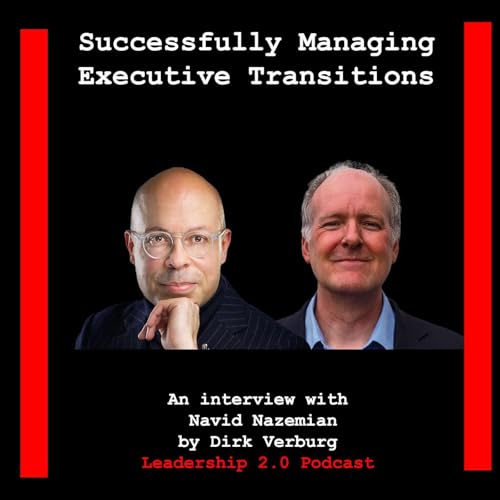
Leadership 2.0 Podcast Por Dirk Verburg arte de portada

Leadership 2.0

Leadership 2.0

De: Dirk Verburg
Escúchala gratis

Welcome to the 'Leadership 2.0' podcast!


I believe that leadership is very important for two reasons. First of all, the decisions leaders take, and their capabilities to implement these decisions, are the most important differentiators between the success and failure of the organizations they work for. Secondly, leaders make a huge difference in the well-being of the people in their organizations, and, finally, for the well-being of our society as a whole. This podcast presents interviews with thought leaders and practitioners in the area of leadership, to inspire you to become the best leader you can be! What my guests say about this Podcast: 'You ask very good questions', 'You really do your research', 'You go beyond the surface'. So, if you want to listen to dialogues about leadership that go beyond the surface, this podcast is probably for you! Happy listening, and, please let me know what you think!

© 2026 Leadership 2.0
Economía Exito Profesional Gestión Gestión y Liderazgo Política y Gobierno
Episodios
  • 37. 'Ensuring Successful Executive Transitions' - Navid Nazemian
    Feb 21 2026

    In corporate life, we accept that 40% of newly appointed executives fail - we simply accept it as an unavoidable risk.

    The financial and professional implications of failed transitions however, are significant for both the individual and the organization.

    For the individual, it means their livelihood is threatened and their professional reputation is damaged.

    For organizations, failed transitions have financial implications (recruitment costs and performance losses), as well as operational implications (new initiatives), and have a negative impact on for instance, employee engagement and the Employer Value Proposition (EVP).

    🎤 In the 37th episode of the Leadership 2.0 podcast, I talk to Navid Nazemian, my brother in arms in the Executive Transition Coaching space, about how organizations can mitigate the risk associated with executive appointments by engaging an executive coach.

    ► During our conversation, we discussed the following topics:

    • Why executive transitions should be managed
    • The number one reason why executive transitions fail
    • The value of executive coaches in executive transitions
    • Why many organizations do not use executive coaching
    • The timeframe of transition coaching
    • The structure of transition coaching
    • Identifying the right ‘early wins’
    • Balancing ‘learning and delivering’
    • Selecting ‘the team’
    • Developing transition skills
    • Managing executive exits
    • Final thoughts

    ► About Navid Nazemian

    When it comes to executive transitions, Navid Nazemian speaks with an authority that is grounded in research and complemented by authentic, demonstrated experience. His coach education took him on a three-year journey across three continents—Europe, Africa, and America.

    Working with over 250 C-level coaching clients worldwide, he distills key insights, guidance, and coaching to maximize leadership impact. Using strategies designed to avoid and overcome obstacles quickly, he has helped numerous C-suite coaching clients successfully eliminate unproductive actions and solve their toughest, most complex transition challenges.

    Navid has been recognized as HR's Most Influential Practitioner by HR Magazine, received the Outstanding Leadership Award from Education 2.0, and has been ranked as the world’s #1 Executive Coach by CEO Today for three consecutive years.

    He is the author of 'Mastering Executive Transitions: The Definitive Guide'.

    ► Newsletter: http://masteringleadership.kit.com/

    Any questions or comments? Press this link and send me a message!

    Más Menos
    53 m
  • 36. 'The Dark Side of Leadership' - Manfred Kets de Vries
    Jan 12 2026

    Unfortunately, nowadays one look at a television news bulletin or a glance at a newspaper cover is enough to see the dark side of leadership. However, many people do not need to switch on the TV or read the paper to witness this; instead, they experience the dark side of leadership every day within their own organizations. They happen to work for "Psychopath Lights"—or, as Manfred Kets de Vries likes to call them 'Seductive Operational Bullies' (SOBs).

    In the 36th episode of the Leadership 2.0 podcast, I interview Manfred Kets de Vries, who has published extensively on this topic. During our conversation, Manfred and I discussed the following:

    • 00:00 Why do people want to lead others?
    • 02:32 Why do people want to be led?
    • 11:05 The Dark Dyad and Psychopaths Lights (SOBs)
    • 16:51 Why are SOBs attracted to the Financial Sector?
    • 21:30 Can SOBs Be coached?
    • 26:38 The Impact of Life Changing Circumstances On SOBs
    • 35:21 Strategies for SOB victims
    • 40:45 Why Leaders Should Understand Their Shadow Side


    ► About Manfred Kets de Vries

    Manfred F. R. Kets de Vries is the Distinguished Clinical Professor of Leadership Development and Organisational Change and the Raoul de Vitry d'Avaucourt Chaired Professor of Leadership Development, Emeritus, at INSEAD.

    His specific areas of interest are leadership, career dynamics, executive stress, entrepreneurship, family business, succession planning, cross-cultural management, team building, coaching, and the dynamics of corporate transformation and change. Manfred F. R. Kets de Vries directs The Challenge of Leadership Executive Education programme.

    He is the founder of the INSEAD Global Leadership Centre, the programme director of INSEAD's top management seminar The Challenge of Leadership, and the scientific director of the INSEAD Executive Master in Change. He has received the INSEAD Distinguished Teacher Award five times. He has held professorships at McGill University, the Ecole des Hautes Etudes Commerciales, Montreal, and the Harvard Business School, and has lectured at management institutions around the world.

    Financial Times, Le Capital, Wirtschaftswoche, and The Economist rated Manfred Kets de Vries as one of the world's top fifty leading management thinkers, as well as one of the most influential contributors to human resource management.

    In 2008, he received the Lifetime Achievement Award from the International Leadership Association (the Leadership Legacy Project), being viewed as one of the world’s six founding professionals in the development of leadership as a field and discipline.

    He is the author, co-author or editor of forty-nine books and has published over 400 papers as articles or chapters in books. His books and articles were translated into thirty-one languages. He is a member of seventeen editorial boards.

    Kets de Vries is a consultant on organisational design/transformation and strategic human resource management to leading US, Canadian, European, African, and Asian companies. As an educator and consultant, he has worked in more than forty countries.

    ► Kets De Vries Institute (KDVI) https://kdvi.com/

    Any questions or comments? Press this link and send me a message!

    Más Menos
    49 m
  • 35. 'Lost In (Business) Transformation' - Rupert Brown
    Dec 14 2025

    'Lost in Business Transformation'

    Despite the fact that there is a solid body of knowledge about the topic of change management for several decades already, McKinsey's infamous notion that '70% of all change management efforts fail' is still seen as adequately representing the current situation.

    Rupert Brown is an experienced chief people officer and change management specialist with extensive expertise in mergers, acquisitions, digital transformation, joint ventures, and turnarounds. Through his book 'Lost in Transformation', Rupert aims to deliver a candid, emotionally intelligent manifesto for doing transformation differently.

    In the 35th episode of the Leadership 2.0 podcast, I interview Rupert about his book and how organizations can ensure the success of their change management efforts.

    • Why Transformation projects continue to fail
    • The difference between Change and Transformation
    • The Bad Reputation of the word 'Transformation'
    • Why we still struggle with Change Management
    • In-Groups and Out-Groups in Change Management Processes
    • Chief Acceleration Officers
    • Trust is Energy
    • Crises as Catalysts for Change
    • The impact of our Permacrisis on Change Management
    • Behavioral Skills to cope with the BANI world'
    • Change Management and AI


    ► About Rupert Brown

    Rupert Brown is an experienced chief people officer and change management specialist with extensive expertise in mergers, acquisitions, digital transformation, joint ventures, and turnarounds. His insights are captured in this book that emphasizes leading change in various organizations.
    Rupert has worked for and advised global multinationals like Procter & Gamble, Gillette, and A.P. Moller-Maersk, as well as nimble, private equity-backed, and family-owned businesses across diverse sectors such as consumer goods, shipping, software, telecommunications, education, and not-for-profit. His knowledge is particularly valuable for those feeling lost in transformation initiatives.

    ► Book https://www.amazon.co.uk/Lost-Transformation-Discover-Leadership-Derailing/dp/B0FQ1FWCKD

    ► Website https://rupert-brown.com/

    Any questions or comments? Press this link and send me a message!

    Más Menos
    56 m
Todavía no hay opiniones