Latent Space: The AI Engineer Podcast Podcast Por Latent.Space arte de portada

Latent Space: The AI Engineer Podcast

Latent Space: The AI Engineer Podcast

De: Latent.Space
Escúchala gratis

The podcast by and for AI Engineers! In 2025, over 10 million readers and listeners came to Latent Space to hear about news, papers and interviews in Software 3.0. We cover Foundation Models changing every domain in Code Generation, Multimodality, AI Agents, GPU Infra and more, directly from the founders, builders, and thinkers involved in pushing the cutting edge. Striving to give you both the definitive take on the Current Thing down to the first introduction to the tech you'll be using in the next 3 months! We break news and exclusive interviews from OpenAI, Anthropic, Gemini, Meta (Soumith Chintala), Sierra (Bret Taylor), tiny (George Hotz), Databricks/MosaicML (Jon Frankle), Modular (Chris Lattner), Answer.ai (Jeremy Howard), et al. Full show notes always on https://latent.space

www.latent.spaceLatent.Space
Ciencia
Episodios
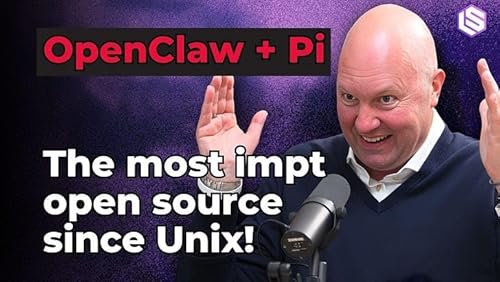
  • Marc Andreessen introspects on The Death of the Browser, Pi + OpenClaw, and Why "This Time Is Different"
    Apr 3 2026
    Fresh off raising a monster $15B, Marc Andreessen has lived through multiple computing platform shifts firsthand, from Mosaic and Netscape to cofounding A16z. In this episode, Marc joins swyx and Alessio in a16z’s legendary Sand Hill Road office to argue that AI is not just another hype cycle, but the payoff of an “80-year overnight success”: from neural nets and expert systems to transformers, reasoning models, coding, agents, and recursive self-improvement. He lays out why he thinks this moment is different, why AI is finally escaping the old boom-bust pattern, and why the real bottleneck may be less about models than about the messy institutions, incentives, and social systems that struggle to absorb technological change.This episode was a dream come true for us, and many thanks to Erik Torenberg for the assist in setting this up. Full episode on YouTube!We discuss:* Marc’s long view on AI: from the 1980s AI boom and expert systems to AlexNet, transformers, and why he sees today’s moment as the culmination of decades of compounding technical progress* Why “this time is different”: the jump from LLMs to reasoning, coding, agents, and recursive self-improvement, and why Marc thinks these breakthroughs make AI real in a way prior cycles were not* AI winters vs. “80-year overnight success”: why the field repeatedly swings between utopianism and doom, and why Marc thinks the underlying researchers were mostly right even when the timelines were wrong* Scaling laws, Moore’s Law, and what to build: why he believes AI scaling laws will continue, why the outside world is messier than lab purists assume, and how startups can still create durable value on top of rapidly improving models* The dot-com crash and AI infrastructure risk: Marc’s comparison between today’s AI capex boom and the fiber/data-center overbuild of 2000, plus why he thinks this cycle is different because the buyers are huge cash-rich incumbents and demand is already here* Why old NVIDIA chips may be getting more valuable: the pace of software progress, chronic capacity shortages, and the idea that even current models are “sandbagged” by supply constraints* Open source, edge inference, and the chip bottleneck: why Marc thinks local models, Apple Silicon, privacy, trust, and economics all point toward a major role for edge AI* American vs. Chinese open source AI: DeepSeek as a “gift to the world,” why open models matter not just because they’re free but because they teach the world how things work, and how open source strategies may shift as the market consolidates* Why Pi and OpenClaw matter so much: Marc’s claim that the combination of LLM + shell + filesystem + markdown + cron loop is one of the biggest software architecture breakthroughs in decades* Agents as the new “Unix”: how agent state living in files allows portability across models and runtimes, and why self-modifying agents that can extend themselves may redefine what software even is* The future of coding and programming languages: why Marc thinks software becomes abundant, why bots may translate freely across languages, and why “programming language” itself may stop being a salient concept* Browsers, protocols, and human readability: lessons from Mosaic and the web, why text protocols and “view source” mattered, and how similar principles may shape AI-native systems* Real-world OpenClaw use: health dashboards, sleep monitoring, smart homes, rewriting firmware on robot dogs, and why the most aggressive users are discovering both the power and danger of agents first* Proof of human vs. proof of bot: why Marc thinks the internet’s bot problem is now unsolvable via detection alone, and why biometric + cryptographic proof of human becomes necessaryTimestamps* 00:00 Marc on AI’s “80-Year Overnight Success”* 00:01 A Quick Message From swyx* 01:44 Inside a16z With Marc Andreessen* 02:13 The Truth About a16z’s AI Pivot* 03:29 Why This AI Boom Is Not Like 2016* 06:33 Marc on AI Winters, Hype Cycles, and What’s Different Now* 10:09 Reasoning, Coding, Agents, and the New AI Breakthroughs* 12:13 What Founders Should Build as Models Keep Improving* 16:33 AI Capex, GPU Shortages, and the Dot-Com Crash Analogy* 24:54 Open Source AI, Edge Inference, and Why It Matters* 33:03 Why OpenClaw and PI Could Change Software Forever* 41:37 Agents, the End of Interfaces, and Software for Bots* 46:47 Do Programming Languages Even Have a Future?* 54:19 AI Agents Need Money: Payments, Crypto, and Stablecoins* 56:59 Proof of Human, Internet Bots, and the Drone Problem* 01:06:12 AI, Management, and the Return of Founder-Led Companies* 01:12:23 Why the Real Economy May Resist AI Longer Than Expected* 01:15:53 Closing ThoughtsTranscriptMarc: Something about AI that causes the people in the field, I would say, to become both excessively utopian and excessively apocalyptic. Having said that, I think what’s actually happened is an enormous amount of ...
    Más Menos
    1 h y 16 m
  • Moonlake: Causal World Models should be Multimodal, Interactive, and Efficient — with Chris Manning and Fan-yun Sun
    Apr 2 2026
    We’ve been on a bit of a mini World Models series over the last quarter: from introducing the topic with Yi Tay, to exploring Marble with World Labs’ Fei-Fei Li and Justin Johnson, to previewing World Models learned from massive gaming datasets with General Intuition’s Pim de Witte (who has now written down their approach to World Models with Not Boring), to discussing the Cosmos World Model with with Andrew White of Edison Scientific on our new Science pod, to writing up our own theses on Adversarial World Models. Meanwhile Nvidia, Waymo and Tesla have published their own approaches, Google has released Genie 3, and Yann LeCun has raised $1B for AMI and published LeWorldModel.Today’s guests have a radically different approach to World Modeling to every player we just mentioned — while Genie 3 is impressive, its many flaws demonstrate the issues with their approach - terrain clipping, noninteractivity (single player, no physics/no objects other than the player move), and maximum of 60 second immersion. Moonlake AI (inspired by the Dreamworks logo) is the diametric opposite - immediately multiplayer, incredibly interactive, indefinite lifetime, capable of MANY different kinds of world models by simulating environments, predicting outcomes, and planning over long horizons. This is enabled by bootstrapping from game engines and training custom agents: In Towards Efficient World Models, Chris Manning and Ian Goodfellow join Fan-Yun in explaining why their approach to efficiency with structure and casuality instead of just blind scaling is sorely needed:SOTA models still show physical or spatial understanding glitches, such as solid objects floating in mid-air or moving “inside” other solid objects.If the goal is to plan for the next action, how often is a high-resolution pixel view necessary for modeling the world? Our bet is that there is a disproportionately large share of economically valuable tasks where such detail is not required. After all, humans with a wide variety of sensory limitations have little difficulty doing almost everything in the world. Furthermore, for a large number of purposes, describing a scene or a situation in a few words of language (“the car’s tires squealed as it cornered sharply”) is sufficient for understanding and planning.Experiments also show that humans only partially process visual input in a top-down, task-directed way, often making use of abstracted object-level modeling. In almost all cases, partial representations combined with semantic understanding are sufficient.…If the goal is to facilitate the understanding of causality in multimodal environments, then the world model—whether it is used in the virtual world or the physical world—must prioritize properties such as spatial and physical state consistency maintained over long time periods, and an ability to evolve the world that accurately reflects the consequences of actions. That’s what Moonlake is building.Game engines are the right starting point abstraction to efficiently extract causal relationships, and building the interfaces and community (including their new $30,000 Creator Cup) to kickstart the flywheel of actions-to-observations.We were fortunate enough to attend their sessions at GDC 2026 (the Mecca of Game Devs), and were impressed by the huge variety and flexibility of the worlds people were building with Moonlake’s tools already! Live videos on the pod.Full Video Pod on YouTube!Timestamps00:00 Benchmarking Gets Hard00:47 Meet Moonlake Founders01:26 Why Build World Models03:12 Structure Not Just Scale05:37 Defining Action Conditioned Worlds07:32 Abstraction Versus Bitter Lesson14:39 Language Versus JEPA Debate20:27 Reasoning Traces And Rendering Layer37:00 Gameplay Over Graphics38:02 Fiction Rules And World Tweaks39:15 Code Engines Beat Learned Priors41:10 Diffusion Scaling Limits43:23 Symbolic Versus Diffusion Boundary46:14 Platform Vision Beyond Games50:24 Spatial Audio And Multimodal Latents54:23 NLP Roots Hiring And Moon Lake NameTranscript[00:00:00] Cold Open[00:00:00] Chris Manning: Think this whole space is extremely difficult as things are emerging now. And I mean, it’s not only for world models, I think it’s for everything including text-based models, right? ‘cause in the early days it seemed very easy to have good benchmarks ‘cause we could do things like question answering benchmarks.[00:00:20] But these days so much of what people are wanting to do is nothing like that, right? You’re wanting to get some recommendations about which backpack would be best for you for your trip in Europe next month. It’s not so easy to come up with a benchmark, and it’s the same problem with these world models.[00:00:41] Meet the Founders[00:00:41] swyx: Okay. We’re back in the studio with Moon Lake’s, two leads. I, I guess there’s other founders as well, but, sun and Chris Manning. Welcome to the studio.[00:00:54] Fan-yun Sun: Thanks. Thanks, Chris. Thanks ...
    Más Menos
    1 h y 7 m
  • Mistral: Voxtral TTS, Forge, Leanstral, & what's next for Mistral 4 — w/ Pavan Kumar Reddy & Guillaume Lample
    Mar 30 2026
    Mistral has been on an absolute tear - with frequent successful model launches it is easy to forget that they raised the largest European AI round in history last year. We were long overdue for a Mistral episode, and we were very fortunate to work with Sophia and Howard to catch up with Pavan (Voxtral lead) and Guillaume (Chief Scientist, Co-founder) on the occasion of this week’s Voxtral TTS launch:Mistral can’t directly say it, but the benchmarks do imply, that this is basically an open-weights ElevenLabs-level TTS model (Technically, it is a 4B Ministral based multilingual low-latency TTS open weights model that has a 68.4% win rate vs ElevenLabs Flash v2.5). The contributions are not just in the open weights but also in open research: We also spend a decent amount of the pod talking about their architecture that combines auto-regressive generation of semantic speech tokens with flow-matching for acoustic tokens (typically only applied in the Image Generation space, as seen in the Flow Matching NeurIPS workshop from the principal authors that we reference in the pod).You can catch up on the paper here and the full episode is live on youtube!Timestamps00:00 Welcome and Guests00:22 Announcing Voxtral TTS01:41 Architecture and Codec02:53 Understanding vs Generation05:39 Flow Matching for Audio07:27 Real Time Voice Agents13:40 Efficiency and Model Strategy14:53 Voice Agents Vision17:56 Enterprise Deployment and Privacy23:39 Fine Tuning and Personalization25:22 Enterprise Voice Personalization26:09 Long-Form Speech Models26:58 Real-Time Encoder Advances27:45 Scaling Context for TTS28:53 What Makes Small Models30:37 Merging Modalities Tradeoffs33:05 Open Source Mission35:51 Lean and Formal Proofs38:40 Reasoning Transfer and Agents40:25 Next Frontiers in Training42:20 Hiring and AI for Science44:19 Forward Deployed Engineering46:22 Customer Feedback Loop48:29 Wrap Up and ThanksTranscriptswyx: Okay, welcome to Latent Space. We’re here in the studio with our gues co-host Vibh u. Welcome. Thanks. Excited for this one as well as Guillaume and Pavan from Mistral. Welcome. Excited to be here.Guillaume: Thank you.swyx: Pavan. You are leading audio research at Ms. Charles and Guam, your chief scientist.Announcing Voxtral TTSswyx: What are we announcing today where we’re coordinating this release with you guys?Guillaume: Yeah, so we are releasing box trial TTS. So it’s our first audio model that generates speech. It’s not our first audio model. We had a couple of releases before we had one in the summer that was a box trial, our first audio model, but it’s was like transcription models. A SR like a few months later we released some update on top of this, supporting more languages.Also a lot of table stake features for our customers context biasing ization. Time stamping and the transcription. We will start some real time model that can transcribe not just at the end of the, you just don’t need to fill your entire audio file, but that can also come in [00:01:00] real time. And here, this is the natural extension in the audio.So basically speech generation. So yeah. So we support nine languages. And this is a pretty small model 3D models. So very fast. And also status is the same level at the best model, but it’s much more efficient in terms of cost and also much in terms of cost. It’s also much to only a fraction of the cost of parking competitors.They, and we are also releasing the way that this modelswyx: yeah. Mainly linked, not, yeah. What’s the decision? Factor him.Guillaume: It’s a good question.Pavan: Ooh.swyx: Yeah. For provide any other sort of research notes to add on whatPavan: we maybe we’ll dive into it later in the forecast too.Architecture and CodecPavan: But it’s a novel architecture that we develop inhouse.We traded on several internal architectures and ended up with a auto aggressive flow matching architecture. And also have a new in-house neural audio codec. Which, converts this audio into all point by herds latent [00:02:00] tokens, semantic and acoustic tokens. And yeah, that’s that’s their new part about this model and we’re pretty excited that it’s, it came out with such good quality and Jim was mentioning. Yeah, it’s a three B model. It’s based off of the TAL model that we actually released just a few months back and insert trunk and mainly meant for like the TTS stuff, but they need text capabilities are also there. Yeah.swyx: So there’s a lot to cover.I always I love any, anything to do with novel encodings and all those things because I think that’s obviously I creates a lot of efficiency, but also maybe bugs that sometimes happen. You were previously a Gemini and you worked on post training for language models, and maybe a lot of people will have less experience with audio models just in general compared to pure language.What did you find that you have to revisit from scratch as you joined this trial and started doing this? At leastUnderstanding...
    Más Menos
    49 m
Todavía no hay opiniones