It's Baton Rouge: Out to Lunch Podcast Por ItsBatonRouge.la arte de portada

It's Baton Rouge: Out to Lunch

It's Baton Rouge: Out to Lunch

De: ItsBatonRouge.la
Escúchala gratis

OUT TO LUNCH finds Baton Rouge Business Report Editor Stephanie Riegel combining her hard news journalist skills and food background: conducting business over lunch. Baton Rouge has long had a storied history of politics being conducted over meals, now the Capital Region has an equivalent culinary home for business: Mansur's. Each week Stephanie holds court over lunch at Mansur's and invites members of the Baton Rouge business community to join her. You can also hear the show on WRKF 89.3FM.2026 ItsBatonRouge.la Economía Gestión y Liderazgo Liderazgo Marketing Marketing y Ventas
Episodios
  • Tech Never Sleeps
    Mar 22 2026

    Think about the last time you showed your ID. Maybe at the airport, maybe at a bar, maybe somewhere you had to prove you were who you said you were. You pulled out a card. A piece of plastic. Maybe it was a little beat up. Maybe the photo was from ten years ago.

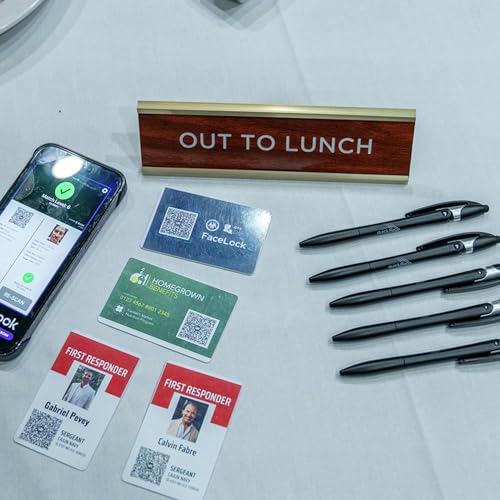
    There’s a decent chance that if you live in Louisiana, you’ve also used a phone to do that. That digital driver’s license on your phone — that was built right here, in Baton Rouge, by a company called Envoc. Calvin Fabre built it.

    Calvin is a long-time friend of Out to Lunch: he's made multiple appearances on this show over the years as he's developed his company, and some of Louisiana's most advanced tech. He's been writing code since he was 12 years old — 1978, give or take — when he got an Atari 800 and discovered that he could make a computer do exactly what he told it to do. He has essentially been doing that ever since.

    Calvin studied computer science at Southeastern Louisiana University and built Envoc into a software firm that now works on some of the most consequential identity technology in the country. You may know Envoc best as the company behind LA Wallet — Louisiana’s digital driver’s license. Calvin divested the IP on that about a year ago, but the work continues: he’s now sitting at international standards meetings with Apple, Samsung, Google, and representatives from Hong Kong, New Zealand and Canada, working out what digital identity should look like everywhere.

    He’s also thinking carefully about who gets left behind when identity goes digital — seniors, low-income users, people who don’t trust the technology or can’t easily access it. For Calvin, that’s not an afterthought. It’s the whole point.

    Samantha Morgan started her career as a journalist — arts writing, then Hurricane Katrina turned it into hard news overnight, then broadcast, then the BP oil spill, then digital. Eventually she stopped working for other people’s newsrooms and started her own production company - Quick Flip Media. She says she named it after a phrase she repeated every day for twenty years in television: flip it quick.

    Samantha is a Baton Rouge native — Old Goodwood, specifically — who has tried to leave more than once. She jokes that the natural disasters keep pulling her back.

    Calvin and Samantha have both ended up running their own business after years of building something for someone else. And in both cases, the reason seems to be the same: the problem was too interesting to leave to other people.

    Calvin has been at this long enough that he was building software before most of the people who use it were born. Samantha has covered enough Louisiana history that she has a personal archive most newsrooms would envy. Not surprisingly, neither one of them are done. Because, after all, tech never sleeps.

    Out to Lunch is recorded live over lunch at Mansurs on the Boulevard. You can find photos from this show by Ian Ledo and Miranda Albarez at itsbatonrouge.com.

    See omnystudio.com/listener for privacy information.

    Más Menos
    30 m
  • Apps Born In Baton Rouge
    Mar 14 2026

    I’m Amy Irvin, host of Out to Lunch in Baton Rouge. I was a college student once. A long time ago. And like a lot of college students, I picked some of my classes based on the professor. Word of mouth, mostly. What my friends said. Whether the 8 a.m. course section was worth getting out of bed for or not.

    These days, there’s a website that tries to do that systematically. You’ve probably heard of it. Rate My Professor. And if you’ve ever spent time on it, you might have noticed it’s also a place where students settle scores, write reviews about a professor’s appearance, and occasionally make things up entirely.

    My lunch guest, Nash Mahmoud, noticed the same thing. He happens to be a professor. He also happens to be a software engineer. So he built something better.

    Nash came to the United States from Jordan in 2008 to pursue a graduate degree at Mississippi State. He got his master’s, then his PhD, then a tenure-track faculty offer at LSU — and somewhere along the way between learning his way around campus, walking to football games, and dining at local spots around town, Baton Rouge became home.

    He’s been teaching software engineering at LSU for the better part of a decade. A few years ago, while advising nearly 40 students at once, he started paying close attention to how they were using Rate My Professor to make decisions about their education. What he saw bothered him: anonymous reviews, no way to verify whether the reviewer was even a real student, bias against female faculty, and a single bad comment that could follow a professor for years.

    Nash spent a couple of years researching the problem. Then he started coding. On March 14th, 2024 — Pi Day — Nash launched Professor Index, a verified, AI-powered professor review platform designed to reduce misinformation and bias. It’s now live at 20 universities and has more than 3,500 downloads. Professor Index has become so popular that students are sending in requests to add more campuses faster than he can keep up.

    My other lunch guest, Courtney Sparkman, taught himself to code because a problem at his job was driving him crazy and he couldn’t find anyone else to fix it. He was running security companies, then. Now he runs a software company that serves 700 of them.

    Courtney is from Chicago and moved to Baton Rouge when his wife — his fiancée at the time — got a job here after pharmacy school. He says the thing that surprised him most about Baton Rouge was how welcoming the city is to newcomers.

    Courtney is a self-described serial entrepreneur. Before coming to Baton Rouge, he helped his father build a security guard company from the ground up — zero employees to about 300, and several million dollars in revenue — before they sold it. Then he went to work for a larger security firm and immediately recognized every problem he thought he’d left behind: guards showing up late, incident reports written hours after the fact, supervisors with no real-time visibility into what was happening in the field.

    Courtney taught himself to code and built the solution himself. It’s called OfficerApps.

    OfficerApps launched in 2013. Today, OfficerApps serves about 700 security companies, from five-person operations to firms with thousands of officers in the field.

    Nash and Courtney have both figured out — the hard way, mostly — that building the thing is only the beginning. Getting people to use it, trust it, and tell someone else about it: that’s the actual work.

    Nash launched his Professor Index app on Pi Day and is now traveling to college campuses to make the case in person. And in Courtney's case, besides being the software developer he also answers OfficerApps support calls himself so customers know somebody’s there.

    Neither of these fathers of apps born in Baton Rouge planned it quite the way it happened. That turns out to be a pretty common feature of good ideas.

    Out to Lunch is recorded live over lunch at Mansurs on the Boulevard. You can find photos from this show by Ian Ledo and Miranda Albarez at itsbatonrouge.com.

    See omnystudio.com/listener for privacy information.

    Más Menos
    28 m
  • The Art of Camping
    Mar 8 2026

    Think about the last time you visited a city you’d never been to before. Not for business — just to go. What made you decide to stay somewhere? What made you feel like the place wanted you there?

    Most of the time, we don’t give a lot of credit to the people who set that stage. The campground owner who keeps a shuttle running at midnight so you can get back safely from the French Quarter. The art curator who figured out that if he put a show up in a doctor’s office, more people would see it than in any gallery. These are the people who decide, quietly and without much fanfare, what kind of place a city is going to be.

    Camping

    Mike Dunn did not grow up dreaming of owning a campground. He grew up on a dairy farm in Maryland, spent his career running cranes and heavy equipment, and took a wrong turn somewhere around 2011 that led him to a night attendant job at the New Orleans KOA — which, as wrong turns go, turned out pretty well.

    Within six months, KOA had promoted him to run the park. A few years after that, he and his wife Deborah bought it. They are now in their third year as owners of the New Orleans KOA Holiday in River Ridge — 100 RV sites, three deluxe lodges, 12 full-time employees, shuttle service to the French Quarter and the Superdome, a souvenir shop, a dog park, and a recreation hall.

    For most of its history the park’s guests were 60% international. Canadians, Europeans, Australians. In the last year or so that has flipped to 90% domestic. Mike and Deborah are figuring out what that means for a business built around introducing the world to New Orleans.

    If you're wondering what a person with a business in New Orleans is doing on a show about Baton Rouge business - well, people who stay in an RV park are generally not people who live in the same city as the RV park. So I thought it might be useful for those of us here in Baton Rouge who visit New Orleans to know about it.

    Art

    Keidrick Alford grew up in Zachary, Louisiana. His parents let him draw on the walls. That tells you most of what you need to know.

    He went to college, spent time in real estate, then nearly a decade in hospitality — long hours, demanding work, not a lot left over at the end of the day. The whole time, he was watching something on the side: Baton Rouge was turning out artists from LSU who had no idea what to do with themselves once they left. The business side of being an artist — contracts, galleries, marketing, pricing — nobody was helping them with any of that.

    In 2018, Keidrick started Ellemnop to fill that gap. Since then, he’s curated nearly 90 exhibitions — in galleries, in medical offices, in whatever space made sense. Today he’s a managing partner in The Pearl, a 5,000-square-foot warehouse in Old South Baton Rouge that will house gallery space, artist residencies, and apprenticeship programs in bodyshop work, barbering, and welding. Yes, all in the same building.

    There’s a word that comes up a lot when you talk to Mike and Keidrick, and that word is “guests.” Mike uses it for the people who pull into his campground, and Keidrick uses it for the people who walk into his exhibitions. They both mean the same thing by it: these are people who trusted you with their time, and you don’t waste it.

    Mike went to New Orleans planning to stay a little while. Keidrick has been in Baton Rouge his whole life, looking for ways to make it worth staying. Different journeys, same destination.

    Out to Lunch is recorded live over lunch at Mansurs on the Boulevard. You can find photos from this show by Ian Ledo and Miranda Albarez at itsbatonrouge.com.

    See omnystudio.com/listener for privacy information.

    Más Menos
    30 m
Todavía no hay opiniones