Episodios

  • Women Building the Future of Media: She-Cam Sessions from SXSW
    Mar 25 2026
    Podcasting got a seat at the grown-up’s table at South by SouthWest for the first time, smack in middle of Women’s History Month. So Insider Interviews captured content from three women also making strides in media, during Podcast Movement Evolutions. I spoke with these media powerhouses at The Podcast Academy / Sounds Profitable co-sponsored booth to talk about building: businesses, communities, the future of media itself…and building up women everywhere. Learn from: the co-founder of a startup modernizing how print and out-of-home are bought and sold,a global communications CEO who has built her career on making messaging move people,and one of the new forces behind podcasting’s growing presence itself. Mach on Modernizing “Premium” Media for a New Era Beth Mach, Co-Founder & COO of Spacely Media, introduces the first transactional marketplace for premium media — giving print, out-of-home, and venue advertising the digital infrastructure it’s never had. “Buying in those channels today still looks like it did 20 years ago — lots of PDFs, lots of phone calls. Spacely closes that gap.” Their platform replaces friction with functionality, and dashboards instead of PDFs. Like Neil Vogel, in my recent episode with the People, Inc. CEO, Mach is bullish on magazines and makes the case for why brands are coming back to these channels. She also explains why credibility wins the room when you’re raising money. It shouldn’t be different as a female founder. But… “Every founder meets skepticism. When you are female, it adds another layer — especially when the room has historically looked a little different.” — Beth Mach Lund on Messaging to and for Humans Wendy Lund, Global CEO of Allison Worldwide and returning Insider Interviews guest (exactly one year later!), reflects on her path from women’s health advocacy to leading a global agency — and what she’s building now. Her path ran from a master’s in women’s history to nonprofit marketing, to running a global agency. With her move to Global CEO of Allison Worldwide and Vice Chair of health at parent company Stagwell, Wendy described her enthusiasm for Allison’s strengths, across campaigns, media/influencer, and experiential. She reinforces the importance of listening, purpose-driven work, and addressing ongoing inequities in women’s health and mental health. “My favorite value has always been belonging. Do your customers feel like they’re part of something? To me, that is so sticky.” Her advice for building brand love in a fragmented media world is deceptively simple: be real, and build belonging. She’s also clear-eyed about the disconnect between how much we talk about innovation — and how much attention women’s health actually gets: “AI is on the tip of everybody’s tongue — but at the end of the day, it’s also steeped in emotion. And we’re 51% of the population. That means we should get 51% of the attention.” — Wendy Lund DeMellier Sounds Like an Inspiration Molly DeMellier, Head of Communications at Sounds Profitable, gives an insider’s scoop on the organization helping shape podcasting’s growing presence at SXSW and beyond. She points to the combined strengths of the co-founders: Bryan Barletta’s (“terrifying”) encyclopedic industry brain and Tom Webster’s research engine, along with her own expanding role shaping panel strategy, supporting retainer clients, and helping partners amplify their stories. Molly describes Sounds Profitable place in podcasting as building community and connection through events, networking, research, and partner support, emphasizing that “Podcasting is really taking off and it’s the people that power it.” But, noting the industry’s representation gap, takes her role seriously when working on events like Podcast Movement, pondering “who do I put on stage that’s going to inspire that next person” to know they can see themselves podcasting. And she closes with something that sticks: her belief that women shouldn’t have to choose between a career and a family — and why she’s determined to make sure the next generation sees women in power. “A big fear I have is that women will leave professions not by choice, but by force. And my biggest fear is what about the children who see their mom who didn’t have a choice?” — Molly DeMellier This is Episode 50 in Season 2. I think it sounds like a milestone worth celebrating. Key Moments & Time Codes 00:00 — How Podcast Movement Evolutions made its first-ever appearance at SXSW 00:53 — Beth Mach explains why Spacely calls it premium media — and why that reframe matters for the industry 04:50 — Beth explains how buying a print ad in 2025 still works the way it did 20 years ago — and how Spacely is finally changing that 09:40 — Why print titles that shut down years ago are quietly relaunching — and what that signals for brands 14:55 — On ...
    Más Menos
    19 m
  • Nir Eyal: How Beliefs Drive Behavior and What Marketers Get Wrong
    Mar 19 2026
    I found a smiling Buddha medallion on the sidewalk on my way to the Uber, and I believed it was a sign it would be a good trip. Then I got in the car and discovered my fellow passenger was Nir Eyal — behavioral designer, Stanford lecturer, and bestselling author with a new book to promote at SXSW: “Beyond Belief.” We were both headed for the same flight. I, of course, invited him to record a podcast episode and he invited me into the United Club lounge record there! I believed in my good fortune, and belief systems turned out to be the focus of Nir’s work. “We like to say that you’ll believe it when you see it — but in fact, that’s not true. The opposite is true: you see it when you believe it.” — Nir Eyal What I captured in 20 minutes was a masterclass in consumer psychology from one of the most cited thinkers in behavioral design. And a lot of fun. Nir’s first book, “Hooked”, gave marketers and product builders a framework for engineering repeat engagement. Yup, he explains his four-step model that of why users keep returning to things like Facebook, Duolingo, Slack, and even my beloved Starbucks. His follow-up, “Indistractable,” tackled the flip side: how to protect your own focus in a world engineered to steal it. And his new third book makes the case that advertising’s most powerful function isn’t awareness or recall. It’s actually shaping what using a product feels like. Or tastes like. Nir backs this up citing a Stanford fMRI study where participants tasted the exact same wine twice — once labeled cheap, once labeled expensive. Of course they rated the “expensive” pour as tastier, and brain scans confirmed they were genuinely experiencing more pleasure. The implication for marketers is significant: brand belief doesn’t just influence what consumers say about a product — it rewires how they perceive it in real time. As Nir puts it, “we are creating the experience, just as we’re creating the coffee and the cup.” We also get into distraction and focus ( — territory that’s directly relevant to anyone managing teams, creative output, or their own attention. Nir draws a clean line between traction (any action that moves you toward what you planned to do) and distraction (anything that doesn’t) — and gave me a HUGE a-ha understanding about the common assumption that multitasking is counterproductive. You’re going to want to learn about the distinction between single-channel and multi-channel multitasking. It’s how high performers and even distracted performers like me, can structure their time. (Nir shares his personal system for consuming long-form reading; it’s a practical tactic worth stealing.) This conversation was unplanned, unscripted, and recorded forty minutes before boarding a flight. That it delivered this much useful thinking on marketing, behavioral design, consumer psychology, and focus is a testament to how deeply Nir has thought about all of it — and, okay, maybe to the Buddha medallion. Key Moments: 00:00 How a serendipitous ride to the airport turns into an impromptu bonus episode with author Nir Eyal01:34 Nir’s background: behavioral designer, Stanford lecturer, and author of three books on habits, distraction, and belief02:16 The Hooked framework: the four-step model behind every habit-forming product — and how to apply it03:45 Beyond Belief: why advertising’s real job is shaping experience, not just building awareness06:07 The Stanford fMRI wine study: proof that brand belief changes consumer perception at a neurological level07:50 What marketers consistently underestimate: the experience loop of belief, anticipation, and confirmation08:15 Facts vs. beliefs: a distinction with major implications for messaging and brand strategy09:08 The one condition a product must meet before habit formation is even possible12:45 Traction vs. distraction: a framework for reclaiming focus — and why the difference isn’t the behavior14:11 Why planned downtime isn’t distraction — and how to stop moralizing screen time15:37 The multitasking reframe: single-channel vs. multi-channel, and when doing two things at once actually works17:04 Nir’s read-at-the-gym system: a practical productivity hack for high-volume information consumers18:38 How beliefs shape attitudes and perception — what we’re able to see19:33 Persuasion vs. coercion: the ethical and commercial case for “good” behavioral design Connect with Nir Eyal LinkedIn: https://www.linkedin.com/in/nireyal/ Instagram: https://www.instagram.com/nireyal Get his book Beyond Belief: geni.us/beyondbelief Connect with E.B. Moss and Insider Interviews: With Media & Marketing Experts LinkedIn: https://www.linkedin.com/in/mossappeal Instagram: https://www.instagram.com/insiderinterviews Facebook: https://www.facebook.com/InsiderInterviewsPodcast/ Threads: https://www.threads.net/@insiderinterviews If you enjoyed this episode, ...
    Más Menos
    11 m
  • Changing Perceptions in CTV Advertising: Insights from Premion’s Blake Hebert
    Mar 9 2026
    CTV advertising may come with its share of acronyms and moving parts, but about 70% of advertisers say they plan to increase their investment in it, according to the latest industry survey from Premion. Blake Hebert, Premion’s Sr Dir. of Publisher Operations, isn’t surprised by that momentum. But he also knows marketers still face challenges like complexity. In Ep. 49, he talks about where the medium stands today—and how Premion is helping simplify the path for local and mid-market advertisers. Blake, who just welcomed baby #2, returned to work to help introduce Premion’s baby #4 — that latest CTV survey done with Advertiser Perceptions. And no one’s crying about this one: only 1% of respondents said they expect to decrease their CTV budgets. With a rare perspective from being hands on across the buy side and sell side, from agency life at RPA to roles at Hulu and SpotX/Magnite, Blake now has a front-row seat to what’s coming from publishers and platforms. He shares those insights back with internal teams and advertisers to make the CTV landscape easier to navigate. And with us in this conversation. What advertisers are learning, and what Blake explains particularly well, is that success in CTV isn’t just about shifting dollars into streaming. It’s about understanding how consumers actually watch content today. He was spot on: “Consumers don’t decide to watch linear or stream; they just watch…. And they’re not just in one place. I’ll watch Amazon Prime and then flip back over to my Hulu app.” So, advertisers have to be spot on everywhere, too, which is exactly why marketers are increasingly planning around “total TV” or converged video strategies instead of separating traditional television and streaming into different buckets. Of course, this new world can feel like a maze. Fragmentation, walled gardens, and measurement challenges are still very real issues. Blake walks us through how platforms like Premion try to simplify that complexity by aggregating inventory across multiple streaming partners and layering in data that helps advertisers reach audiences efficiently. They’re especially focused on supporting local and mid-market advertisers who can now enjoy similar strategies and tactics as the big holding company agencies. Another takeaway is about targeting. In digital advertising, the instinct is often to target audiences down to the smallest possible segment. But Blake makes the case that hyper-targeting can sometimes backfire, or just lose some efficiency, especially in smaller geographic markets. His advice? Balance precision with scale. If you pile on too many audience filters, you may end up shrinking your available audience more than you intended. We also spend time talking about a topic that seems unavoidable in every media conversation right now: AI. Blake’s view is pragmatic and optimistic, particularly for local advertisers who may not have access to large creative or analytics teams. So, he says: “The sooner you can embrace it and understand how to use it as a tool, the better you’ll be in the long run.” In fact, he sees #AI helping smaller businesses build creative, optimize campaigns, and generate insights in ways that used to require a lot more resources. But, like taking on CTV, the world has changed! We also touch on a few trends that may shape the next phase of CTV advertising, like the growing importance of live sports in streaming environments to new opportunities emerging around gaming and smart TV engagement. The good news for me? Blake called in from his hometown of Austin, which is the home of SXSW. Pair that with his work as president of the local Austin chapter of the American Advertising Federation and I may be very well connected for the GSD&M party and more! I know people who know people. And now we all know a little more about CTV. To keep up with the fast-changing world of TV advertising, get the insider scoop in 30 minutes flat on what’s working in CTV right now and how Premion’s putting it to work. Key Moments 0:00 Changing Perceptions in CTV Advertising: Episode overview 0:41 Buy side to sell side: why Blake’s perspective on CTV is different 2:00 Premion’s edge: simplifying CTV for local advertisers 3:44 The headline stat: 70% growing CTV budgets — only 1% cutting 5:23 Why “linear vs. streaming” is the wrong question 7:26 Curation explained: smarter than the old ad-network model 12:02 Walled gardens don’t contain consumers — and that matters 15:00 AI as an equalizer for under-resourced local advertisers 18:00 The targeting trap: how over-targeting shrinks your audience 21:02 Live sports and more new opportunities 26:09 AAF Austin Shoutout Connect with Blake Hebert and Premion Download the Advertiser Perceptions 2026 Survey Connect with E.B. Moss and Insider Interviews: With Media & Marketing Experts LinkedIn: https://www.linkedin.com/in/mossappeal Instagram: https://...
    Más Menos
    14 m
  • Keeping Humans in Machines – POVs on AI from Baratunde Thurston and Terry Rice
    Mar 4 2026
    This bonus episode of Insider Interviews: With Media & Marketing Pros came together super spontaneously at On Air Fest in Brooklyn, where podcasters, creators, and technologists gathered recently to talk about the future of audio and, no spoiler alert, the future of AI. After a keynote session that talked about living WITH machines by keeping humanity present I had to grab Baratunde Thurston and Terry Rice to keep talking about how creators, entrepreneurs, (and parents) are navigating exactly that. Both of these conversations landed on the same core idea as my previous episode with Jack Myers: The real differentiator won’t be the machines—it’ll be the humans using them. Baratunde Thurston, author, speaker, comedian, and “thought leader of interdependence,” has been thinking about this balance for years and created his podcast Life with Machines to really explore that. As he asks: How do we live well with technology, instead of just enduring it? Living Well with Tech per Baratunde He’s experimenting with AI directly in his own creative process—even creating an AI character named “Blair” as a kind of co-producer on his show. But he’s also clear that there’s a line between assistance and authorship. #AI can help with research, feedback, or execution. But the deeper creative work, like ideas, voice, perspective, still needs to come from a human. “There’s something slower and messier about crafting things yourself—but there’s also a pride of creativity that I want to maintain.” Baratunde, and not surprisingly after him Terry Rice, also raised an issue that’s only going to become more important: authenticity. As generative AI content becomes harder to identify, the industry may need new ways to verify that a real person is behind what we’re seeing, hearing, or reading. Some technologists are already exploring ideas like “proof of humanity.” But Baratunde’s take was refreshingly simple: “I think the thing we’re going to trust the most is this: I feel you. We’re sharing the same air.” (He grabbed my arm to illustrate, saying “THIS is what matters.”) In other words, real-world presence and connection may become even more valuable in a digital ecosystem increasingly filled with synthetic content. My second conversation was with Terry Rice, entrepreneur, speaker, and host of The Signal, a podcast designed to help entrepreneurs cut through the noise and focus on practical strategies for growing their businesses. Terry uses AI in his own workflow, like generating prep guides before interviews (which I wish I had done for these spontaneous chats!) or organizing research. He also got so inspired by his kids that he built a way to help parents, with a way to build their own app for their kids! Trust me, you have to listen and hear what he did. But he made an important distinction: the value isn’t letting AI do all the thinking. It’s knowing what good looks like. “The real skill isn’t producing every answer yourself—it’s recognizing when something is good and when it isn’t.” That was one of those lightbulb emoji comments. It’s also a mindset that he’s already teaching his kids. In fact, his ten-year-old daughter summed it up in a way that might be the most useful rule for all of us navigating AI right now: “It’s okay to fight with AI.” Out of the mouths of (this generation’s) babes. Question it. Push back. Refine the answer. Through lines? AI will absolutely change how content gets made and how businesses operate. But creativity, judgment, curiosity—and yes, a little humanity—are still very much part of the equation. And for now at least, that’s something machines can’t replicate. (But props to Chat GPT for helping me summarize some of this brilliance!) Key Moments: 01:36 – Baratunde Thurston on the philosophy behind Life with Machines02:40 – Experimenting with AI as a co-producer03:20 – Where creators should draw the line with AI06:43 – The emerging concept of “proof of humanity”07:55 – Why physical presence may matter more in an AI world10:13 – Should AI try to imitate humans?11:10 – Could real human experiences become a luxury?12:18 – AI’s environmental impact and future possibilities 15:54 – Build With Them AI Parenting 17:18 – A Brand Marriage: The Signal and Fiverr 19:54 – Vulnerability Builds Trust 22:47 – No Guilt Using LLMs 23:52 – Teaching Kids to Challenge AI Connect With: Baratunde Thurston — Author, comedian, cultural thought leader; host of Life with Machines Podcast Terry Rice — Journalist, entrepreneur; host of The Signal and founder of Build With Them On Air Fest Connect with E.B. Moss and Insider Interviews: With Media & Marketing Experts LinkedIn: https://www.linkedin.com/in/mossappeal Instagram: https://www.instagram.com/insiderinterviews Facebook: https://www.facebook.com/InsiderInterviewsPodcast/ Threads: https://...
    Más Menos
    13 m
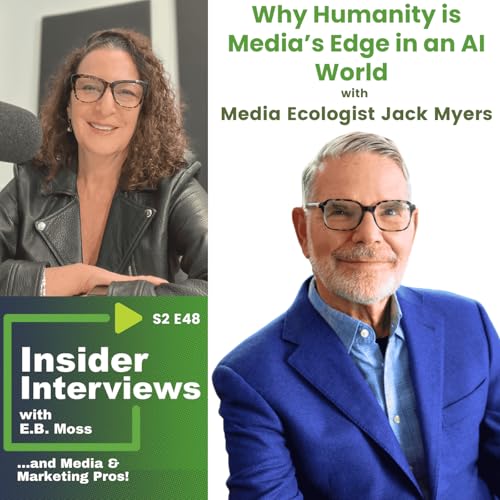
  • Why Humanity is Media’s Edge in an AI World
    Feb 25 2026
    Jack Myers has been sharing observations and insights about media longer than some platforms have even existed. I used to study his “Jack Myers Report,” when I started in cable and it was actually the first faxed newsletter. Then fast forward a decade or two and I became the first Managing Editor of Jack’s next successful communications platform: Media Village! Its thousands of articles, interviews, and executive insights now serve as a living history of the business. That was where I created my first podcast…and fast forward another decade and Jack has his own podcast now, too… and has authored some seven books! But DON’T fast forward through this half hour of gems from Jack that will inform and inspire you about how we may not really BE in a “technology-first era.” Jack acknowledges he can relate to Don Quixote as some might think he’s “tilting at windmills” in fighting the perception that humanity will prevail in our tech-focused world. Why? Because Jack has seen and understands the through line of it across generational changes…and as a strategy. In this episode — and in fact in his own show with Tim Spengler, called Lead Human — we talk about what it means to be “human first” in a technology-accelerated era. We topline what empathetic leadership, performance culture, and how organizations are recalibrating as they navigate AI. He and Tim go deep on those topics, so check it out. In what Jack calls a human-recalibrated era, he’s seeing a shift from “people first” as a cultural slogan to “people first” as a performance strategy — embedded into compensation, collaboration models, and operating systems. “It’s not about how much content we produce, but how thoughtfully we decide what deserves to exist and be amplified.” But now that we’re both in podcasting how does this Media Ecologist see it as a business model? He explains the tension between programmatic advertising and authenticity, and why speed — in content, in media, in AI — may be the most overrated metric in the room. Early podcasting days at MediaVillage And yes, we cover his latest reinvention: a historical fiction novel, a forthcoming science fiction trilogy, and what writing fiction reveals about understanding the human condition. At the end, I ask Jack what he hopes the media industry embraces more of — and less of — in the years ahead. His answer is less sentimental than you might expect, and more structural than most pundits are willing to articulate. This conversation spans decades of media evolution — from fax machines to AI voice replication — but it ultimately comes down to one idea: Speed without judgment is just noise. Key Highlights: 01:34 – What “human first” really means in media. 02:17 – Just the fax… the start of tracking generational shifts. 05:18 – Media Village: The house that Jack built – on relationships and thought leadership 09:44 – How good listening led to a podcast — first for E.B., now for Jack 12:02 – Launching a leadership podcast in the AI era and how empathy is a performance strategy 19:32 – Technology-first or a time for human recalibration. 23:50 – The future of podcast monetization 28:32 – His pivot to fiction (or is it?!) in The Kissinger Conspiracy 32:17 – Media’s inflection point. More responsibility. Less addiction to speed. Think ecosystem — not silos. Connect with Jack Myers: Jack Myers The Jack Myers Report Connect with E.B. Moss and Insider Interviews: With Media & Marketing Experts LinkedIn: https://www.linkedin.com/in/mossappeal Instagram: https://www.instagram.com/insiderinterviews Facebook: https://www.facebook.com/InsiderInterviewsPodcast/ Threads: https://www.threads.net/@insiderinterviews Substack: Moss Hysteria Please follow Insider Interviews, share with another smart business leader, and leave a comment on @Apple or @Spotify… or a tip in my jar!: https://buymeacoffee.com/mossappeal! THANK YOU for listening!
    Más Menos
    Menos de 1 minuto
  • The Architecture Behind Better TV Advertising
    Feb 5 2026
    A couple of years ago, I recorded an episode with Marketing Architects’ tech and marketing leads in a hotel room at CES. Three people. One bed. Good content… questionable ergonomics. Fast forward to now: better audio setups, better posture, and an even clearer picture of why Marketing Architects has built such a strong reputation as an all-inclusive agency—one that genuinely challenges how TV has always been planned, bought, and measured. Aaron Lange, now CTO, helped build Marketing Architects from the ground up to operate differently. Instead of carving up responsibilities across multiple vendors, they do it all—analytics, creative, media buying, and measurement—inside one connected system. “All inclusive for us means we do everything for our brands—from analytics and creative to media buying and attribution measurement.” — Aaron Lange The goal isn’t control for control’s sake; it’s accountability, speed, and performance you can actually learn from. That philosophy led directly to Annika, their proprietary AI-powered buying platform. Aaron described Annika not as software, but almost as a living system: “She’s making decisions every 15 minutes based on traffic spikes, orders, or anything else that we want to feed her.” Annika – from Marketing Architects That feedback loop—test, learn, optimize, repeat—is core to how they invest media dollars today. Nikki Erkkila, VP of Media Partnerships, brings that technology into the real world, working closely with broadcasters, streamers, and platform partners. What stood out to me is how grounded her perspective is (perhaps due to her 20-years of yoga practice after work!), especially in an era obsessed with automation. Despite all the tech, she reminded me that “partnerships and relationships are really the baseline of it.” Nikki described today’s media environment this way: “TV is just TV now. We’re really breaking down those silos from ‘we’re just watching broadcast, or we’re just watching cable, or we’re just watching streaming’ when you’re watching television now.” — Nikki Erkkila That perspective drives how Marketing Architects plans TV advertising, too: across streaming, national, local, linear—it’s one ecosystem. Audiences don’t think in silos, so media plans shouldn’t either, or compete for budget. We also talk about how AI is changing creative development, especially by speeding things up. Testing happens faster, creative can be adjusted more easily, and messaging can be more localized without losing the emotional storytelling that makes TV effective in the first place. I liked that Marketing Architects’ creative team calls itself “creative engineers,” because it signals that they know when AI helps, and when human judgment matters more. Seems Nikki and Aaron do too. Our sports talk is timely too (beyond Aaron explaining his passion for volleyball.) With the Super Bowl and Olympics upon us, live sports are a huge reminder of why TV still matters—big moments, shared viewing, real attention. But how people watch those moments now is fragmented, fluid, and often platform-agnostic. So, one of the big takeaways here is that planning has to reflect that reality, instead of forcing audiences into outdated buckets. If you’re an advertiser, an agency leader, or anyone trying to make TV work harder, this episode offers practical ideas on how to think about TV as one ecosystem, how to let performance guide decisions without stripping out emotion, and how to build systems that can adapt as viewing habits shift. Key Moments: 00:02:09 – Why Marketing Architects was built to challenge how TV was “always done” 00:02:33 – What “all-inclusive agency” really means 00:04:03 – Nikki introduces Annika and real-time media decisioning 00:05:40 – Aaron on why Annika updates every 15 minutes 00:06:21 – Aaron’s entrepreneurial background and tech mindset 00:08:19 – Why relationships still matter in modern media partnerships 00:09:19 – “TV is TV now”: breaking down linear vs. streaming silos 00:11:38 – How AI is being used across every business unit 00:14:12 – Creative Engineers and faster creative testing 00:15:26 – The performance-first budgeting model explained 00:21:37 – Live sports, new platforms, and shifting viewer behavior 00:25:20 – Emerging inventory and new opportunities for advertisers 00:26:46 – Why TV fundamentals still work—and why that matters Connect with: Aaron Lange Nikki Erkkila Connect with E.B. Moss and Insider Interviews: With Media & Marketing Experts LinkedIn: https://www.linkedin.com/in/mossappeal Instagram: https://www.instagram.com/insiderinterviews Facebook: https://www.facebook.com/InsiderInterviewsPodcast/ Threads: https://www.threads.net/@insiderinterviews Substack: Moss Hysteria Please follow Insider Interviews, share with another smart business leader, and leave a comment on @...
    Más Menos
    14 m
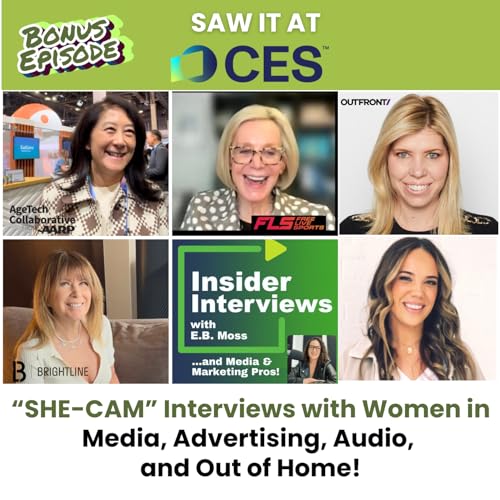
  • She-Cam Interviews with Women in Tech at CES: A Bonus Episode
    Jan 22 2026
    It’s a fast but mighty 20 minute bonus episode of Insider Interviews! Took my “she-cam” on another* spontaneous journey through the Consumer Electronics Show (CES 2026) to speak with six different women, of six different tech and media areas. They provided first-hand insights on #AI, content, and advertising. These industry leaders span audio, advertising and age tech, sports, streaming, and out of home, so there’s really something for everyone! Quick coverage bites include: Vobble at CES • A snippet about ‘Vobble,’ an interactive audio device that lets kids build stories; MY sound didn’t do it justice, but your kid might love it IRL (and you might love it as a bedtime story aid!) • A walk through the innovations for better health and aging in place via the Age Tech Collaborative from AARP, thanks to their VP of Startup Programming, Amelia Hay. A la this being an episode with all women in tech and media, as Amelia said of the Collaborative: “We have over 200 startups in the collaborative, and probably 40% are women founders… I think we’re really pushing that envelope and putting our stake in the ground in technology.” (PS: did I mention I’d love that sleep-helper AND the hearing-helping eyeglasses from EssilorLuxotica on display there?!) BrightLine Interactive Ads • I got a lesson in the history of ad innovations and how to apply “Changemaker” thinking, from Brightline (and SustainChain) founder, and now author, Jacqueline Corbelli, who I call “the doyenne of interactive advertising!” A simple summary of “changemaker” playbook is what Jacquie has done her entire career: “Think about what you want and go further…” • A chat with the dual founder of Sports Studio, Inc. and Rasenberger Media, Cathy Rasenberger , illuminated how her freshman streaming platform is scoring distribution wins, perhaps because it’s appropriately named “Free Live Sports“?! FreeLive Sports Cheers to them for “aggregating more free sports content than any other platform… We’re democratizing sports for all the fans.” • Stacy Minero, newly named CMO of Outfront Media, and Erin Harris, Head of Fluency Sales for SiriusXM, explain changes in their now UNtraditional mediums and how they each are leveraging AI to power creative and efficient DOOH advertising and audio content, respectively. Erin noted that, “We still see the strongest performance with human voice, but we’re extremely excited about AI in terms of helping us find little levers to pull, to make things more personal.” And as Stacy added: “There’s a huge opportunity for AI to unlock productivity, especially in the area of post-production… to do some of the grunt work so that people can focus on the fun work.” AI meets Outfront Media We say, “YES!” Don’t miss out on learning from each of these powerhouse women and their compelling companies. *And don’t miss my last full episode — also captured at CES — with executives in audio, video and brand marketing! Connect with E.B. Moss and Insider Interviews: With Media & Marketing Experts LinkedIn: https://www.linkedin.com/in/mossappeal Instagram: https://www.instagram.com/insiderinterviews Facebook: https://www.facebook.com/InsiderInterviewsPodcast/ Threads: https://www.threads.net/@insiderinterviews Substack: Moss Hysteria Please follow Insider Interviews, share with another smart business leader, and leave a comment on @Apple or @Spotify… or a tip in my jar!: https://buymeacoffee.com/mossappeal! THANK YOU for listening!
    Más Menos
    Menos de 1 minuto
  • Stingray, Gold Bond & DAX on What’s New and Next in TV, Audio, and Brand Connection
    Jan 15 2026
    If you work in media, marketing, or advertising, you know this tension: Screens dominate. Measurement has lagged. And it’s harder to answer questions like “Where does attention really happen?” and “What actually moves people…and how do I prove it?” This episode offers some answers, from three executives I spoke with at CES 2026. Though we talk about the newest cool tools (it IS the largest consumer tech show), these conversations explore how media works when it follows consumers from the couch to the car, in stores, in culture, and across audio—and how measurement is finally catching up to meaning. Learn what’s working now and what’s coming next, according to: Jim Riley, President of Stingray U.S., explains how audio, ambient TV, karaoke, and in-car experiences are converging—and how their effort to connect these environments creates value for brands, platforms, and consumers alike. From FAST channels to automotive dashboards, Jim shares how following people across screens (and beyond them) is reshaping media strategy. (And don’t miss an archival image of Jim making music “back in the day” himself!) Kimberly Hairston-Hicks, CMO of Sanofi’s Gold Bond, brings a powerful brand perspective rooted in authenticity and cultural relevance. She talks candidly (and I sing) about letting go of control, redefining success beyond impressions, and building partnerships based on shared values—showing how human connection and business results don’t have to be at odds. Hint: They paired perfectly with celebrity Chelsea Handler over shared values and love of the product! Chelsea Handler Skiing with Gold Bond! (And learn why Kimberly wears a “cape,” and owes a debt of gratitude to women who help women!) Jennifer Louie Oon, SVP of Sales at DAX US, closes the loop with a look at audio advertising today—and why its moment is now…especially when brands can reach markets or audiences other platforms or apps often miss. She explains how DAX is solving for that, along with measurement tools that can finally demonstrate audio’s impact in real time and the power of advertisers still having presence in screen-free moments. (And find out why old school Legos really grabbed her during the world’s largest tech show!) Get some practical thought starters on audio advertising, brand authenticity, media measurement, and human-centered marketing—without the jargon or hype…and with a little bit of singing and laughs! Key Moments & Time Codes 00:00–01:22 — Why this episode connects audio, TV, brand marketing, and ad tech 03:29–04:43 — Why karaoke is becoming a serious media business Jim Riley explains how Stingray turned a universal behavior—singing in the car—into a gamified, social, and monetizable experience across TVs and automotive dashboards. 05:40–06:20 — From couch to car to checkout Jim outlines Stingray’s vision for linking TV, in-car audio, and retail media—following consumers across environments and tying media exposure to real-world action. 08:02–08:37 — When advertising doesn’t belong everywhere A candid discussion on why karaoke stays ad-free, how premium experiences are monetized differently, and what “everybody wins” actually looks like in practice. 12:44–13:20 — “Let it go” as a marketing strategy Kimberly Hairston-Hicks shares why perfection is the enemy of progress—and how letting go of control creates stronger brands and better outcomes. 18:19–20:29 — Authenticity beats star power Kimberly breaks down the Gold Bond–Chelsea Handler partnership, revealing why shared values—not celebrity size—drive cultural relevance and real KPIs. 21:01–22:11 — When impressions aren’t the point anymore A reframing of success: why cultural moments, memory, and longevity matter just as much as raw reach—and how brands should measure that. 26:07–27:25 — Beauty, confidence, and showing up fully A powerful, personal exchange on how products—and leadership—can change how people feel about themselves, from the boardroom to daily life. 35:07–36:05 — Audio measurement finally catches up Jennifer Louie Oon explains how DAX is using brand-lift measurement to prove what audio has always delivered—and why this changes how brands plan media. 37:18–38:06 — Why audio’s moment is now Screen-free moments, smarter targeting, and better measurement come together—making the case for audio as a core, not supplemental, channel in 2026 planning. Connect with: Jim Riley Kimberly Hairston-Hicks Jen Oon Connect with E.B. Moss and Insider Interviews: With Media & Marketing Experts LinkedIn: https://www.linkedin.com/in/mossappeal Instagram: https://www.instagram.com/insiderinterviews Facebook: https://www.facebook.com/InsiderInterviewsPodcast/ Threads: https://www.threads.net/@insiderinterviews Substack: Moss Hysteria Please follow Insider Interviews, share with another smart business leader, and leave a ...
    Más Menos
    Menos de 1 minuto