Episodios

  • EP 33: AI in Compliance: Turning Regulation into Competitive Advantage
    Feb 22 2026

    Compliance has traditionally been viewed as a pure cost center—regulatory overhead that doesn't generate revenue. But AI is fundamentally changing this equation by turning compliance from a defensive obligation into an actual strategic advantage. New LSTM networks are achieving 94.2% accuracy in compliance monitoring while simultaneously cutting false positives dramatically.

    Sam and Mac explore why AI in compliance might be the biggest impact area that nobody is talking about. The false positive problem has always made compliance painful and expensive—traditional systems generated massive false positive rates, with analysts drowning in alerts where 95% turned out to be completely legitimate activity. This creates compliance fatigue where analysts become desensitized because so many alerts are false.

    The episode covers AI's impact across major regulatory areas: AML (Anti-Money Laundering), KYC (Know Your Customer), Sanctions Screening, and Trade Surveillance. For AML, AI narrows down suspicious patterns while letting routine activity pass without alerts. For KYC, banks report 78% faster onboarding times and 85% reduction in manual review—customers approved in an hour instead of days.

    AI must be transparent and auditable. The future is shifting from reacting to violations to preventing them entirely, flagging patterns on day three instead of catching problems on day 30, saving millions in potential federal lawsuits.

    Más Menos
    15 m
  • EP 32: AI Fraud Detection - Fighting Fire with Fire
    Feb 22 2026

    Over 50% of fraud now involves AI. FIDZY surveyed 562 fraud professionals globally and found AI-powered fraud has become the norm, not the exception. We're talking about deepfakes, synthetic identities, and AI-powered phishing so sophisticated it's basically indistinguishable from legitimate communications. The counter punch? 90% of banks are now using AI to fight back—fighting fire with fire.

    Sam and Mac paint the threat landscape: deepfake calls that sound exactly like your bank's fraud department, using your bank's actual spoofed phone number, with perfect voice and professional script asking for your PIN. California bank customers received dozens of these calls and many fell for it because the technology is that convincing.

    This is an arms race. Fraudsters use AI, banks use AI—there's no final victory. As bank AI gets smarter at detection, fraud AI evolves to evade those systems. It's like computer viruses and antivirus software—never-ending evolution and counter-evolution. The economic stakes are enormous: Deloitte estimates US banking losses from fraud could increase from $12.3 billion in 2023 to $40 billion by 2027, more than tripling in four years due to generative AI sophistication.

    Human oversight remains essential. 88% of banking professionals say human oversight is non-negotiable. AI identifies potential issues and surfaces them to analysts, but humans make final calls on complex cases. The benefit: 43% of institutions report increased efficiency because AI handles high-volume straightforward cases, freeing human experts for complex nuanced cases requiring judgment.

    Más Menos
    17 m
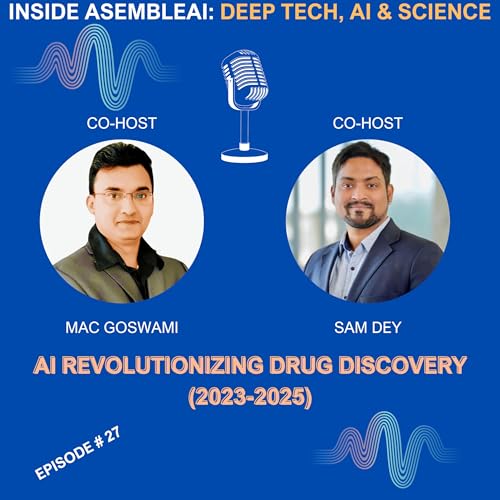
  • EP 27: AI Revolutionizing Drug Discovery (2023 - 2025)
    Feb 19 2026

    The pharmaceutical industry is experiencing its most significant transformation in decades. AI is slashing drug development timelines from 10-15 years to 18-24 months and reducing costs from $2.6 billion to tens of millions—making previously impossible treatments financially feasible.

    Sam and Mac explore how AI is fundamentally changing drug discovery. Traditional methods required screening millions of compounds through physical laboratory testing, costing billions with a 90%+ failure rate. AI transforms this by simulating molecular interactions computationally, predicting which compounds will bind effectively to target proteins, and identifying promising candidates from virtual libraries containing billions of potential molecules. What took years in wet labs now happens in days.

    The impact extends beyond economics. AI is enabling treatments for rare diseases that pharmaceutical companies traditionally ignored due to small patient populations. When development costs drop from billions to millions, diseases affecting 50,000 patients globally become economically viable to address. AI serves as a true partner to scientists—identifying patterns in biological data humans would never detect, suggesting novel molecular structures chemists wouldn't intuitively design, and predicting side effects before human testing.

    However, significant challenges remain. Data quality is the most critical obstacle—AI models are only as good as their training data, and pharmaceutical research data is often messy, incomplete, or inconsistent. The "black box" problem poses another challenge: deep learning models make predictions through complex transformations that scientists can't interpret, creating tension between efficiency and understanding. Ethical considerations around algorithmic bias, data ownership, and equitable access demand careful attention.

    The regulatory landscape adds complexity. The FDA is still developing frameworks for evaluating AI-discovered drugs, and regulatory uncertainty can slow translation from discovery to approved therapy. Despite these challenges, investment in AI drug discovery has surged to record levels, with AI-discovered drugs progressing through clinical trials and validating the technology's potential.

    The future of drug discovery will heavily rely on AI innovations, but success requires thoughtful integration with attention to data quality, algorithmic transparency, ethical practices, and regulatory compliance. The pharmaceutical industry stands at an inflection point where today's decisions about responsible AI implementation will shape healthcare outcomes for decades.

    Más Menos
    13 m