Episodios

  • EP 33: AI in Compliance: Turning Regulation into Competitive Advantage
    Feb 22 2026

    Compliance has traditionally been viewed as a pure cost center—regulatory overhead that doesn't generate revenue. But AI is fundamentally changing this equation by turning compliance from a defensive obligation into an actual strategic advantage. New LSTM networks are achieving 94.2% accuracy in compliance monitoring while simultaneously cutting false positives dramatically.

    Sam and Mac explore why AI in compliance might be the biggest impact area that nobody is talking about. The false positive problem has always made compliance painful and expensive—traditional systems generated massive false positive rates, with analysts drowning in alerts where 95% turned out to be completely legitimate activity. This creates compliance fatigue where analysts become desensitized because so many alerts are false.

    The episode covers AI's impact across major regulatory areas: AML (Anti-Money Laundering), KYC (Know Your Customer), Sanctions Screening, and Trade Surveillance. For AML, AI narrows down suspicious patterns while letting routine activity pass without alerts. For KYC, banks report 78% faster onboarding times and 85% reduction in manual review—customers approved in an hour instead of days.

    AI must be transparent and auditable. The future is shifting from reacting to violations to preventing them entirely, flagging patterns on day three instead of catching problems on day 30, saving millions in potential federal lawsuits.

    Más Menos
    15 m
  • EP 29: AlphaFold, AlphaGenome, And the Scientific Revolution
    Feb 21 2026

    In 2024, the Nobel Prize in Chemistry was awarded for an AI breakthrough - an unprecedented recognition that signals a fundamental shift in scientific discovery. This episode explores how Google DeepMind's AlphaFold and AlphaGenome are revolutionizing protein biology and genomics, solving problems previously deemed unreachable.

    For 50 years, determining protein structures required months of painstaking laboratory work using X-ray crystallography or cryo-electron microscopy. AlphaFold shattered that paradigm by predicting structures for 200 million proteins in months—work that would have taken centuries using traditional methods. The accuracy is remarkable: for well-studied proteins, AlphaFold's predictions match experimental results with near-atomic precision.

    Sam and Mac explain how AlphaFold works, breaking down the AI's ability to predict 3D protein structures from amino acid sequences alone. This capability transforms drug discovery—pharmaceutical companies can now identify binding sites, predict drug interactions, and design molecules computationally before expensive laboratory synthesis.

    AlphaFold 3 takes this further by predicting how proteins interact with other molecules, DNA, RNA, and small drug compounds. This enables researchers to model entire biological pathways and understand disease mechanisms at molecular resolution. Google DeepMind is collaborating with major pharmaceutical companies, accelerating drug development timelines and reducing costs dramatically.

    AlphaGenome extends AI's reach into genomics, analyzing DNA sequences to predict gene expression patterns, regulatory elements, and genetic variations' functional impacts. Together, these tools are solving fundamentally unreachable problems in biology, making the impossible routine.

    The broader implications extend beyond any single discovery. AI is compressing timelines, reducing costs, and democratizing access to sophisticated biological research. Academic labs without massive infrastructure can now compete with well-funded institutions. Rare diseases become tractable research targets. Scientific discovery accelerates exponentially.

    TAGS: AlphaFold, Nobel Prize, Google DeepMind, Protein Structure, Drug Discovery, AlphaGenome, Genomics, AI Biology, Biotechnology, Pharmaceutical AI

    EPISODE LENGTH: ~15 minutes

    Más Menos
    16 m
  • EP 28: AI-Powered Patient Care Through Synthetic Data
    Feb 20 2026

    By 2024, synthetic data will comprise 60% of all healthcare AI training data. This episode explores how this shift is solving the industry's massive data problem while protecting patient privacy.

    Healthcare faces a critical paradox: AI needs vast patient data for accurate diagnoses and personalized treatments, but HIPAA and GDPR restrict access to real records. Synthetic data offers a breakthrough—artificially generated datasets that mimic real patient populations statistically without containing actual patient information.

    Sam and Mac explain how generative AI techniques like GANs and auto-encoders create synthetic data preserving statistical properties of real healthcare data while eliminating privacy concerns. These datasets train AI to detect diseases, predict outcomes, and recommend treatments without exposing sensitive information.

    The AI healthcare market is expected to grow from $26.6 billion in 2024 to $187.7 billion by 2030, driven by synthetic data breakthroughs. AI tools trained on synthetic datasets are automating clinical documentation, reducing clinician burnout by handling administrative tasks consuming hours daily. For rare diseases with limited real data, synthetic data enables previously impossible AI training.

    However, challenges exist. If original data contains demographic biases or reflects healthcare disparities, synthetic data perpetuates those biases. This can lead to AI performing poorly for underrepresented populations, worsening health inequities. Careful validation and bias detection are essential.

    Regulatory guidance for synthetic data generation and use is still developing. Healthcare organizations must navigate this evolving framework carefully to ensure compliance while leveraging advantages.

    Early adoption provides competitive advantages. Organizations developing expertise in high-quality synthetic datasets are positioning themselves to lead the AI-driven healthcare transformation. The future of patient care increasingly depends on AI trained on synthetic data protecting privacy while enabling innovation.

    TAGS: Synthetic Data, Healthcare AI, Patient Privacy, HIPAA, Generative AI, GANs, Rare Disease AI, Clinical Documentation, AI Bias, Patient Outcomes, Healthcare Analytics

    Más Menos
    16 m
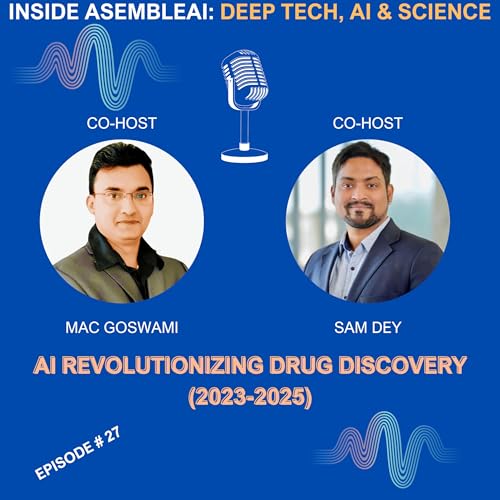
  • EP 27: AI Revolutionizing Drug Discovery (2023 - 2025)
    Feb 19 2026

    The pharmaceutical industry is experiencing its most significant transformation in decades. AI is slashing drug development timelines from 10-15 years to 18-24 months and reducing costs from $2.6 billion to tens of millions—making previously impossible treatments financially feasible.

    Sam and Mac explore how AI is fundamentally changing drug discovery. Traditional methods required screening millions of compounds through physical laboratory testing, costing billions with a 90%+ failure rate. AI transforms this by simulating molecular interactions computationally, predicting which compounds will bind effectively to target proteins, and identifying promising candidates from virtual libraries containing billions of potential molecules. What took years in wet labs now happens in days.

    The impact extends beyond economics. AI is enabling treatments for rare diseases that pharmaceutical companies traditionally ignored due to small patient populations. When development costs drop from billions to millions, diseases affecting 50,000 patients globally become economically viable to address. AI serves as a true partner to scientists—identifying patterns in biological data humans would never detect, suggesting novel molecular structures chemists wouldn't intuitively design, and predicting side effects before human testing.

    However, significant challenges remain. Data quality is the most critical obstacle—AI models are only as good as their training data, and pharmaceutical research data is often messy, incomplete, or inconsistent. The "black box" problem poses another challenge: deep learning models make predictions through complex transformations that scientists can't interpret, creating tension between efficiency and understanding. Ethical considerations around algorithmic bias, data ownership, and equitable access demand careful attention.

    The regulatory landscape adds complexity. The FDA is still developing frameworks for evaluating AI-discovered drugs, and regulatory uncertainty can slow translation from discovery to approved therapy. Despite these challenges, investment in AI drug discovery has surged to record levels, with AI-discovered drugs progressing through clinical trials and validating the technology's potential.

    The future of drug discovery will heavily rely on AI innovations, but success requires thoughtful integration with attention to data quality, algorithmic transparency, ethical practices, and regulatory compliance. The pharmaceutical industry stands at an inflection point where today's decisions about responsible AI implementation will shape healthcare outcomes for decades.

    Más Menos
    13 m