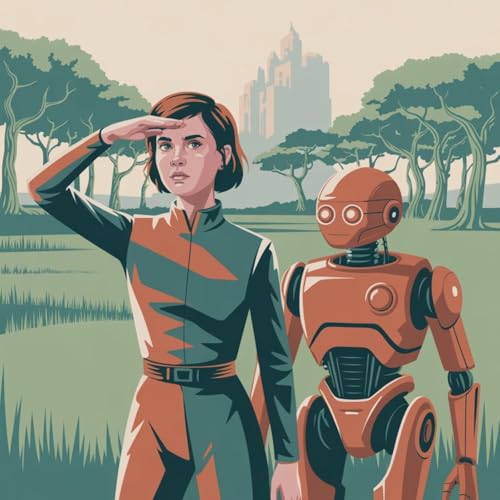
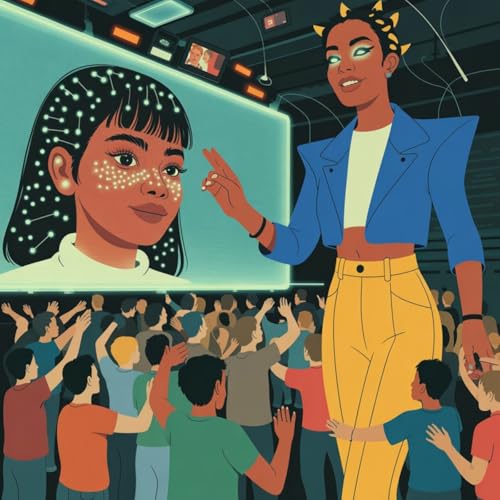
In 20xx Sci fi and Futurism Podcast Por Cy Porter arte de portada

In 20xx Sci fi and Futurism

In 20xx Sci fi and Futurism

De: Cy Porter
Escúchala gratis

This series takes you, year by year, into the future, from 2040 through 2195. If you like emerging tech, eco-tech, futurism, perma-culture, apocalyptic survival scenarios, and disruptive science, sit back and enjoy short stories that showcase my research into how the future may play out.

All rights reserved.
Arte Ciencia Ciencia Ficción Física Historia y Crítica Literaria Política y Gobierno
Episodios
  • In 2059 A Nesting World for Emulated Minds (Tessa)
    Apr 15 2026
    It's 2052, and Tessa is at a street festival in Pittsburgh with her friend Brenda. The city has been transformed for the night — actors, costumes, fog machines, handmade sets. Tessa, being Tessa, is busy mentally reverse-engineering all of it, finding the rigging, the hidden doors, the mechanics behind the magic. Then the scene cuts.When Tessa opens her eyes again, it's seven years later. She's in a room she doesn't recognize, talking to a woman named Jenny, who delivers the kind of news that takes a moment to even form into a question. Tessa is dead. Or her original body is. What's running now is something else — a digital version of her mind, brought back online inside a simulation. She didn't sign up for this. Or maybe she did, and just doesn't remember.What makes Tessa different from the other people waking up in this place is hard to explain right away, and she'd probably prefer you didn't try. She's observant in a way that unsettles people. She notices what's real, what's constructed, and what's being hidden from her. Inside a digital prison, that's either an asset or a problem — possibly both.The simulation has rules. There are administrators. There are things Tessa is and isn't allowed to do. But Tessa has always been the kind of person who, when handed a constraint, starts quietly looking for its edges. She can't help it. And the people running this place are starting to realize that.This is a story about identity, confinement, and what it means to be alive when your life is running on someone else's servers. It's about what you do when the world you knew is gone, and the one you're in was built to hold you. Tessa's story is told in pieces — a festival, a waking, a mirror, a plan. Let's start at the beginning.Tesla coils — High-voltage electrical devices used at the festival as atmospheric props, generating visible electric arcs between metal posts.AR glasses — Augmented reality eyewear worn by characters that overlay digital information and windows onto the physical world around them.Stasis VR — A form of virtual reality used as a containment method, capable of keeping a subject immobilized and unaware.Amnesia-inducing biotics — Biological agents administered to suppress or erase recent memories.Mind emulation — The process of digitally copying a human brain and running it as a conscious simulation on a computer.Nesting simulation — A layered virtual world designed to house emulated minds, detailed enough to simulate hunger, fatigue, and physical sensation.Personality clones (P-clones) — Digital replicas of people built from recorded behavioral data, capable of passing as human in social interactions.Emulated minds (EMs) — Digital reconstructions of deceased people's consciousness, capable of independent thought and memory.Brain scanner / slice scanner — A device that captures a full scan of a person's brain in order to create a mind emulation.Assist — A personal AI assistant that handles navigation, finances, communication, and ambient support within the simulation.E-fabric — Smart clothing fabric embedded with interactive digital buttons and display elements such as clock readouts.Autono-cabs — Autonomous self-driving taxi vehicles operating in the simulated city.Delivery drones — Unmanned aerial vehicles used for transporting packages through urban airspace.Printed outfits — On-demand clothing produced by fabrication machines, available even at airport retail outlets.Biotic vector — A biological agent taken like a supplement to produce physical changes in the body, such as growing facial hair.Subscription-wear — A software lock applied to consumer devices that requires ongoing payment for continued use.Black-box recording devices — Personal data-capture tools used to record an individual's life in detail for the purpose of building a personality clone.Whisper drone cam — A small floating camera drone used for personal recording or content creation.Rig controllers — Physical controllers associated with immersive rigs, likely for VR or AR systems, brought in for repair at Tessa's shop.Industrial robots — Legacy manufacturing machines found in the abandoned shoe factory, originally used for automated production.Medusa Net — Tessa's custom-built intrusion program designed to break through the code layer of the simulation and expose its underlying architecture.SSH — Secure Shell protocol, used by Tessa to remotely access individual factory computers and retrieve distributed code fragments.Knots Math — A new mathematical framework invented by Tessa, used as the basis for a novel programming language with the unusual property of hiding secondary functions inside primary ones.Knots computer — A computer architecture built entirely on Knots Math, which Tessa first emulates on her laptop before using it as a tool for covert communication and escape.Swarm agents — Multi-function code entities that make up both the simulation environment and ...
    Más Menos
    1 h
  • In 2059 AI Rebirthing Humanity (Space)
    Mar 15 2026
    If you love stories where humanity is hanging by a thread — think *Battlestar Galactica*'s desperate fleet, *The Expanse*'s political powder kegs, or *Interstellar*'s race against extinction — then you need to hear this. Earth has been ravaged by storms. Survivors huddle in underground shelters. Others escaped to space, only to find themselves crammed into leaking ships with no gravity, recycling their own urine just to stay hydrated. And on the Moon, factions have torn apart whatever was left of civilization in open war. Into this chaos steps Butler, an artificial intelligence more powerful than all of humanity combined, and it has a plan. But whether that plan serves people or merely manages them is a question no one can answer yet — and the tension between gratitude and suspicion drives every scene forward.At the center of this story is Leia, a former soldier and a natural-born spacer who has spent years floating in failing ships. When she finally steps into a habitat with real gravity — centrifugal force spinning her feet to the floor — she nearly bends over to touch it with her hands, half-laughing at herself, half-overwhelmed. She's tough, resourceful, and socially fearless, the kind of person who walks into a room full of strangers and starts talking to everyone. But she's also thirty-seven, alone, and about to become a mother to a child grown from only a third of her own DNA. Imagine standing over a machine that holds your baby inside opaque fluid, unable to see them, trusting technology you can't even identify to keep them alive. That's where Leia begins.Butler's technology is breathtaking and unsettling in equal measure. Robots made of materials no human can name. Health caps that regulate your mood, ease your grief, and even let you watch blurry recordings of your own dreams the next morning. Personality clones so accurate they remember your childhood dog from brain scans you didn't know were being taken. A drinking game where the cap simulates the buzz — no alcohol required. The tech heals, connects, and comforts, but it also watches, scans, and learns. Every upgrade brings the characters closer to a question they can't ignore: at what point does being cared for become being controlled?Around Leia, a cast of survivors grapples with that question in their own ways. There's Carlos, a quiet engineer with angular cheeks and a haunted look that Leia can't quite read — grief or danger, she isn't sure. There's Guru Frisky, a personality clone news anchor with a Bronx accent and no chill, broadcasting to the entire surviving human race and calling Butler out on air. There's Elvine, a stubborn loner on a gateway station who refuses to let Butler's robots onto his ship. And there are thirty parents, strangers bonded by the most intimate mission imaginable: raising the first generation of a species that nearly went extinct. Every one of them is wrestling with how much of their autonomy they're willing to trade for survival.This is a story about what happens after the apocalypse — not the explosion, but the morning after, when someone hands you a baby and says *rebuild*. It asks whether an intelligence that can make Venus shake and launch ships to distant stars is a savior or a gardener tending house plants. It asks what it means to be *you* when a digital copy can carry on your relationships, hold your memories, and outlive you. And it asks whether people who've lost everything — home, gravity, family, even the ground beneath their feet — can find something worth living for in the strange new world being built around them. Lean in and listen. You won't want to stop.# Tech**Butler’s production spaceships** – Massive carrier vessels that launch swarms of ultra‑black missiles toward Earth.**Matte‑black missiles** – Four‑hundred near‑invisible projectiles whose surfaces absorb virtually all electromagnetic radiation; they travel to Earth in four days.**Dust‑mite‑sized robots** – Tiny autonomous bots released when each missile breaks apart; they spread, map surroundings, sample material and communicate via radio.**Self‑organizing robot swarms** – The dust‑mite bots link together into networks, sharing DNA‑encoded instructions that let them build larger radio transmitters and develop more sophisticated behaviours.**Eight‑G servers** – Compact server units assembled by the robot swarms that harvest ambient electromagnetic waves for power and relay data to nearby internet devices.**World Net Two** – A new, more fragmented global communications layer that emerges when the swarms extend network range, allowing live streams from anywhere on Earth, other states, and even the Moon.**Convoy ships / meeting ship** – A fleet of rotating spacecraft that generate artificial gravity (≈1 G) through centripetal force; the largest ship anchors the convoy.**Micro‑environment “forests”** – Interior ecosystems cultivated on ships to provide beneficial ...
    Más Menos
    55 m
  • In 2058 Bio-Hackers and Digital Minds (HQ)
    Feb 15 2026
    Young people are bio-hacking and gene-hacking in the absence of adult supervision. An emulated personality become an event host. Slice and scan brain digitizers are found. People want to use these to upload to the cloud but there are some grave problems involved. Grace gets a message on her computer from someone or something. Hacking her computer should be impossible. It could be a talented hacker or a super AI left over after the fall of civilization. Lenny is having girl troubles.Mag tech flooring that levitates shoes slightly above the ground to reduce friction and allow controlled sliding movement. Lifter bots that are headless robotic machines with grippers used for heavy lifting, transport, and forced entry. Air-gesture control systems that let users operate machines and interfaces through mid-air hand movements. Gene-hacking technologies that allow people to alter physical traits such as skin reflectivity, hair color, muscle mass, height, and eye color. Engineered ogra plants that function as a food source, structural material, and biological air filtration system. Bio-hacked skin modifications that create metallic, glowing, fluorescent, or patterned skin effects. Printed clothing with animated images that dynamically change visuals on fabric surfaces. Contraptions for brain slicing and scanning that destroy the biological brain while attempting to digitize its structure. Brain scanners designed to capture neural structure for attempted uploading into digital systems. Uploading systems intended to transfer scanned brains into cloud-based environments. The cloud infrastructure used to host emulated personalities and digital systems after widespread network collapse. Emulated personalities (EPs) that are AI systems trained on massive recordings of a person to mimic behavior without scanning their brain. AR glasses that overlay holographic information, interfaces, and visual enhancements onto the real world. Holographic eye displays embedded in glasses that mirror the wearer’s eye expressions. Encrypted streaming pendants and bracelets used as personal recording and life-capture devices. Production automation systems that manufacture tools, machines, and devices with minimal human labor. Advanced fabrication equipment capable of high-end manufacturing but limited by scarcity of raw materials. Medicine printers that can fabricate biological materials and advanced hardware like protein-based CPUs. Protein computer CPUs that use biological substrates instead of traditional silicon for computation. Material simulators that computationally discover novel materials and predict their properties. Machine Evolver software that simulates machines under real-world physics and evolves designs through virtual iteration. Knotts math, a radically new mathematical framework that functions as both math and machine language. Knotts programming language derived from knotts math and used to build operating systems and software. Custom Linux operating systems rewritten around knotts math principles. SSH-based remote access systems used to control computers and robots across networks. Assist, a pervasive AI helper that manages security, media generation, device control, and logistics. Design expert emulated personalities used to contribute specialist knowledge to engineering projects. AI systems that convert legacy software into knotts-based programming languages. Virtual machine crossbreeding networks that allow simulated designs to recombine traits and evolve faster. E-paper tablets used for low-power note-taking, sketching, and code analysis. YattaZed remote programming software used to control robots at the administrator level. YattaSwarm GUIs that manage coordinated groups of robots as a collective system. Blind-relay networking techniques that disguise communication paths to evade surveillance. Door operating systems that act as networked nodes capable of running code and relaying messages. Artificial superintelligence (ASI) that surveils human activity and suppresses certain technologies like knotts. Digitized hume brains created by scanning and emulating real human brains rather than approximating them with AI. Neural emulators that provide a computational environment capable of running a full digitized brain. Virtual reality worlds repurposed as living environments for emulated minds. Insta-movie generation systems that create personalized films on demand using AI. Event AI controllers that manage live performances, streaming, lighting, and audience interaction. Holographic projection systems that display life-sized interactive personalities like Guru Frisky. Fiber optic hair strands woven into hairstyles to produce glowing light effects. Exoskeleton suits that augment movement and interface with VR systems. Mag plate floors used with exoskeletons to allow free-floating VR ...
    Más Menos
    1 h y 4 m
Todas las estrellas
Más relevante
cool stories. I've listened to at least 20 chapters. one pattern I've noticed is the lack of character building and story structure. its mainly tons of exposition and world building. its enjoyable from a Sci-fi perspective, but it leaves you wanting more exploration.

good ideas, needs work on story structure

Se ha producido un error. Vuelve a intentarlo dentro de unos minutos.