

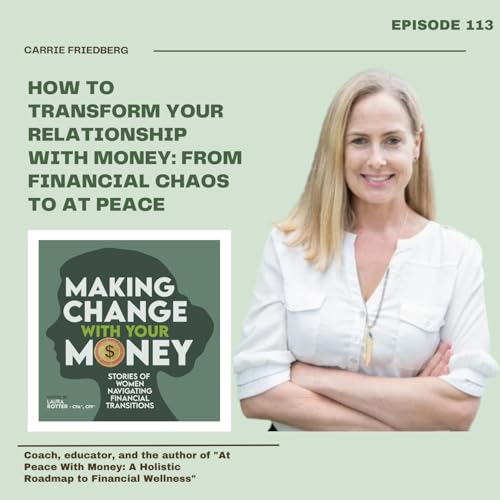
How To Transform Your Relationship With Money with Carrie Friedberg
No se pudo agregar al carrito
Add to Cart failed.
Error al Agregar a Lista de Deseos.
Error al eliminar de la lista de deseos.
Error al añadir a tu biblioteca
Error al seguir el podcast
Error al dejar de seguir el podcast

How To Transform Your Relationship With Money with Carrie Friedberg
-
Narrado por:
-
De:
What happens when someone who grew up witnessing financial conflict decides to transform their relationship with money? Laura sits down with Carrie Friedberg, author of the book "At Peace With Money: A Holistic Roadmap to Financial Wellness," to explore how she moved from credit card debt and constant anxiety to becoming a money coach who helps others find their own financial peace.
Carrie grew up in a household where money was a source of tension and secrecy. Despite enjoying financial security on the surface, the misalignment between her parents around spending created an atmosphere of stress that Carrie carried into her young adult life. Living on a teacher's salary while maintaining an active social life, she found herself trapped in a cycle of credit card debt, emotional spending and profound anxiety about money.
The turning point came through an unexpected source: her yoga practice. The physical, emotional, and spiritual transformation Carrie experienced on the mat gave her the courage to seek help with her finances. After trying various approaches on her own, she discovered the power of working with a money coach who provided both practical tools and emotional support. This two-year journey didn't just change her bank account; it transformed her self-esteem, her relationships, and ultimately her career path.
Now a money coach herself, Carrie shares the essential steps for building financial wellness, from tracking your spending for at least 90 days to creating a realistic spending plan that honors both your current lifestyle and your future goals. She emphasizes that financial health isn't about deprivation or quick fixes but rather a sustainable practice that requires consistent attention and self-compassion.
💡 Money patterns often begin in childhood.
Growing up with parents who held opposing views on spending left Carrie anxious around money. She observed secrecy, conflict, and tension during everyday financial moments, which her body absorbed long before she could articulate it. Understanding these early imprints is a critical step in reshaping adult money habits.
💡 Financial wellness is a long-term practice.
Just as physical or emotional health doesn’t change overnight, neither does financial health. Carrie’s transformation unfolded over years. The reward was improved self-esteem, healthier relationships, and peace of mind.
💡 Tracking spending creates awareness and change.
The most powerful tool in Carrie’s journey was tracking every dollar she spent for at least 90 days. This practice helped her see her real habits instead of assumptions. Whether done by hand, through apps, or with a bookkeeper, the key is awareness rather than avoidance.
💡 A spending plan doesn’t require sacrificing joy.
Carrie learned that financial health doesn’t mean cutting out everything you love. By identifying non-negotiable self-care and intentionally spacing out other expenses, she shifted away from feast or famine spending.
Book