Episodios

  • How I Stopped Fearing the Payer Mix and Scaled Referral Volume — Steven Gonzalez
    Apr 15 2026

    Steven Gonzalez, CEO of HealthView Home Health and Hospice, joins David Knack to demystify the complex world of home health and how it intersects with home care. Steven shares how he overcame the "referral problem" by realizing it was actually a payer mix and contract challenge.

    With a focus on patient-centered care that has earned his agency a top-25 national ranking on Fortune's Best Small Workplaces, Steven explains the clinical nuances—from wound care to physical therapy—that make home health a vital partner for non-medical home care agencies.

    The conversation explores the "Home Health 101" framework, detailing how agencies can better communicate to ensure patients get the right care at the right time. Steven also discusses the future of the industry, including how technology and AI are freeing up clinicians to focus on "the human stuff" that truly drives outcomes.

    Lesson Takeaways:
    1. Master Your Payer Mix: Success in home health isn't about the number of referrals; it's about understanding contracts and reimbursement rates to ensure sustainable growth.
    2. Home Care is the Eyes and Ears: Non-medical home care providers are essential partners who spot clinical declines early, allowing home health to intervene before a hospital readmission occurs.
    3. Differentiate Through Specialized Clinical Care: Offering specific services like advanced wound care or high-intensity therapy sets an agency apart from competitors who only handle basic cases.
    4. Focus on the "Human Stuff": Use technology to automate administrative "chores" so your team can spend more time building genuine, dignified connections with patients and families.
    5. Quality Ratings Drive Referrals: Maintaining high star ratings and Great Place to Work certification creates a trust badge that hospital discharge planners and families look for first.

    Timestamps:
    00:00 - Introduction to the "Home Health 101" series and Steven Gonzalez
    02:29 - Steven's journey from non-medical home care to leading a post-acute company
    05:02 - How HealthView differentiates itself through culture in a competitive nursing market
    09:13 - The day-to-day of home health: Who gets referred and why
    12:45 - The real challenge: It's a payer mix problem, not a referral problem
    18:20 - Why Medicare Advantage plans are squeezing home health margins
    22:31 - The metrics that matter: Hospitalization, rehospitalization, and proving value
    28:47 - The critical gap home care can fill in the care continuum
    33:43 - How home care providers should approach partnerships with data in hand
    37:56 - The exciting future of personalized medicine and AI in home-based care

    Quotes:
    Steven Gonzalez: "It's not a referral problem, it's really a payer mix problem and whether your rates are favorable or not."
    Steven Gonzalez: "I see home care as the eyes and ears; they are there when the clinical team is not."
    David Knack: "We're excited about letting technology do the chores, the laundry of the business, so we can connect with people."
    David Knack: "Home care agencies fit into this work by being the experts in the home on a day-to-day basis."

    Resources:
    1. Connect with Steven Gonzalez on LinkedIn: https://www.linkedin.com/in/stevegonzalez/
    2. Learn more about HealthView Home Health: https://hvhh.com/
    3. Read Steven's articles on Inc.com: https://www.inc.com/author/steven-gonzalez
    4. Connect with David Knack on LinkedIn: https://www.linkedin.com/in/david-knack/
    5. Powered by Zingage: https://zingage.com
    6. Watch this episode on Zingage's YouTube: https://www.youtube.com/@Zingage

    Más Menos
    40 m
  • How I Stopped Saving Everyone and Saved My Agency — Bob Roth
    Apr 9 2026

    Bob Roth, co-founder and managing partner of Cypress Home Care Solutions, joins host David Knack to discuss the painful mistake that nearly sank his agency: letting empathy override good business sense. After building a successful home care brand in Arizona, Bob recounts how he held onto a toxic C-suite leader for too long because of compassion, leading to a 20-person turnover in just three years.

    In this candid re-release, Bob reveals how his greatest strength (being a caring, compassionate person) is also his greatest weakness. He shares why home care owners must fire fast even when it hurts, how he rebooted Cypress from 18 to 157 caregivers in under a year, and why he believes the term "non-medical" is holding the industry back. Bob also offers hard truths about Medicare Advantage, the new GUIDE program, and why you should stop feeding discharge planners lunch.

    Lesson Takeaways:

    1. Kindness Without Boundaries Hurts Your Team: Empathy is an asset, but tolerating underperformance from a trusted leader because you "feel bad" leads to a mass exodus of good staff. You can't save everyone without sinking the ship.

    2. Reframe What You Are, Not What You Aren't: Calling our trade "non-medical" or "non-skilled" tells the world what we are not. We provide "in home supportive care services." To get a seat at the healthcare table, we must act and speak like medical partners.

    3. Don't Fish in the Wrong Pond (Acute Care): It is a waste of time and money to feed hospital discharge planners if you are a private-pay agency. 9 out of 10 people leaving the hospital cannot afford private care. Fish where the fish are: trust officers, foundations, and families who can pay.

    4. Innovate or Become Obsolete: Post-COVID, caregivers won't come to you. You have to go to them. Using machine learning (AI) for credentialing and virtual interviewing cuts hiring time from a month to 4 days. If you stay static, you will be in the rearview mirror.

    Timestamps:

    01:20 – Bob's accidental start: From Gatorade and Michael Jordan to caregiving

    03:35 – Redefining the industry: Why "non-medical" is a losing label

    04:30 – The ice cream break: Cookies and cream vs. S'mores

    05:48 – The surprising summer job as a beach lifeguard in Delaware

    07:46 – The big mistake: A 20-person turnover in three years

    11:38 – The toxic C-suite leader and the nine-month payout

    14:33 – Strength and weakness being the same thing

    15:32 – Fixing the mistake by bringing in younger leadership

    15:51 – What's totally overrated in home care right now

    20:27 – The "told you so" moment on Medicare Advantage

    21:28 – Running a business with Medicare Advantage reimbursement

    23:10 – How many respite hours dementia families actually need

    26:14 – The stupid mistake: Wasting money feeding hospital planners

    30:38 – How Cypress rebooted from 18 to 157 caregivers

    39:25 – How to connect with Bob Roth

    Quotes:

    David Knack: "Your greatest strength is that you're a caring, compassionate person, but your greatest weakness is that you're a caring, compassionate person."

    Bob Roth: "I look back at that and I wouldn't do it any differently... except I thought I would get a different response from this individual. You have to do what's right for the business, not right for humanity."

    Bob Roth: "We are the Rodney Dangerfield of the healthcare continuum. We get no respect. If you call our industry non-medical, you're not going to get a seat at the table."

    Bob Roth: "If I stayed the way we were in 2019, I probably wouldn't be here today. You need to innovate. You need to collaborate. If you stay static, you're going to be obsolete."

    Resources:

    1. Connect with Bob Roth on LinkedIn: https://www.linkedin.com/in/bob-roth-b131b0/

    2. Learn more about Cypress Home Care Solutions: https://www.cypresshomecare.com/

    3. Email Bob directly: bobroth@cypresshomecare.com

    4. Read Bob's article on innovation in HomeCare Magazine

    5. Connect with David Knack on LinkedIn: https://www.linkedin.com/in/david-knack/

    6. Powered by Zingage: https://zingage.com

    7. Watch this episode on Zingage's YouTube: https://www.youtube.com/@Zingage

    Más Menos
    41 m
  • How I Stopped Hiding My Wins and Started Branding Myself — Nancy Gillette
    Mar 31 2026
    Nancy Gillette, Chief Growth Officer at Pocket RN, joins host David Knack to discuss her career-defining mistake: never promoting herself or building a personal brand despite accomplishing extraordinary things. With over 20 years in home care and home health, Nancy opens up about how she quietly won for two decades, letting her companies' successes overshadow her own contributions, and how that limited the opportunities that came her way. The conversation dives deep into the groundbreaking CMS GUIDE program (Guiding an Improved Dementia Experience), which Nancy has scaled to over 2,000 provider locations across all 50 states since July 2025. She explains how GUIDE offers families 72 hours of free respite care through Medicare, creating a game-changing partnership model where home care agencies can participate without dealing with Medicare compliance. Nancy also shares why home care must shift from being staunchly non-medical to embracing collaborative healthcare partnerships, the importance of storytelling over generic brags, and why not all referrals are created equal when building a sustainable business. Lesson Takeaways: 1. Your Wins Don't Market Themselves: Quietly winning feels safe, but it limits opportunities. People need to know what you've accomplished to connect you with the right roles, partnerships, and platforms. Share your agency's impact on families, not just generic brags about quality. 2. GUIDE Is Home Care's First Medicare Breakthrough: Medicare's GUIDE program represents a seismic shift, recognizing home care's value for the first time with 72 free respite hours annually for dementia patients. This is home care's opportunity to prove outcomes and unlock future value-based care programs. 3. Tell Specific Stories, Not Generic Claims: Anyone can say they have the best caregivers. Real impact comes from specific client stories that demonstrate how your training and approach solved actual problems. One detailed story beats a hundred vague promises about quality care. 4. Not All Referrals Build Sustainable Growth: Hospice clients cycle quickly, creating a hamster wheel of constant replacement. Focus on dementia and Parkinson's clients who need escalating care over time. Sticky clients with progressive conditions create predictable, sustainable revenue streams. 5. Move Beyond Non-Medical to Become Healthcare Partners: Home care's future requires embracing non-medical interventions within scope of practice. Teaching caregivers about low-salt diets for CHF patients or reinforcing PT exercises prevents hospitalizations and positions home care as true healthcare collaborators. Timestamps: 00:00 – Introduction and overview of Pocket RN's virtual nursing model 01:49 – What is the GUIDE program and how does it work? 06:37 – The big mistake: Never promoting myself or building my brand 09:16 – Building a national network: 0 to 2,000 locations since July 2025 12:22 – The power of specific storytelling over generic brags 14:50 – Why GUIDE represents a seismic shift for home care and Medicare 18:03 – Teaching caregivers non-medical interventions to prevent hospitalizations 21:53 – The little mistake: Chasing the wrong kinds of referrals 25:00 – Staying connected to impact to prevent compassion fatigue 28:21 – Recent win: GUIDE creating 24/7 private pay referrals for partners Quotes: Nancy Gillette: "I really never promoted myself. I didn't try to brand myself as the engine behind the growth. I used to always want to sort of quietly win. Opportunities present themselves when people know what you have done and accomplished." Nancy Gillette: "You can teach anyone anything about this business. You can't make people care about someone else's mother. Either you care or you don't, and you can't fake that. You can feel when people are trying to help you." Nancy Gillette: "People used to look me straight in the eye and say home care is not healthcare. And I used to say, boy are you wrong. Medicare putting any dollars at all into home care is a seismic shift." David Knack: "Get super specific about your brags. Somebody may not have the exact same situation, but they can relate to it. That specificity, even though it's not exactly what they're looking at, is way better than saying we work with lots of clients." Resources: 1. Connect with Nancy Gillette on LinkedIn: https://www.linkedin.com/in/nancy-gillette-b15487183/ 2. Learn more about Pocket RN: https://www.pocketrn.com/ 3. Home Care Agencies - Partner with Pocket RN: sales@pocketrn.com 4. Families - Learn about GUIDE: guide@pocketrn.com 5. Connect with David Knack on LinkedIn: https://www.linkedin.com/in/david-knack/ 6. Powered by Zingage: https://zingage.com 7. Watch this episode on Zingage's YouTube: https://www.youtube.com/@Zingage
    Más Menos
    31 m
  • How I Stopped Keeping Wrong People and Built a Stronger Team — Diana Tucker
    Mar 24 2026
    Diana Tucker, co-founder and President of Private Home Care, joins host David Knack to share the hard-learned lesson that reshaped how she leads her multi-state home care company. After 11 years of growth from St. Louis into Illinois and Kansas, Diana opens up about her biggest mistake: tolerating underperformance for too long because people were kind, loyal, or simply because she didn't want to disrupt the team. Diana reveals how she learned that kindness without accountability isn't compassion, it's complacency, and how this realization transformed her approach to team building. The conversation explores the nuanced challenges of acquisitions, why Private Home Care prioritizes caregiver experience as the foundation of client care, and how Diana's Background on hospitality management shaped her service-first philosophy. She also discusses implementing predictive AI sensors in homes, why trying to be the hero in every situation burns out owners and disempowers teams, and how technology like Zingage's Riley helps maintain consistent caregiver engagement. Lesson Takeaways: 1. Kindness Without Accountability Is Complacency: Tolerating underperformance because someone is nice or has tenure isn't compassion. In home care, keeping the wrong person in the wrong role impacts client wellbeing. Honor people for their contributions, but don't let nostalgia shape your future. 2. Not Every A-to-B Player Gets You to C: Team members who excelled at getting you from startup to stability may not be the right fit for scaling. Recognize when someone's season with your company has ended and empower them to find a better fit elsewhere. 3. Put Caregivers First, Client Care Follows: Your caregivers are your product in home care. When they feel supported, engaged, and valued, they provide better care. Invest in above-industry wages, benefits, training, and systems that keep them connected to your team. 4. Stop Being the Hero in Every Situation: Jumping in to solve every scheduling issue, caregiver conflict, or anxious family call creates bottlenecks and burns you out. Teach your team how to solve problems without you so your business becomes calmer and your clients get better care. 5. Know Your Acquisitions Before You Buy: The best acquisitions happen when you already know and trust the sellers. Misaligned expectations with unfamiliar owners can lead to challenging transitions. Strong relationships and shared values create seamless integrations that retain both staff and clients. Timestamps: 00:00 – Introduction to Diana Tucker and Private Home Care's AI innovation 04:18 – The big mistake: Tolerating underperformance for too long 06:42 – When team members outgrow their roles in scaling companies 09:32 – Building a team culture, not just a family 12:25 – Acquisition lessons: Chicago versus St. Louis experiences 16:38 – What's underrated: How caregivers feel about their jobs 20:13 – Diana's hospitality background and the customer-is-always-right philosophy 22:23 – The little mistake: Trying to be the hero in every situation 25:06 – Creating caregiver stability through AI and consistent engagement 30:41 – Recent win: 11-year caregivers still showing up with smiles Quotes: Diana Tucker: "I held onto people because they were kind, or they had been with us from the start. But in home care, keeping the wrong person in the wrong role isn't just a business risk. It impacts the wellbeing of our clients." Diana Tucker: "I had to accept that kindness without accountability isn't compassion, it's complacency. Now I lead with a different philosophy: Honor people for the part they played in your journey, but don't let nostalgia shape your future." Diana Tucker: "We have to put caregivers first. When they're supported, they would provide better care for our clients. Sometimes if you just help someone very little bit when they need it most, that goes long way." David Knack: "Sometimes your team members may feel threatened or unhappy at first, but in the long run they would understand that now I can do my job better because I'm not doing someone else's job as well." Resources: 1. Connect with Diana Tucker on LinkedIn: https://www.linkedin.com/in/dianatuckerphc/ 2. Learn more about Private Home Care: https://privatehomecare.com/ 3. Connect with David Knack on LinkedIn: https://www.linkedin.com/in/david-knack/ 4. Powered by Zingage: https://zingage.com 5. Watch this episode on Zingage's YouTube: https://www.youtube.com/@Zingage
    Más Menos
    33 m
  • The $19 Million HR Mistake (And Why Arbitration is Your Flood Insurance) — Angelo Spinola
    Mar 17 2026
    Angelo Spinola, the "attorney for the home care industry" at Polsinelli, joins host David Knack for a candid conversation about the legal landmines buried in the home care business. A former caregiver himself, Angelo brings a unique, empathetic perspective to the complex web of regulations that providers face. He reveals why compliance isn't just about avoiding lawsuits, it's about protecting your enterprise value, your freedom, and the business you've worked so hard to build. Angelo breaks down the biggest blind spots he sees, from the explosion of city and state-specific laws (like domestic worker bills of rights) to the often-misunderstood reach of HIPAA and anti-kickback statutes in private pay settings. He shares a staggering story of a $19 million lawsuit triggered by a simple HR clerical error, underscoring the critical importance of having a properly implemented arbitration agreement. He also offers a realistic look at the current enforcement landscape, including aggressive DOJ investigations and what providers can expect from the shifting regulatory winds on AI and the companionship exemption. Lesson Takeaways: 1. The home care industry is a "flood zone" for litigation. A legally sound, well-executed arbitration agreement is your flood insurance. It forces individual claims instead of devastating class actions, protecting you from catastrophic, business-ending settlements. 2. Don't wait for a lawsuit, investigation, or sale to uncover your problems. Being proactive about compliance is exponentially cheaper than the reactive "strip-down and rebuild" phase, which can decimate your company's valuation and lead to massive escrows or holdbacks during an M&A transaction. 3. New laws, especially industry-specific ones like wage transparency or domestic worker bills of rights, are often "strict liability." A plaintiff's lawyer can easily scan job postings for non-compliance and build a class action, turning a simple oversight into a six or seven-figure headache. 4. Just because "everyone is doing it" doesn't make it legal. Angelo recounts the $300 million pay-per-visit case, where an industry-wide operational norm was fundamentally non-compliant, creating a massive, unforeseen liability for major providers. 5. Don't get distracted by the latest tech. Identify your single biggest operational struggle: retention, scheduling, travel time, and then find the AI tool specifically designed to solve that problem. Adoption and real ROI depend on solving a tangible pain point. Timestamps: 00:00 – Welcome to Home Care Hindsight by Zingage 01:18 – From caregiver to legal advocate: Angelo's origin story 03:06 – The shifting regulatory landscape: Companionship exemption and state laws 05:28 – The nightmare of city and municipality-level compliance 06:32 – How Polsinelli tracks the "hodgepodge" of local laws 07:44 – AI in home care: Opportunity, hype, and the regulatory whiplash 10:25 – Why AI won't replace caregivers, but will make them more efficient 12:00 – Tailoring solutions to the unique dysfunction of every agency 13:10 – The "shiny toy" syndrome: Solving a problem vs. buying a gadget 14:44 – The biggest mistake: The "me too" mentality and ignoring "flood insurance" 16:00 – The three ways providers find Angelo (and only one of them is good) 18:00 – How compliance risk destroys enterprise value in an M&A deal 20:41 – The $300 million case: When an industry-wide practice becomes a liability 22:04 – A modern horror story: The FBI visit, jail time, and cooperating the wrong way 25:03 – "Monopoly money": How potential liability impacts your sale price 28:43 – Blind spots: Fraud, HIPAA in private pay, and "gotcha" claims 31:26 – Industry-specific laws (like Philadelphia's) that fly under the radar 33:27 – Practical advice for small providers without a legal budget 34:14 – The #1 defense tool: A properly implemented arbitration agreement 35:17 – The $19 million mistake: A single wrong email and a class action nightmare 38:15 – Angelo's final plug: Why industry-specific counsel matters Quotes: Angelo Spinola: "The home care industry is a flood zone. And if you're living in a flood zone, you need flood insurance. The argument isn't, 'well, I haven't seen it flood yet.'" Angelo Spinola: "When you find a problem in diligence, you see these assessments... 'For $40 million of potential exposure.' As a litigator, we're not paying $40 million. But that potential becomes 'funny money' used to change your deal price or create massive holdbacks." David Knack: "Every home care agency is dysfunctional in its own way." Resources: 1. Connect with Angelo Spinola on LinkedIn: https://www.linkedin.com/in/angelospinola/ 2. Learn more about Polsinelli's Home Care Practice: https://www.polsinelli.com/health-care 3. Connect with David Knack on LinkedIn: https://www.linkedin.com/in/david-knack/ 4. Powered by Zingage: https://zingage.com 5. Watch this episode on Zingage's YouTube: https://...
    Más Menos
    42 m
  • How I Stopped Chasing Activity Metrics and Started Teaching Referral Partners Instead — Melanie Stover
    Mar 10 2026
    Melanie Stover, founder of Home Care Sales and the only OT-led sales training firm focused on home health, hospice, and in-home care, joins host David Knack to break down one of the most persistent mistakes in the industry: confusing activity with productivity. Melanie explains why many agencies hire a marketer, hand them a territory, and expect referrals to magically appear without giving them a real strategy. Instead of focusing on high-volume sales calls and generic pitches, Melanie advocates for "diagnosis-based selling," a method that teaches sales reps to speak the language of clinicians and connect their services directly to patient needs. She shares how this approach transforms referral conversations from brochure-dropping visits into meaningful discussions about care outcomes. Along the way, Melanie recounts a pivotal mistake early in her career that revealed how overlooked non-medical home care often is within larger healthcare organizations, and how better integration across the care continuum can unlock referrals that should have existed all along. David and Melanie also explore why educational marketing beats "donuts and brochures," the surprising effectiveness of highly targeted referral strategies, and how the best marketers build a handful of deep partnerships instead of chasing hundreds of accounts. Lesson Takeaways: 1. Activity doesn't equal Productivity: Many agencies push reps to complete dozens of sales calls per week, but without a clear message or strategy those visits rarely convert into referrals. 2. Speak the Clinician's Language: Referral partners think in diagnoses and patient outcomes. When sales reps frame conversations around specific conditions and care plans, it becomes easier for clinicians to connect patients to services. 3. Education Beats Brochures: The most effective marketers bring useful insights, such as how home care supports specific diagnoses, rather than generic lists of services. 4. Focus on the Right Accounts: The best marketers don't chase hundreds of referral sources. Instead, they build deep relationships with a small group of high-quality partners who consistently refer appropriate clients. 5. Integrate the Continuum of Care: Many healthcare systems fail to connect home health, hospice, and non-medical home care teams. When those relationships are aligned, referral opportunities multiply. Timestamps: 00:00 – Welcome to Home Care Hindsight 01:14 – David introduces the episode and mentions the Anthropic webinar 02:00 – Meet Melanie Stover and her OT-led sales training approach 03:08 – The common mistake: Hiring a salesperson and "throwing them a zip code" 04:47 – Diagnosis-based selling: Speaking the clinician's language 06:26 – Why salespeople must control and guide the conversation 08:37 – Melanie's background as a clinician and how it shaped her sales philosophy 09:55 – Creating a structured sales process for home care 11:00 – Turning referral conversations into discussions about care outcomes 12:12 – Why clinicians often overlook non-medical home care 13:40 – The "big mistake" that shaped Melanie's perspective on the industry 14:14 – Discovering an overlooked home care division during consulting work 16:24 – What leaders can do to ensure home care gets referrals 17:56 – Why sister companies often fail to refer to each other 19:21 – The care access problem in home care 20:25 – The most overrated metric in the industry: activity 22:28 – Why brochure-and-donut marketing doesn't work 22:51 – The "lazy but effective" marketer strategy 24:29 – How the best reps focus on a small number of high-value accounts Quotes: Melanie Stover: "Owners will hire a salesperson, throw them a zip code, and call it a strategy." Melanie Stover: "Activity doesn't mean productivity. We've seen reps doing 60 sales calls a week and their census is going down." Melanie Stover: "When you speak the language of clinicians, you can reach into their caseloads and connect patients to the care they need." Melanie Stover: "Referral partners don't need another home care company—they need someone who can help them solve problems." David Knack: "If you get specific about who you help, referral partners actually widen their lens of who you might be a good fit for." Resources: 1. Watch the Anthropic + Zingage webinar: https://anthropic.ondemand.goldcast.io/on-demand/034e5271-8c4f-41f6-947d-0d3b18878425 2. Connect with Melanie Stover on LinkedIn: https://www.linkedin.com/in/melaniestoverot/ 3. Learn more about Home Care Sales: https://www.homecaresales.com 4. Home Care Sales on LinkedIn: https://www.linkedin.com/company/homecaresales/ 5. Connect with David Knack on LinkedIn: https://www.linkedin.com/in/david-knack/ 6. Powered by Zingage: https://zingage.com 7. Watch this episode on Zingage's YouTube: https://www.youtube.com/@Zingage
    Más Menos
    45 m
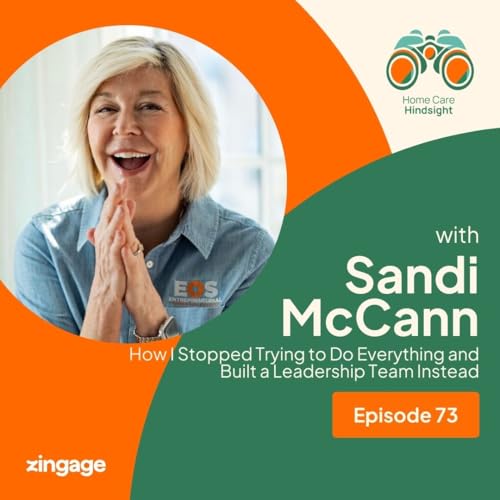
  • How I Stopped Trying to Do Everything and Built a Leadership Team Instead — Sandi McCann
    Mar 4 2026

    Sandi McCann, founder of HomeCare of the Rockies and now an EOS implementer, joins host David Knack to share her journey from burnout to building a business that could thrive without her.

    Sandi opens up about her biggest mistake as a founder: trying to do everything herself for nearly a decade holding onto control out of perfectionism and fear, until she physically, emotionally, and spiritually burned out.

    She explains how implementing EOS (Entrepreneurial Operating System) helped her fall back in love with her business and ultimately prepared it for sale in 2021. But the sale brought an unexpected identity crisis: "Who am I when I'm not running a business?" Sandi walks through her post-exit journey of self-discovery, coaching, and ultimately becoming an EOS implementer herself.

    The conversation covers the underrated power of discernment when adopting new tools, why owners must know themselves before they can lead others, and the non-negotiable need for strong sales, operations, and finance functions working together. Sandi also shares how a 136-line-item P&L became a strategic asset for grants, banking, and eventually selling her company.

    Lesson Takeaways:
    1. Know Thyself First: You can't lead effectively if you don't understand your strengths, energy drains, and natural tendencies. Self-awareness is the foundation of sustainable leadership.
    2. Fill the Gaps Deliberately: Every business needs strong sales, operations, and finance functions. If you're not strong in an area, hire someone who is—don't just power through.
    3. An Operating System Provides Scaffolding: Tools like EOS give owners and leadership teams a framework to delegate effectively, communicate clearly, and grow without chaos.
    4. Discernment Beats Shiny Objects: Before adopting any new tool or solution, ask: What problem are we solving? What's our highest need right now? Layering on tools without focus creates incomplete solutions.
    5. Clean Financials Are a Strategic Asset: Detailed, well-organized P&L statements unlock grants, build banker confidence, attract buyers, and reveal insights about retention, training ROI, and operational efficiency.

    Timestamps:
    00:00 – Welcome to Home Care Hindsight Podcast by Zingage
    01:40 – Introducing Sandi McCann: Founder, coach, EOS implementer
    02:10 – Building Home Care of the Rockies: "I should have been an entrepreneur all along"
    03:00 – The identity shift after selling: "Who am I when I'm not running a business?"
    05:00 – The people who helped her figure out what's next
    06:40 – Sandi's big mistake: Trying to do everything herself
    08:50 – The toll it took: Burnout, police calls, and walking out of yoga to crises
    09:40 – How EOS helped her fall back in love with the business
    10:10 – Why she finally sold: "I was done"
    11:30 – What prevented delegation: Control, perfectionism, and fear
    12:20 – Advice for new owners: Know yourself and fill the gaps
    14:50 – The three functions every business needs: Sales, operations, finance
    16:10 – Underrated industry practice: Discernment when adopting new tools
    18:00 – The trap of layering on tools without solving core problems
    19:00 – David on incomplete solutions: "Bridges that don't reach both sides"
    22:30 – The scheduler problem: Why AI can't replace human nuance yet
    24:00 – A little mistake owners make: Ignoring profitability in pursuit of growth
    26:30 – How weak operations undermines sales
    28:00 – The power of a 136-line-item P&L
    30:00 – Using financial data to win grants and attract buyers
    33:00 – A recent win: Watching a team member grow into confident leadership
    35:00 – Sandi's plug: Run your business on an operating system
    35:45 – How to connect with Sandi

    Quotes:
    Sandi McCann: "The big mistake was just trying to carry too much. It's unsustainable for any one human, especially for things that don't give me energy."

    Sandi McCann: "Know thyself. You can't be all things to all people. And then fill in the gaps with what you don't have."

    Sandi McCann: "What's undervalued in home care is discernment. Owners are layering on tools but not running any of them really well."

    Sandi McCann: "If you're not in warrior shape, your people know. They see you, and they go everywhere you go."

    Resources:
    1. Connect with Sandi McCann on LinkedIn: https://www.linkedin.com/in/sandimccann/
    2. Sandi with EOS: https://implementer.eosworldwide.com/sandi-mccann/
    3. Connect with David Knack on LinkedIn: https://www.linkedin.com/in/david-knack/
    4. Powered by Zingage: https://zingage.com
    5. Watch this episode on Zingage's YouTube: https://www.youtube.com/@Zingage

    Más Menos
    37 m
  • How I Stopped Being the Bottleneck and Built a Team of Heroes Instead — Sara Wilson
    Feb 24 2026
    In this episode of Home Care Hindsight, David Knack sits down with Sara Wilson, CEO and President of Home Assist Health, to discuss her lifelong journey in home care and the biggest lesson she's learned while scaling her organization. Sara shares her unique origin story, raised in the industry as her parents helped establish one of Arizona's first Medicaid waiver agencies, and how she eventually found her way back to the family business after a brief stint in corporate America. The conversation pivots to the core mistake that many successful founders make: holding on too tightly. Sara openly discusses her identity as an "organic growth entrepreneur" and how her need to be involved in every detail became a liability as the company grew. She explains the difference between being the "hero" in the early stages and creating "heroes" on her team during the growth stage. They explore the vulnerability required to let go, the importance of hiring people who are better than you, and how data-driven dashboards can provide the confidence needed to step back and let your team run. Lesson Takeaways: 1. In the early stages of a company, being deeply involved in everything is necessary. However, to scale, you must transition from being the sole problem-solver to developing your team to hold the strings for the organization. This builds capacity and prevents you from becoming the bottleneck. 2. The belief that it's "faster to do it myself" is a trap. While it might be true in the short term, it caps the team's growth and creates a culture of dependency. Long-term success requires the patience to delegate and develop others, even if it's slower initially. 3. It can be vulnerable to hand over responsibilities that have become part of your identity, especially when someone else might do them better. True leadership requires the humility to say, "It's not about being perfect, it's about building something that doesn't require you to be perfect." 4. Implementing performance dashboards at the individual, department, and corporate levels provides objective facts. Seeing that key metrics are trending in the right direction gives leaders the peace of mind and confidence to let go and trust their team's execution. 5. While financial metrics like census and gross margin are essential for business health, they shouldn't define your value. True success is measured by impact metrics: client satisfaction, hospitalization rates, employee retention, and continuity of care. This focus keeps the organization rooted in its purpose, not just a transaction. Timestamps: 00:00 - Welcome to Home Care Hindsight powered by Zingage 01:45 - Sara's origin story: Growing up in the industry during the 1980s 03:30 - Leaving for corporate America and realizing she felt like a "cog in a wheel" 04:15 - Finding her way back and falling in love with home care professionally 06:30 - Connecting the dots: How human communication drives outcomes in home care 07:10 - The big mistake: Being a founder who over-functions and caps growth 08:55 - The three reasons we hold on: Speed, ego, and vulnerability 10:55 - The lesson: "Early stage, be the hero. Growth stage, create heroes." 11:55 - The constant challenge of stepping back and letting new programs grow 13:55 - A playbook for transition: Using revenue triggers to hire and build teams 17:10 - What's overrated in home care: Default metrics like hours and census 18:15 - What's underrated: Outcome data and the true impact on community and health systems 22:20 - The little mistake: Leaders getting in their own way by forgetting their purpose 23:35 - Practical tactic: Using data-driven decision making to find peace and let go 24:40 - Celebrating wins: Using dashboards to incentivize both quantitative and qualitative success 26:05 - What Sara is proud of lately: Achieving CHAP accreditation for home health Quotes: Sara Wilson: "Being very honest... I had to stay close to everything early on and that was necessary. But it becomes a liability at scale. It's founder over-functioning, and at some point you have to let go." Sara Wilson: "It's faster to do it myself… But what if somebody comes in and they can do it better? It requires some humility to say it's not about being perfect." Sara Wilson: "We need to know our margins, but they shouldn't define our value. What should define our value is the impact we're having in our communities and in the lives that we're touching." Sara Wilson: "If we swing too heavily into efficiency and we swing too far away from the people, we're not able to effectively engage our workforce. If we become a transactional industry, we're going to get a transactional workforce, not a compassionate, purpose-driven workforce." Resources: 1. Connect with Sara Wilson on LinkedIn: https://www.linkedin.com/in/sara-wilson-85095266/ 2. Home Assist Health Website: https://homeassisthealth.org/ 3. Connect with David Knack on LinkedIn: https://www.linkedin.com/in/david-knack/ 4. Powered by Zingage: https...
    Más Menos
    29 m