Episodios

  • Operation: Market Garden
    Mar 4 2026

    After the success of the D-Day landings in France and the break out from the Normandy area, momentum was on the side of the Allies. The German Army was being pushed back across a wide front and had yet to put up a resistance capable of halting the advance. Confidence was sky-high and the Allies thought ending the war by Christmas of 1945 was a real possibility. All that was needed was a corridor into Germany itself. The Siegfried Line limited the routes available to move armor so any and all options were being considered. Bernard Montgomery had an idea to Uno reverse card Hitler and march back along the route through Belgium the Nazi's had used to invade France. The problem with this plan's success was completely contingent on the capture of 8 or 9 bridges along the route...all currently in enemy hands. The two most crucial bridges across the largest waterways just happened to be the furthest behind enemy lines. You'd think with so many things that could go wrong this plan would be scrapped right....right? Well instead more than 41,000 airborne troops were dropped via plane or glider behind enemy lines to capture key bridges while a ground forces would race to through the area those men captured. Everything relied on timing. Towns had to be captured and secured before the armored convoy could pass through so any delays meant that Allied troops dropped further away would be on their own against what turned out to be a much stronger German force than anticipated. Market Garden was not destined to succeed but that didn't stop the men of the Airborne from giving everything they had trying to make it.

    Support the show

    Más Menos
    2 h y 53 m
  • Al Capone
    Feb 25 2026

    Al Capone came to the head of the Chicago Outfit at 26 years of age. Now leading the largest organized crime family outside of New York, Al made a fortune by bootlegging in liquor during prohibition. He definitely did all the other mob stuff, Gambling, Sex Work, Racketeering, but booze is where he hit it big. Fighting for control of the lucrative alcohol game spilled onto the streets of Chicago in a way that hadn't and still hasn't been seen. This was a time when you'd be walking down Michigan Avenue and see 4 guys jump out of a car in broad days light and open up with Tommy Guns trying to bump off a rival leader. Bombings were commonplace, and almost the entire law enforcement establishment was on the take, bought and paid for by Capone. Finally the Federal Government has to step in to take him down. How'd they do it?....well you're gonna have to listen to find out.

    Support the show

    Más Menos
    2 h y 54 m
  • 1980 U.S. Men's Olympic Hockey Team: The Miracle on Ice
    Feb 18 2026

    Yes we know that's a lengthy title. By the 1980 Winter Olympics in Lake Placid, New York, it had been 20 years since the U.S. won the gold. Those two decades saw a dominance unlike any other at the time by the Soviet Union and their seemingly unbeatable team. The Cold War was front and center. Expectations were pretty low for the U.S. Men's team going into the games but through a series of lucky events a man named Herb Brooks was put in the driver seat. Herb was coming off a NCAA Hockey National Championship in 1979 at the University of Minnesota and looked to create a team that could stand toe to toe with the Soviets using creativity and team chemistry. Now we should note this comes at a time when professional athletes didn't compete on olympic national teams. This team would be comprised of college athletes, many from Minnesota and many from Boston, and oh man some of these guys did not like each other, carrying over rivalries from school. They only had about 7 months to become a team capable of doing what many believed impossible. Well if you know the story, you know they did, and what follows would come to be known as The Miracle on Ice.

    Support the show

    Más Menos
    2 h y 19 m
  • William Shakespeare
    Feb 11 2026

    The man who would come to be known as The Bard, was born in April 1564 in Stratford-upon-Avon, United Kingdom. One of, if not the greatest playwright in human history, William Shakespeare is responsible for 38 plays, 154 Sonnets, and credited with the invention of over 600 words in the English language. We still use phrases he invented on a daily basis. The man lived the theater and had a gift for capturing the complicated nature of people, creating complex but relatable characters and doing so with a masterful use of language. The man was also an entrepreneur, owning a share of his theater company and theater itself. Performing for royalty became common place for Shakespeare as he established himself as the premier playwright in London while never forgoting his roots in Stratford-upon-Avon where his family resided. Join us today as we explore the life and works of William Shakespeare.

    Support the show

    Más Menos
    2 h y 32 m
  • The Red Ball Express - Patreon Exclusive
    Feb 6 2026

    The Red Ball Express was the life line of supplies that kept the allies going after the D-Day landings. The Allies had no port in mainland Europe capable of bringing in the supplies needed right after the invasion. Enter the Red Ball Express, a literal army of trucks and drivers moving an almost unimaginable amount of ammo, fuel, etc to the allied armies as they moved to push the Germans out of France.

    Support the show

    Más Menos
    3 m
  • The Battle of Verdun
    Feb 4 2026

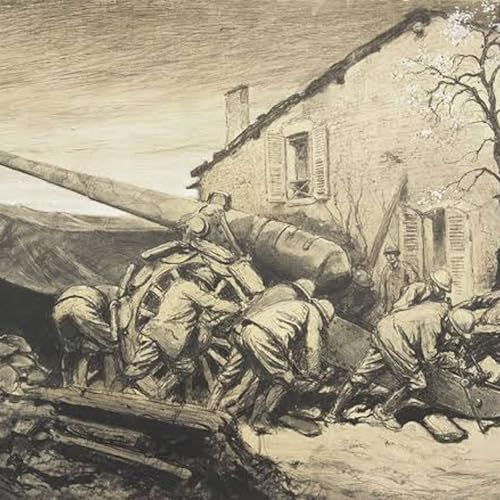
    World War 1 features a couple battles that stand out above the rest. The Battle of the Somme is one, The Battle of Verdun would be the other vying for the top spot. Now where the Somme was a nasty meat-grinder, of trench warfare, Verdun was all about laying siege to forts. Lasting over 300 days it was by far the longest battle of The Great War. Verdun was a fortress town that served as the symbolic home to France's military power. The Verdun region was home to around 20 other forts making it the most heavily defended part of France. German General Erich von Falkenhayn determined the French would do anything to defend this region and if it was lost, do anything to get it back. The plan was to overwhelm the defenders in the area, destroy their fortifications and take advantageous positions. When the French had to counter attack to re-take Verdun, the German Army would be in position to inflict massive casualties or as Falkenhayn put it "bleed the French white." How did that all turn our for him, find out this week as we get Historically High on the Battle of Verdun

    Support the show

    Más Menos
    3 h y 2 m
  • Gary Ridgway: The Green River Killer
    Jan 28 2026

    Professor Adam is in the driver's seat this week for a Serial Killer history episode. Gary Ridgway, better known as The Green River Killer, is the 2nd most infamous serial killer in U.S. history. Ridgway murdered at least 49 women in the state of Washington. He worked areas known for prostitution, and preyed on a part of society that law enforcement had turned a blind eye on. Gary wasn't a mastermind. He wasn't a super criminal. He's certainly not well spoken. In fact, he would even point out his own stature to victims as a way of proving he wasn't the Green River Killer. Even he knew he was a loser. That loser is, was, and always will be purely evil. Join us today as we get Historically High on The Green River Killer

    Support the show

    Más Menos
    2 h y 3 m
  • Captain James Cook
    Jan 21 2026

    James Cook is one of those explorers where upon hearing his name, you gotta take a beat and try to decide if he's a real person or if you're thinking of Captain Hook from Peter Pan or Captain Cook from Breaking Bad. But don't sleep on Jimmy cause the man knew how to quest. Starting out from humble origins cutting his teeth in the coal shipping game, he learned his way around a ship and around the water. Eventually the Royal Navy came calling and he was sent to the new world during the Seven Years War and found he had a talent for cartography. A few years of honing his skills later and James found himself charged with locating the great southern continent that balanced the hemispheres. His voyages would take him around the world several times, seeing places like Tahiti, New Zealand, Australia, Hawaii, the Pacific Northwest of the United States and Canada, both circles (Antarctic and Arctic), and many others. Compared with other explorers of his era he was on the lighter side when it came to the mistreatment of indigenous people so he's got that going for him, which is nice. Join us this week as we set sail on the high seas with Captain James Cook.

    Support the show

    Más Menos
    3 h y 33 m