Episodios

  • 9: Why High-Quality Supplier Partnerships Hold the Key to Fresh, Reliable Salads
    Jan 9 2026

    📺 Watch, Subscribe, Follow on YouTube & Spotify

    Thanks to Our Sponsor

    Harnois Greenhouse

    Website - https://harnoisgreenhouse.com/

    Facebook - https://www.facebook.com/SerresHarnoisGreenhouses

    Instagram - https://www.instagram.com/harnois.ghs/

    LinkedIn - https://www.linkedin.com/showcase/serres-harnois-greenhouse/

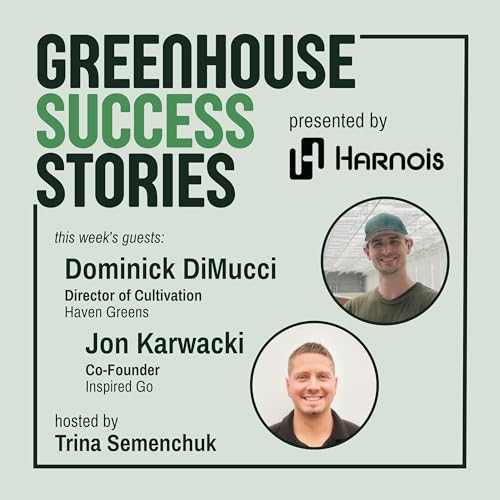
    “You can't run a business if you have to refund people for bad cucumbers,” says John Karwacki, founder of Inspired Go, who appears on Greenhouse Success Stories to reveal how fresh produce supply chains are truly the backbone of any food delivery operation—and why relentless focus on quality has driven Inspired Go’s explosive growth across North America.

    From launching with office deliveries to pivoting during COVID and forging a deep partnership with Dominick DiMucci at Haven Greens, John Karwacki pulls back the curtain on the logistics and data that keep your salad fresh on day five, while Dominick DiMucci shares the real story behind controlled environment agriculture’s glossy image and the hard work it takes to build consistency customers crave. If you think greenhouse-to-buyer partnerships are simple or automated growing is a breeze, this episode will challenge everything you thought you knew—and show what it really takes to deliver perfection from greenhouse to doorstep.

    Key Takeaways
    1. Don’t build a greenhouse and then search for a market—start relationships with buyers before you ever break ground.
    2. Let quality drive your decisions. Obsess over your product, and put the plant’s needs first every single day.
    3. Invest in the right people upfront—team strength and early collaboration fuel lasting success.
    4. Make your operations customer-focused. Gather direct feedback, track retention, and adapt your offerings to what people actually crave.
    5. Approach technology as a servant to the plant—not the master. Use automation and innovation only when it strengthens output and flavor.

    Memorable Quotes"Our job is to provide the plant what it needs to succeed and thrive, not try to force it down a different path for our own reasons. At the end of the day, the plant comes first.""I think it’s important that we’re transparent about the industry. Controlled environment agriculture is often wrapped up in a nice bow, but it’s a lot of work and difficult to execute on a daily basis. Despite things being controlled and sterile, it’s not hard to unsuccessfully operate a greenhouse.""Investing in the team early is something that, at least for Haven Greens, I think has led to us having so much velocity in year one. People are the drivers for your business, and putting the right people in the right places early really sets you up for success."Connect with Dominick & Haven Greens

    Dominick's LinkedIn:

    Más Menos
    51 m
  • 8: Why Year-Round Growing Holds the Key to Sustainable Farm Income With the Help of Harnois Greenhouses
    Dec 19 2025

    📺 Watch, Subscribe, Follow on YouTube & Spotify

    Thanks to Our Sponsor

    Harnois Greenhouse

    Website - https://harnoisgreenhouse.com/

    Facebook - https://www.facebook.com/SerresHarnoisGreenhouses

    Instagram - https://www.instagram.com/harnois.ghs/

    LinkedIn - https://www.linkedin.com/showcase/serres-harnois-greenhouse/

    “One of the things that we grow year round is actually celery. So I think we're going into the third or fourth year of growing celery nonstop year round. So a lot of people, you know, we kind of become known as the, you know, celery people at market,” says Andrew Phelps, co-owner of Phelps Farm in Guttenberg, Iowa, and this week’s featured grower on Greenhouse Success Stories.

    After a career pivot from IT, Andrew Phelps and his wife Amy transformed her family’s farmland into a thriving, small-scale year-round vegetable operation—earning a reputation for consistency, niche innovation, and direct-to-consumer success. From overcoming devastating storms and infrastructure challenges to pioneering unique offerings like customizable CSA boxes and introducing farm-fresh beef, eggs, and honey, Andrew Phelps shares how strategic grants, tech tools, and a hands-on approach turned adversity into opportunity. Discover how this farmer’s market staple is setting a new standard for small growers aiming for year-round production and direct sales.

    Key Takeaways

    You want to build a thriving year-round farm business—take these actions to accelerate your greenhouse journey:

    1. Start where you are—launch your farmers market booth or CSA with whatever you can grow now, and build from there. Progress and consistency beat waiting for perfect conditions.
    2. Invest in robust infrastructure. Upgrade to stronger, automated high tunnels or greenhouses before extreme weather forces your hand—your crops and sanity will thank you.
    3. Apply for grants and cost-share programs early and often. Tap into resources like USDA EQUIP to slash upfront costs and fuel your reinvestment cycle.
    4. Prioritize education and mentorship relentlessly. Attend conferences, connect with extension specialists, and enroll in proven master classes—knowledge and support are your biggest growth multipliers.
    5. Build a direct-to-customer sales strategy: Embrace CSAs, markets, and farm stores to control your margins, build your brand, and stay nimble as you scale.

    Memorable Quotes"We invest quite heavily in education and learning new things. If you’re a new greenhouse grower, figure out your local resources—whether that’s a university extension, conferences, or online master classes. Having someone in your toolbox who can help with problems is a huge asset.""One of the things that we grow year round is celery. I think we're going into the third or fourth year of growing celery nonstop. A lot of people, we kind of...
    Más Menos
    47 m
  • 7: The Importance of Customer-Centric Thinking in Growing a Successful Plant Business
    Dec 12 2025

    📺 Watch, Subscribe, Follow on YouTube & Spotify

    Thanks to Our Sponsor

    Harnois Greenhouse

    Website - https://harnoisgreenhouse.com/

    Facebook - https://www.facebook.com/SerresHarnoisGreenhouses

    Instagram - https://www.instagram.com/harnois.ghs/

    LinkedIn - https://www.linkedin.com/showcase/serres-harnois-greenhouse/

    “My goal is not to be the biggest. My goal is to be the best houseplant vendor here, especially here on the west coast in the North Pacific Northwest,” says Andrej Suske, owner of Cascade Tropicals, who joins Greenhouse Success Stories to share how relentless focus on quality, efficient systems, and deep-rooted passion for plants fuels his thriving business. From selling cut flowers on Berlin street corners at age ten to leading a cutting-edge, lean-driven greenhouse operation, Andrej Suske reveals a journey filled with hard-won lessons, innovations in forecasting and logistics, and insights on surviving both booms and market contractions. For anyone curious about what it really takes to build a standout horticulture business—and why a sense of ownership and love for growing are the keys to long-term success—this episode is not to be missed.

    Key Takeaways
    1. Know your customer and forecast demand relentlessly—success hinges on meeting needs at the right time with the right product.
    2. Prioritize lean principles—train your team to eliminate waste and boost efficiency, so every hour and every square foot counts.
    3. Obsess over top quality—if your plants aren’t best-in-class, level up or step out; average isn’t good enough.
    4. Embrace mistakes as growth—screw up, learn fast, and adapt, but never repeat errors. Progress comes from curiosity and self-ownership.
    5. Make ordering and fulfillment seamless—streamline your system until retailers think of you first, every single week.

    Memorable Quotes"My goal is not to be the biggest. My goal is to be the best houseplant vendor here, especially on the west coast in the North Pacific Northwest. When a store needs houseplants, the first thing I want them to think of is, 'I place an order with Cascade, and I have it by Friday before the weekend.'""I found out when I was a kid that I love growing plants and I love looking at plants. If I can do what I like doing, then I'm already having a big piece of being successful.""Screwing up is something that needs to happen—if we do a lot of work, we’ll also mess up a lot. We shouldn’t be making the same mistake over and over, but otherwise it’s okay to fail, learn, and get better."Connect with Andre

    Andre on LinkedIn - https://www.linkedin.com/in/andrej-suske-22060a201/

    Cascade Tropicals LinkedIn - https://www.linkedin.com/company/cascade-tropicals/

    Website - https://www.cascadetropicals.com/

    Instagram -

    Más Menos
    50 m
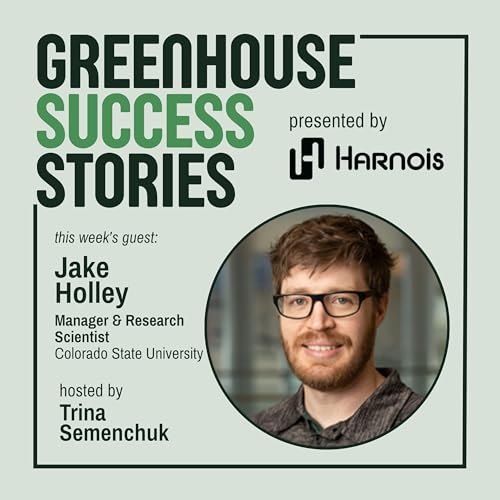
  • 6: How Jake Holley Discovered the Secrets of Spinach Germination for Reliable Crop Success
    Dec 5 2025

    📺 Watch, Subscribe, Follow on YouTube & Spotify

    Thanks to Our Sponsor

    Harnois Greenhouse

    Website - https://harnoisgreenhouse.com/

    Facebook - https://www.facebook.com/SerresHarnoisGreenhouses

    Instagram - https://www.instagram.com/harnois.ghs/

    LinkedIn - https://www.linkedin.com/showcase/serres-harnois-greenhouse/

    “What that means is that when you grow successive spinach cycles, the root exudates are being released into the water that build up to a point where spinach's own root exodus become toxic to itself,” explains Jake Holley, manager of the Metro Ag Research Center in Denver and pioneering researcher in controlled environment agriculture.

    On this episode of Greenhouse Success Stories, Jake brings rare insight into the world of hydroponics—from tackling spinach’s infamous autotoxicity to advancing water quality monitoring with cutting-edge ORP probes. Drawing from 15 years of hands-on experience across academia and industry, Jake reveals how product validation, public education, and innovative trials at Metro Ag are lighting the way for growers worldwide. Discover why this researcher’s practical wisdom and drive to make science accessible have him shaping the future of urban agriculture, one experiment at a time.

    Key Takeaways
    1. Grow your confidence—and your crops—by testing new products risk-free in R&D settings before you invest. Seek third-party validation for solutions and experiment boldly.
    2. Build hands-on experience with hydroponics at any scale. Try growing lettuce or spinach at home—simple setups and DIY methods can feed your household year-round.
    3. Collaborate and connect with local and global growers, educators, and innovators. Share your knowledge, tour facilities, and help raise awareness about CEA in your community.
    4. Tackle tough crops head-on. Use strategic variety selection, light management, and germination techniques, like vernalization, to overcome the frustrations of growing spinach and other challenging plants.
    5. Monitor and optimize your systems relentlessly. Integrate affordable new tech, like ORP probes, to predict issues and automate water quality management—stay ahead to boost yields and save time.

    Memorable Quotes"What that means is that when you grow successive spinach cycles, the root exudates are being released into the water that build up to a point where spinach's own root exudates become toxic to itself.""My job is to advance and support urban agriculture, not just within Denver, but nation and worldwide. In that effort, my job really has three somewhat distinct categories: facility management, supporting academic research, and conducting trials to advance knowledge of hydroponic systems and controlled environment agriculture.""I think providing stuff that growers can actually use and saves time and energy has been really cool for me—to see actual impacts and not just research that ends up tucked away in a journal."Connect with Jake

    LinkedIn -

    Más Menos
    50 m
  • 5: Why Growing Year-Round in Manitoba Holds the Key to Local Food Security with Cormac Foster
    Nov 28 2025

    📺 Watch, Subscribe, Follow on YouTube & Spotify

    Thanks to Our Sponsor

    Harnois Greenhouse

    Website - https://harnoisgreenhouse.com/

    Facebook - https://www.facebook.com/SerresHarnoisGreenhouses

    Instagram - https://www.instagram.com/harnois.ghs/

    LinkedIn - https://www.linkedin.com/showcase/serres-harnois-greenhouse/

    “People often look at Manitoba as a place that they say it's too cold...there's no way you can grow year round in Manitoba...It's freezing, which is a fair point. And a lot of people think that, but that actually isn't true, and we've proven that now,” says Cormac Foster, VP of Engineering and Development at Vermillion Growers, who joins Greenhouse Success Stories to share how his team shattered the myth that year-round, large-scale greenhouse farming in one of Canada’s harshest climates is impossible.

    From navigating daunting permitting obstacles and innovating solutions for extreme humidity and temperature swings, to pioneering new utility models and helping carve a path for future greenhouse engineers, Cormac Foster details the journey of building Manitoba’s first commercial vegetable greenhouse. Behind the fresh tomatoes now appearing in local stores lies a story of technical ingenuity, global collaboration, and a bold vision to turn the province into an ag-tech powerhouse. Want to know how they made it happen—and what’s next? Don’t miss this episode.

    5 Key Takeaways
    1. Challenge the “it’s too cold” myth—innovative greenhouses can thrive year-round even in extreme climates like Manitoba. Start exploring what’s possible in your region.
    2. Build your dream team—seek out the best global experts, consultants, and growers to turn your greenhouse vision into reality. Don’t settle, connect and collaborate widely.
    3. Prioritize humidity and climate control—extreme weather demands experimental thinking and robust systems. Test new solutions, monitor closely, and adapt rapidly.
    4. Advocate for your industry—push for updated regulations, utility classes, and incentive programs that support greenhouse agriculture. Take the lead in driving policy changes.
    5. Own your learning journey—expand your skills in biosystems engineering, project management, and communication to unlock new opportunities in controlled environment agriculture. Invest in yourself and share your expertise.

    Memorable Quotes"And people often look at Manitoba as a place that’s too cold, like there’s no way you can grow year-round here. It’s freezing, which is a fair point, and a lot of people think that, but that actually isn’t true—and we’ve proven that now.""My work really was focused on the design and then actually trying to see how can we get this design permitted and approved for use in Manitoba. How do we bring this technology that’s approved maybe in Europe or in other jurisdictions in North America here, and how did this work in our area?""Our official mission at Vermillion Growers is to grow high quality produce, healthy people, and sustainable communities. There’s a lot to unpack there, but that’s our mission as a company—we really do have big vision and big goals."Connect with...
    Más Menos
    54 m
  • 4: Why Year-Round Strawberry Production Equals Sustainable Local Food Systems with Vertiberry's Olivier Paulus
    Nov 21 2025

    📺 Watch, Subscribe, Follow on YouTube & Spotify

    Thanks to Our Sponsor

    Harnois Greenhouse

    Website - https://harnoisgreenhouse.com/

    Facebook - https://www.facebook.com/SerresHarnoisGreenhouses

    Instagram - https://www.instagram.com/harnois.ghs/

    LinkedIn - https://www.linkedin.com/showcase/serres-harnois-greenhouse/

    “You cannot afford to make a mistake. It needs to be perfect the entire time because your whole yield figures, your business plan, your financing is based on this full production. So if halfway it fails and you have to restart, well, you’re in trouble,” says Olivier Paulus, owner and founder of Verteberry, who shares his journey transforming from engineer to strawberry innovator on Greenhouse Success Stories.

    After pioneering one of Belgium’s earliest vertical farms and transitioning to Quebec, Olivier Paulus reveals the complexities of year-round berry production, the pivotal role of plant quality, and the razor-thin margin for error that defines modern greenhouse entrepreneurship. His hands-on, “biology first” approach, strategic partnerships, and candid insights into the challenges of R&D, scaling, and commercial viability make for an episode packed with actionable wisdom for anyone eyeing success in controlled-environment agriculture. Curious about the future of strawberries in snow and why lean, honest growing sets the foundation for breakthrough results? Don’t miss this episode.

    5 Key Takeaways

    Every greenhouse breakthrough starts with bold action—here’s what to do next:

    1. You don’t need a farming background to succeed. Dive into research, ask questions, and let curiosity fuel your first grow—starting small is better than not starting at all.
    2. Forget shortcuts. Quality crops always come first—focus relentlessly on plant health and let technology and profit strategies follow afterwards.
    3. Scaling takes grit and real relationships. Reach out to industry leaders, invite feedback, and collaborate—connection and transparency accelerate your progress.
    4. The market loves reliability. Build systems for consistent, repeatable results—use quick trials, learn from mistakes, and measure success by customer satisfaction.
    5. Stay lean and honest. Get your hands dirty, keep costs tight, and regularly check your work—your plants will always tell you the truth, so listen and adapt.

    Memorable Quotes"You cannot afford to make a mistake. It needs to be perfect the entire time because your whole yield figures, your business plan, your financing is based on this full production. So if halfway it fails and you have to restart, you're in trouble.""The most important advice is really work on that lean and mean mindset. Pull that mindset into becoming a good grower or finding a good grower. Do not lie to yourself—the plants will tell the truth. You cannot hack it. Make sure you get a good crop, whether it's lettuce, herb, or strawberry. Start with that.""We've been doing this for eight years and I still feel there is so much to learn, so much to improve on so many fronts. That's the challenging but also the motivating part."Connect with Olivier +...
    Más Menos
    48 m
  • 3: What $7 Million in Unexpected Tariffs Taught Richard Lee About Resilience in Agriculture
    Nov 14 2025

    📺 Watch, Subscribe, Follow on YouTube & Spotify

    Thanks to Our Sponsor

    Harnois Greenhouse

    Website - https://harnoisgreenhouse.com/

    Facebook - https://www.facebook.com/SerresHarnoisGreenhouses

    Instagram - https://www.instagram.com/harnois.ghs/

    LinkedIn - https://www.linkedin.com/showcase/serres-harnois-greenhouse/

    “You can’t suck and blow at the same time. We’re talking about keeping our elbows up by Canadian support. Canadian. And then you have these draconian policies being implemented at all levels of government,” says Richard lee, Executive Director of the Ontario Greenhouse Vegetable Growers Association, who joins Trina Semenchuk on Greenhouse Success Stories to expose the mounting obstacles faced by greenhouse growers in Ontario.

    With decades of experience blending entrepreneurial spirit and environmental advocacy, Richard shares how everything from waste management to property taxation threatens the Canadian greenhouse sector’s growth and sustainability—and why municipalities might be driving innovative producers out of the country. His first-hand accounts reveal both crisis and opportunity, making for a provocative conversation anyone interested in the future of food, farming, and Canadian innovation shouldn’t miss.

    5 Key Takeaways
    1. Collaboration makes solutions possible—reach out to local municipalities, associations, and stakeholders to advocate for greenhouse-friendly policies before you build or expand.
    2. Waste is opportunity in disguise. Audit your greenhouse packaging and waste streams, and connect with innovative recyclers to pioneer sustainable, circular solutions.
    3. Fight for unified, fair regulations. Lend your voice to push for harmonized recycling, infrastructure, and trade policies that empower—not restrict—growers.
    4. Don’t wait for disaster—secure your business. Work with associations to advocate for payment protection, business risk programs, and fair access to trade markets now.
    5. Build strong relationships with community leaders. Schedule ongoing meetings, invite them on greenhouse tours, and celebrate shared successes to strengthen support for your operation’s future.

    Memorable Quotes"You can't suck and blow at the same time. We're talking about keeping our elbows up by Canadian support, and then you have these draconian policies being implemented at all levels of government. Don't get me wrong, it's not just municipalities that aim to contradict any future investment in greenhouse.""We need to be proactive, not reactive. We keep playing this game of whack-a-mole—something pops up, we whack it, we're just chasing issues. We know what the growth trajectory is, we know what we need to do to support that trajectory. The question now becomes, do you want to support it? That's at the municipal, provincial, and federal level.""Controlled environment agriculture, greenhouse is the future of agriculture and is where we need to continue to put our resources. The future is going to be bright, but we need to be proactive to support it."Connect with Richard

    LinkedIn:

    Más Menos
    1 h y 1 m
  • 2: Why Mentoring Your Team Holds the Key to Sustainable Greenhouse Success with Laura Martin
    Nov 7 2025

    📺 Watch, Subscribe, Follow on YouTube & Spotify

    Thanks to Our Sponsor

    Harnois Greenhouse

    Website - https://harnoisgreenhouse.com/

    Facebook - https://www.facebook.com/SerresHarnoisGreenhouses

    Instagram - https://www.instagram.com/harnois.ghs/

    LinkedIn - https://www.linkedin.com/showcase/serres-harnois-greenhouse/

    “Being a grower is incredibly hard work. You’re the first one in, the last one out, and when things go wrong, whether it’s weather, pests or timelines, it all lands on you,” says Laura Martin, head grower at Shackan Indian Band, whose thirty years in the greenhouse industry have spanned everything from family-run cedar hedging operations to pioneering native species restoration in British Columbia’s wildfire-ravaged landscapes.

    In this episode of Greenhouse Success Stories, Laura Martin opens up about her lifelong passion for propagation, the relentless challenges of labor shortages in remote locations, and her vision to transform her nursery into a hands-on learning center for the next generation of growers. Discover why Laura Martin sees mentoring and community collaboration as the keystones to long-term greenhouse success—and what it takes to build something meaningful from the ashes.

    5 Key Takeaways
    1. Build your succession plan—mentor and train a right-hand person so your greenhouse is never left stranded and you can finally take that well-earned break.
    2. Don’t wait for perfect resumes—hire for passion, work ethic, and willingness to learn, then invest in hands-on teaching and mentorship to fill the skill gap.
    3. Collaborate with local communities and institutions—reach out to First Nations, universities, and trade schools to create a robust pipeline of future growers.
    4. Diversify your approach to labor shortages—leverage grant funding, automation, and creative partnerships to keep operations running strong even in remote areas.
    5. Advocate for hands-on learning—push universities and training programs to focus on real-world greenhouse experience and not just theory.

    Memorable Quotes"Being a grower is incredibly hard work. You're the first one in, the last one out, and when things go wrong—whether it's weather, pests, or timelines—it all lands on you.""I would like to make this nursery into a learning center. I hope to intrigue people to come out, learn here, and become growers so they can go out into the industry with the skills they need.""My advice is to always mentor somebody to be your person. Have someone you're training to be the next in line, so you can start taking a holiday and eventually leave things running well."Resources Mentioned

    Shackan Indian Band - https://www.shackan.ca/

    Connect With Us

    GSS LinkedIn - https://www.linkedin.com/company/verticalfarmingpodcast

    GSS Instagram -

    Más Menos
    48 m
adbl_web_global_use_to_activate_DT_webcro_1694_expandible_banner_T1