Global Faultlines Podcast Por The Hindu arte de portada

Global Faultlines

Global Faultlines

De: The Hindu
Escúchala gratis

Global Faultlines is a deep-dive international affairs podcast that goes beyond breaking news to uncover the roots of global conflicts. From shifting borders to power struggles, it explores the forces that shape international events. With expert voices and sharp analysis, the show offers depth and clarity on the stories shaping our world.The Hindu Ciencia Política Política y Gobierno
Episodios
  • Who won the U.S.-Israel war on Iran?
    Apr 15 2026
    As tensions in West Asia spiral into one of the most dangerous confrontations in recent years, this episode of Global Faultlines breaks down the 2026 Iran–Israel–U.S. war, starting from the U.S.-led “Operation Epic Fury” and the killing of the former Supreme Leader Ayatollah Ali Khamenei to Iran’s sweeping retaliation across the region. We trace the roots of the conflict back to the collapse of the Joint Comprehensive Plan of Action, examine how a long-running shadow war escalated into direct military confrontation, and unpack the strategic, economic, and humanitarian consequences, particularly the disruption of the Strait of Hormuz. With a fragile Pakistan-brokered ceasefire now under strain and high-stakes talks collapsing, we also take a closer look at why diplomacy has failed so far, what the key sticking points are, and whether the region is on the brink of another round of escalation. Expert: Stanly Johny, International Affairs Editor, The Hindu Research, Editing and Production: Sharmada Venkatasubramanian Camera: Shivaraj S, Karthik P Learn more about your ad choices. Visit megaphone.fm/adchoices
    Más Menos
    57 m
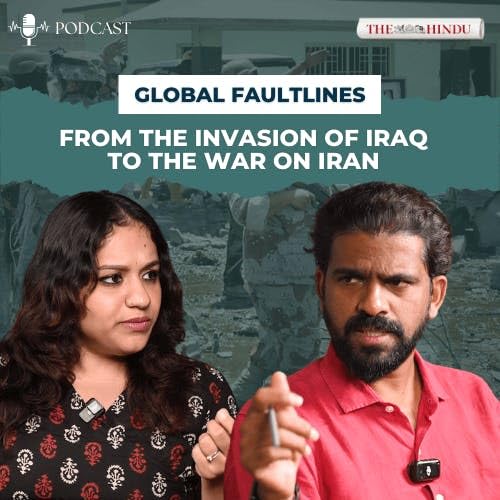
  • Part 2: From the invasion of Iraq to the war on Iran
    Mar 18 2026
    The 2003 U.S.-led invasion of Iraq marked a decisive break in the country’s modern history. It removed the regime of Saddam Hussein, but also dismantled the institutions that had held the state together. In the aftermath, decisions such as the dissolution of the Iraqi army and de-Baathification weakened state authority and contributed to a rapidly deteriorating security environment. Iraq soon descended into insurgency and sectarian violence, with multiple armed groups, including those linked to Al-Qaeda, operating across the country. These conditions enabled the rise of the Islamic State, which seized large parts of Iraqi territory in 2014, bringing the state close to collapse. Although ISIS was eventually defeated territorially, its impact continues to shape Iraq’s political and security landscape. Today, Iraq faces persistent challenges: fragile governance, powerful armed groups, economic strain, and the competing influence of external actors, including Iran and the United States. In this episode of Global Faultlines, we examine Iraq after 2003, the collapse of the state, the rise of ISIS, and the country’s uncertain path forward. Expert: Stanly Johny, International Affairs Editor, The Hindu Research, Editing and Production: Sharmada Venkatasubramanian Camera: Shivaraj S Learn more about your ad choices. Visit megaphone.fm/adchoices
    Más Menos
    46 m
  • Iraq Part 1: How was the modern Iraqi state created?
    Mar 4 2026
    Modern Iraq was not born in 2003. Its origins lie in the aftermath of the First World War, when the collapse of the Ottoman Empire led Britain to assemble a new state. The borders were drawn quickly. Building a stable political order proved far harder. Under the British Mandate, Iraq inherited centralised institutions that concentrated power but struggled to accommodate its ethnic and sectarian diversity. Sunni Arab elites dominated the new state, while Shia Arabs and Kurds often remained politically marginalised, patterns that would shape Iraq’s politics for decades. The 1958 revolution ended the monarchy and marked a turn toward military-led republicanism. The rise of the Ba'ath Party deepened authoritarian rule and ideological nationalism, culminating in the regime of Saddam Hussein. By the late 20th century, Iraq had fought a devastating war with Iran, invaded Kuwait, and endured years of sanctions. The state remained intact, but it was weakened, centralised, and heavily securitised. To understand why Iraq became the focal point of the 2003 invasion, it is essential to examine how the modern state was constructed, and how the fault lines embedded in its early formation continued to shape its trajectory. In this episode of Global Faultlines, we trace the creation of modern Iraq and the foundations of its long instability. Expert: Stanly Johny, International Affairs Editor, The Hindu Research, Editing and Production: Sharmada Venkatasubramanian Camera: Shivaraj S Learn more about your ad choices. Visit megaphone.fm/adchoices
    Más Menos
    46 m
Todavía no hay opiniones