Episodios

  • S3E03 - Cellulose (Plant Cell Biology)
    Mar 25 2026
    #Cellulose #GeniusGames #InDefenseOfPlants #Plants #Botany #CellBiology #MolecularBiology #BoardGames #Science #SciComm Summary This mont we talk Cellulose and all things plants with special guest Matt Candeias, of the In Defense of Plants podcast. In this sequel to Cytosis, we dive inside of a plant cell in a worker-placement game that while similar to its predecessor also adds a lot of new mechanics and strategy. As usual, Genius Games's sciecne is top-notch, and we get to talk about photosynthesis, Rrubisco, how plants nearly wrecked the environment (twice!), why C4 photosynthesis is the best photosynthesis, and the weirdest ways plant use their energy. So grab a houseplant and settle back for all things Cellulose. Timestamps 00:00 Introductions02:40 Pollen and pointy sticks07:59 Intro to Cellulose13:47 Rubisco & chloroplasts20:47 The cell wall25:15 Plant movement29:12 Elements of photosynthesis32:09 CAM & C4 photosynthesis38:03 Water and light shaping plant distributions42:14 Weirdest use for cellulose44:52 Nitpick corner51:12 Grades56:27 Wrap-up Links Official Game Website (Genius Games)In Defense of Plants (Podcast & Book)430,000 year old wooden tool (Science.org)The evolution of C4 photosynthesis (New Phytologist)Skunk cabbage and philodendron making heat (In Defense of Plants) Find our socials at https://www.gamingwithscience.net This episode of Gaming with Science™ was produced with the help of the University of Georgia and is distributed under a Creative Commons Attribution-Noncommercial (CC BY-NC 4.0) license. Full Transcript (Some platforms truncate the transcript due to length restrictions. If so, you can always find the full transcript on https://www.gamingwithscience.net/ ) Jason 0:00 Hello, and welcome to the gaming with Science Podcast, where we talk about the science behind some of your favorite games. Brian 0:10 Today, we're going to talk about cellulose by genius games. Hey, welcome back to gaming with science. This is Brian. This is Jason, and we have a very special guest with us today, Dr Matt Candeias, who is holding up the wall against plant blindness. He is the host of In Defense of Plant, and I'm already breaking my thing. I should be letting him introduce himself, Matt, tell us about yourself. Matt 0:36 Well, first off, thank you guys so much for having me. It's an honor to be here. My name is Matt Candeias, yeah, I'm an ecologist by training. I have always had an interest in sort of the way the natural world interacts with itself, us including and for about the last probably 20 years of my life, that has largely been focused on how plants set the foundation for everything in this world. So yeah, my PhD is in plant ecology. I spent a lot of time looking at how plants kind of form communities and structure themselves over different gradients in the environment. It's been a lot of fun. And as you mentioned, I run in defense of plants, so for many, many years of my life, surprisingly, that number goes up every year and just hits me with a whole new sense of, Oh, I'm getting older. Yeah. It's been a, basically my Ode to My love to plants, and trying to share that passion with the world and try to get people to see plants the way I do. You know, it was one of those things where I just kind of always thought that plants got the short shrift when it came to science communication and the way we looked at the natural world. You know, cheetahs are exciting, elephants are brilliant. Why aren't we talking about plants like that, other than as food or medicine, which is cool, but plants are their own organisms, so I created in defense of plants to celebrate that. And it's been a love affair of communicating that in many different forums, but mostly through podcasting, ever since, Brian 1:51 you are the host, but you have talked to everyone. You have had so many episodes, and you have on special guests pretty much almost every episode. I can't imagine what it's like to schedule all of that. Matt 2:03 Calendars give me anxiety. So it's always anxious. I have tons of anxiety around it, but it's kind of streamlined at this point, and it's just fun. And it turns out that people really want to share their passion too. And when you come in and say, Hey, I'd like to promote the science you're doing, I think it's really cool. People are really receptive to that. So, you know, they my guests make it very easy on me as best as they can. You know, it's the herding cats. The phrase always comes to mind though. You know, we just do our best. Brian 2:29 All right, so I'm glad that you were able to join us for a very plant centric game. I know it's much more cellular biology than ecology, but again, couldn't pass up the opportunity to try to get you to come on and talk to us. But before we get into talking about cellulose, let's do a little bit of science banter. So what's something cool you learned recently or heard about a story or anything like that? We usually let ...
    Más Menos
    1 h
  • S3E02.1 - Brynn Devine (Interview)
    Mar 11 2026
    #Oceans #Finspan #OceansNorth #MarineBiology #Interview #BoardGames #Science Summary In this special bonus episode, we talk with Dr. Brynn Devine, one of the science consultants on Finspan. We get to hear what it was like helping the game's development, why monitoring fish and oceans is so crucial, how cold-calling can open surprising doors, and details on many lovely, lovely fish. Timestamps 00:00 Introductions04:16 How Brynn met Finspan07:37 Being a science consultant16:37 Balancing accuracy and gameplay21:20 Favorite fish25:30 Brynn's great secret27:36 Wrap-up Links Finspan Designer Diary (where Brynn is specifically thanked)Ocean's North Find our socials at https://www.gamingwithscience.net This episode of Gaming with Science™ was produced with the help of the University of Georgia and is distributed under a Creative Commons Attribution-Noncommercial (CC BY-NC 4.0) license. Brynn's photo courtesy of Ocean's North Full Transcript (Some platforms truncate the transcript due to length restrictions. If so, you can always find the full transcript on https://www.gamingwithscience.net/ ) Brian 0:00 Hello and welcome to the gaming with science podcast where we talk about the science behind some of your favorite games. Jason Wallace 0:10 In today's bonus episode, we will be interviewing Dr Brynn divine about her role as science consultant for finspan. All right, everyone, welcome back. This is Brian 0:21 Jason. This is Brian, and Jason Wallace 0:23 today we are joined by a very special guest, Dr Bryn Devine, who was one of the science consultants, maybe the science consultant for finspan. I guess we'll find that out. Dr Devine, Brynn, can you please introduce yourself? Brynn 0:34 Yeah, hi, Jason. Hi Brian. Thanks for having me. I'm Brynn Devine. I'm a fish biologist, fish scientist, and was one of three actually marine biologists who were consulting on the finspan game. Brian 0:44 Very cool. Jason Wallace 0:45 Good to meet you. Thank you for coming on the podcast. When I was reading over the designer diary for finspan, they actually mentioned your name. In fact, it says specifically thanking you for all the endless insights about fish, from their abilities to their fun facts the accuracy of their art. So you apparently made an impression on at least one of the designers of the game. As soon as I read that, I was like, I want to talk to this person. We've had several game creators on this podcast, but we've never had one of the science consultants, one of the people in charge of getting the science right. And so I want to talk about that, but before we get that, let's talk about your credentials. So the internet says that your title is Arctic Fisheries Scientist at Oceans North. Can you tell us a bit about what is Oceans North? And then, what does an Arctic fishery scientist do? Brynn 1:29 Absolutely good questions. Yeah. So I'm currently working for Oceans north. So ocean North is a charitable nonprofit organization that's based here in Canada, and we do a variety of different marine conservation work in partnership with both coastal and indigenous communities across the Canadian Arctic and also the Atlantic region. So my role is Arctic fisheries scientist. Some of my job is providing stakeholder advice on some northern fisheries stocks, but a lot of my job is research based, and I have a long academic science research background, so I really love that aspect of my job. And I get to work with communities to help design science projects and research projects to help answer questions that they may have related to fish and fisheries in their local waters. So for example, I'm currently working on a project tagging sharks up in Nunavut, which is a region in northern Labrador and we're expanding that to look at other species, like cod and salmon, so looking at fish movement. So some of my job is more indoor cat vibes, going to meetings and in the office. And a lot of it, though, is, you know, get to go in the field, get to go to some amazing places, and get to work with really cool fish and really cool people. So Brian 2:30 it's half indoor cat, half catfish. Brynn 2:32 Yes, exactly. It's a good mix. Brian 2:34 How do you tag a shark? Brynn 2:37 Oh, good question. Well you catch one first. And then we're using satellite tags. So it's a little tag that you put either on their fin or in their muscle, and it stays on the shark for you can program it forever, long you want, but usually up to a year, about Max. And then it collects all the data on where they go, their depth, the temperature they use, and then it pops off the shark and relays all the data. Brian 2:56 Really, it actually releases from the shark, and you collect it, or it transmits, or how do you Brynn 3:00 It transmit it all through the you like, pre program, the date you want it to release, and then as soon as it gets surface, it dumps it all through the satellite....
    Más Menos
    30 m
  • S3E02 - Finspan (Fish)
    Feb 25 2026
    #Finspan #StonemaierGames #ElizabethHargrave #Wingspan #ScienceCommunication #Oceans #Fish #BoardGames #Science Summary In this episode we discuss the game "Finspan" by Stonemaier Games, and are joined by Emily Melvin, a PhD candidate in marine science at Duke University. In a game that's basically "Wingspan but with fish", we talk about the game differs from its predecessor, all whole bunch of different fish, what IS a fish, deep-sea nightmares, lovely bioluminescence, ecosystems, invasive species, and just how much we still don't know about our oceans. So take a dive with us into the undersea world of fish and Finspan, and let's have fun playing dice with the Universe. Timestamps 00:00 - Introductions01:41 - Fish bones and flatfish04:17 - Overview of Finspan10:02 - What is a fish?13:41 - Fish eating fish17:31 - Ocean dimensionality23:31 - Young and schools29:14 - Deep-ocean nightmares32:46 - Bioluminescence and venom36:35 - Threats to the ocean43:46 - Nitpicks and constructive criticism50:14 - Final grades55:05 - Sign-offs Links Finspan (Stonemaier Games) and on TabletopiaSingle origin of flat fish (Nature Genetics)Seas the Day (Marine podcast from Duke University)Emily Melvin's professional website and Bluesky profile Find our socials at https://www.gamingwithscience.net This episode of Gaming with Science™ was produced with the help of the University of Georgia and is distributed under a Creative Commons Attribution-Noncommercial (CC BY-NC 4.0) license. Full Transcript (Some platforms truncate the transcript due to length restrictions. If so, you can always find the full transcript on https://www.gamingwithscience.net/ ) Brian 0:06 hello and welcome to the gaming with science podcast where we talk about science behind some of your favorite games. Jason Wallace 0:11 Today we'll be talking about finspan by Stonemaier games. All right, everyone, welcome back to gaming with science. This is Jason. This is Brian, and today we are joined by a special guest, Emily Melvin from Duke University. Emily, will you please introduce yourself for our audience? Emily 0:27 Yeah, hi. Thanks so much for having me. My name is Emily Melvin, and I am a PhD candidate in the marine science and conservation program at Duke's Marine Lab, which is in Beaufort, North Carolina. And I study issues of policy and governance. So broadly speaking, my work focuses on the relationships between humans and the marine environment. And I also am an avid scuba diver. I'm a licensed open water scuba instructor, so a lot of my knowledge relating to this game comes from my experience as a diver as well. Brian 0:57 Oh, that's extra cool. Jason Wallace 0:59 Yes, you got hands on experience. Brian 1:01 That's right. You can talk to us about how when we use the divers to represent the actions. Emily 1:05 Oh, I have thoughts about that. Brian 1:06 I'll bet you do Jason Wallace 1:10 all right. And one thing we've started asking guests recently, do you have a favorite game you like to play? Speaker 1 1:15 It is really hard to pick a favorite game, because I There are so many different categories, but lately, I've been really into playing Ark Nova on Board Game Arena. So I don't have the physical game because I don't know that I have anyone who will play a game that long with me, but I like to play that one online Brian 1:32 Ark Nova is on our list for this season, so we've never played it. I'm looking forward to it. We don't have a copy of it yet, do we? Jason Wallace 1:37 No, so we'll probably be doing Board Game Arena too. Brian 1:40 Oh, okay, okay, Jason Wallace 1:41 all right. So we like to start off with a fun science fact. And Emily, we always give our guests first choice. Do you have some fun science fact that you know or that you picked up recently you'd like to share with our audience? Speaker 1 1:52 Sure, one thing that I came across as I was preparing for this podcast was thinking about the fact that actually fish, bony fish, like a salmon, for example, are more closely related to humans than they are to a shark. So we can talk a lot about that a little bit more later, if you'd like, Brian 2:06 Isn't it like, technically, phylogenetically, we are fish. If you there's no way to draw a grouping around fish that doesn't include us? Jason Wallace 2:13 The word fish is a pretty tough word to define, because of that phylogeny, they're not necessarily grouped together in a way that scientifically makes a lot of sense So Jason Wallace 2:22 yes, this is one of my questions for later. So we will get into that. Brian 2:25 Fantastic. So I found out a thing about flounders or flat fish. So these are in the order, you'll have to tell me how I said this wrong. It's Carangiformes. Unknown Speaker 2:35 I am not great with pronunciation, so it sounds right. Brian 2:37 Well, whatever, you can look at it on Wikipedia if I said ...
    Más Menos
    56 m
  • S3E01 - Primates (Primate Evolution)
    Jan 28 2026
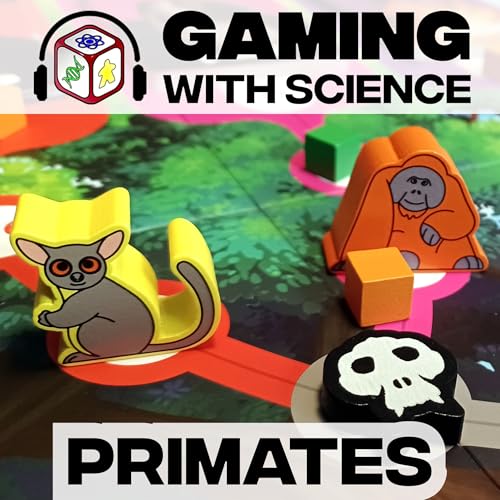
    #Primates #Evolution #GreenButteryflyGames #Conservation #BoardGames #Science Summary Happy 2026, everyone! To celebrate Darwin Day (February 12th), we have a special 90-minute episode with Will and David from the Common Descent Podcast to talk all about Primates! We'll cover the new game by Green Butterfly Games, all six clades of primates it showcases, and tons of other fun facts about us an our arboreal cousins, like how monkeys rafted from Africa to South America and why Aye-ayes are the best nose-pickers. So grab a banana, build a nest, and settle in for a lively discussion of Primates. Timestamps 00:00:00 - Intros00:02:07 - Dung Beetles and Human Endurance00:11:42 - Game Overview00:21:23 - Primate History00:33:00 - Different Primate Groups00:51:17 - Humans in the Game00:57:17 - Representation through Game Mechanics01:07:36 - Picking Nits01:13:09 - Final Grades01:21:55 - Wrap-up Links Primates (Green Butterfly Games)The Common Descent PodcastDung beetles evolving to eat meat (Science.org)Limits of human endurance (Nature.com)An aye-aye picking its nose (YouTube) When the Earth was Green, by Riley Black (Macmillan Publishers)Pitchstorm and Fate of the Nostromo (Board Game Geek) Find our socials at https://www.gamingwithscience.net This episode of Gaming with Science™ was produced with the help of the University of Georgia and is distributed under a Creative Commons Attribution-Noncommercial (CC BY-NC 4.0) license. Full Transcript (Some platforms truncate the transcript due to length restrictions. If so, you can always find the full transcript on https://www.gamingwithscience.net/ ) Jason Wallace 0:00 Brian, hello and welcome to the gaming with science podcast where we talk about the science behind some of your favorite games. Brian 0:12 Today, we're going to discuss primates by green butterfly games. Hey, welcome back to gaming with science. This is Brian. This is Jason. And wait, we've got some other people here. Brian 0:26 Will and David, you're back! Will 0:27 We're back. David 0:28 Can't get rid of us, Brian 0:30 no. Well, not that we would want to actually, this whole reason that this entire episode happened is actually your fault, so please explain yourself. David 0:38 Oh, that's true. We this game was sent to us. We were sent it as a gift from one of our listeners, yeah, oh, we should have, we should have looked up who it was that sent it to us. That would have been really good to get the name. Jason Wallace 0:48 Thank you, anonymous. Listener of another podcast, Brian 0:54 common descent. Listener, whoever you are, thank you and make yourself known. You guys got a game, and you said, Well, we know some people who want to play, who like to play science games, and you approached us, which is totally different, because that's not how this works around here. We usually have to chase people down. David 1:08 We got the gift. I think it, I think we received it shortly after the last time we recorded with you guys. Brian 1:15 Oh, wow. David 1:16 And it was a really cool because it's the it's a perfect game for your podcast? Brian 1:22 Absolutely. David 1:24 We thought it would be super fun, and so, yeah, it was one of the first things we did is we said, hey, do you guys want to play this you want to come back and play this game with us? Brian 1:31 Yep, and we did, and it was fun. And we even did it the weekend of the museum meetup at Fernbank, which, again, is going to date this episode, but whatever, that's fine. We're releasing this episode that will also be our episode that's closest to Darwin Day. So it's also a good game for Darwin Day. So I'm excited to talk about this game. It has a huge amount of science content, and I'm excited about the conversation we're going to get to have about primates and how they're weird. But before we get into that, why don't we do a little bit of science banter? Anything you guys would like to talk about? Will 1:58 One that's on my mind because I literally just finished taking notes on it for one of our news sections, which will come out before this. So it won't be, I won't be spoiling our news. There was a study on dung beetles that have evolved to be necrophageous. So eating dead bodies, Brian 2:16 Did they roll them up into little balls? Will 2:18 Yeah. And this is a thing that I was aware of. We talked about this in the decomposing episode, there are beetles that basically roll up a bit of a meatball and roll it away, bury it and let their young feet off of it, Brian 2:30 okay, Will 2:30 instead of dung, yeah, meatballs. Brian 2:33 That's a different meaning of meatball. Yep. Will 2:37 And there was, there's a group of dung beetles that have evolved to do this, and they studied it by finding those underground Brian 2:48 meat? Will 2:48 open like like like burrows that they used to there are Ichnofossils...
    Más Menos
    1 h y 27 m
  • S2E10.1 - John Coveyou (Interview)
    Dec 17 2025
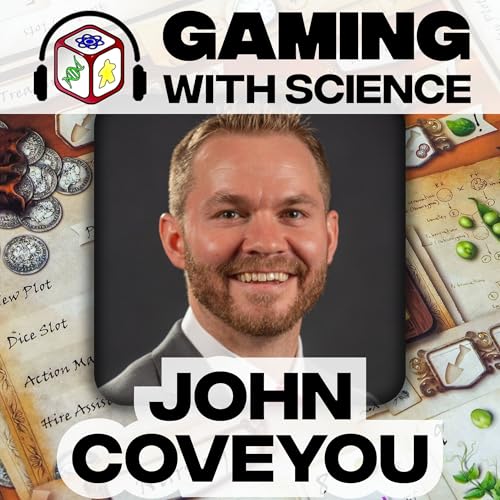
    #GeniusGames #STEMEducation #SciComm #JohnCoveyou #BoardGames #Science We've done several episodes on games from Genius Games (Cytosis, Periodic, Genotype), and now we get to speak to the man behind it all: John Coveyou, founder and CEO of Genius Games. John graciously sat down with us to talk about the beginning of Genius Games, the stigma of "educational" games, the challenges and joys of STEM game design, and some of his favorite non-Genius games to play. So sit back and enjoy this conversation with the man who makes our job easy, John Coveyou. Timestamps 00:00 Introductions01:55 History of John and Genius Games07:50 Designing Educational Games13:19 Balancing Fun and Realism20:54 Most Challenging Games to Design29:55 Upcoming Offerings36:36 Favorite (Non-Genius) Games38:23 Wrap-Up Links Genius Games website Find our socials at https://www.gamingwithscience.net This episode of Gaming with Science™ was produced with the help of the University of Georgia and is distributed under a Creative Commons Attribution-Noncommercial (CC BY-NC 4.0) license. Splash images courtesy of Genius Games. Full Transcript (Some platforms truncate the transcript due to length restrictions. If so, you can always find the full transcript on https://www.gamingwithscience.net/ ) Jason 0:00 Hello and welcome to the gaming with science podcast where we talk about the science behind some of your favorite games. Jason 0:07 Today we're talking with John Coveyou, CEO and founder of genius games. Brian 0:16 Hey everybody. Welcome to a creator interview. I'm Brian. Jason 0:19 This is Jason, Brian 0:20 and joining us is John Coveyou from genius games, John, can you introduce yourself? John 0:26 Sure, yeah, I'm the owner of genius games. I've owned it since about 2011 and we make science accurate board games and jigsaw puzzles for the hobby market. Brian 0:38 Those are very cool and very popular. I think I like the the frog. One in particular is very good. John 0:44 You dissect a frog in a lot of public school science classes, so we want to make sure we threw that one in there. Brian 0:49 I don't think I did a frog. Did you ever do a frog? John 0:52 I did. I think it was 10th grade biology. Jason 0:55 I don't remember if I ever dissected a frog. I did do a fetal pig. Brian 0:59 I remember we did a heart one time and that actually, like, screwed me up for a long time. John 1:03 Yeah, I don't want to know what this stuff looks like inside of my body. Let me just move on. Brian 1:10 Fair enough. We're really excited to be able to get you on to talk to us today. Our whole reason for existence is to talk about board games and science and genius games. As you can imagine, we have done many of your games before. We've done cytosis and periodic. We did genotype. We have more games planned in the future. We're going to be doing cellulose and probably whatever else comes down the pipe. Eventually. I'm sure we'll, we'll touch on most, if not all, of the games in the genius library. John 1:37 Well, that's great, because those are two of my favorite things, science and board gaming and both have, I mean, honestly, had a dramatic impact on my life in many ways. I mean, I run a company that combines those two, but the impact goes much deeper than that. So I'm very excited to talk about both of those things and how they came together. Could you Jason 1:55 give us a bit of your background there? Because this is not necessarily a logical place to end up. At the intersection of science and board game. Your company basically lives in the space of making what I call hard science games, games where they're not just inspired by science, but they try to portray it accurately and faithfully. What brought you to that place? John 2:13 Yeah, and you know, it's a long, windy story, but I will try and summarize it as quick as possible. I think when you see a lot of games out there in the marketplace and you see, you know, a science-based game or a STEM-based game, what you're looking at is a product someone wanted to create, to just generate money. I did not arrive at the place of creating a product. I arrived. I mean, I fell in love with the sciences, and also loved board gaming, and those two things kind of randomly came together. So a little bit about my background in the sciences. After high school, I joined the military. I was in the military for eight years total, but only three of it was on active duty. I spent about a year and a half in Iraq in Mosul and Samara. And while I was there, I was enrolled in some university classes, and one was a chemistry class. And reading through I had, I got a lot of time to read through that chemistry textbook, and some other textbooks I had chemistry and some in physics, I think I was taking at the same time, because of the the stressful environment that I was in studying sciences actually became very therapeutic for me, like ...
    Más Menos
    40 m
  • S2E10 - Nature (Evolution redux)
    Nov 26 2025
    #NatureGame #NorthStarGames #Evolution #Ecology #Predators #BoardGames #Science #SciComm Summary Welcome to Nature, the next evolution of Evolution! We're joined once again by Dr. Thiago Moreira to talk about this reimagining of a popular game, including covering a lot of evolutionary territory we couldn't last time. We'll talk about why everything isn't actually turning into crabs, why anteater-ification needs to be a word, how humans shape evolution from moths to elephants, what exactly a species is and where they come from, and why there's no such thing as "more evolved" creatures, (at least among anything still alive). Timestamps 00:00 Introductions02:14 Better DNA preservation05:00 Bird-hunting tortoise06:54 Basics of Nature16:23 Evolution in a nutshell18:30 Convergent evolution27:42 Human-induced evolution34:22 Species and speciation40:52 Evolution toward simplicity45:49 Final grades Links Nature Web Site (North Star Games) Preserving DNA with EDTA (Phys.org) Video of tortoise hunting a bird (YouTube) Find our socials at https://www.gamingwithscience.net This episode of Gaming with Science™ was produced with the help of the University of Georgia and is distributed under a Creative Commons Attribution-Noncommercial (CC BY-NC 4.0) license. Full Transcript (Some platforms truncate the transcript due to length restrictions. If so, you can always find the full transcript on https://www.gamingwithscience.net/ ) Brian 0:06 Hello and welcome to the gaming with science podcast where we talk about science behind some of your favorite games. Jason 0:10 Today, we will be talking about nature by North Star games. Hey everyone, welcome back. This is Jason. Brian 0:18 This is Brian. Thiago 0:19 I'm Thiago Jason 0:20 again, Thiago, so y'all may remember Tiago Moreira from our episode on evolution back in season one. He is back with us today to talk about nature, which is the next evolution of evolution. So Thiago, can you give our listeners a quick refresh on who you are and what your background is? Thiago 0:38 Hi, of course. My name is Thiago Moreira, I'm a assistant professor of honors and biology at George Washington University in Washington, DC. I do have a background in zoology, and my PhD was in evolutionary biology, and my object of studies are spiders. Brian 0:54 So Tiago has the questionable honor of being our first returning guest. Jason 1:00 All right, we're going to assume that is a high honor. Thiago 1:03 I consider an honor. Jason 1:05 And Tiago, I don't know if we asked you this the first time, but we're making it a habit to ask our guests what their favorite game is. What's your favorite game? Thiago 1:13 Tabletop game? Jason 1:14 Sure. Brian 1:14 Well, I mean, it doesn't have to be. Thiago 1:17 I get into the habit of like playing tabletop games, like board games later. So like, as a gamer, my favorite was always role playing games. And I'm from Brazil, and in Brazil at the time that I was a kid, we didn't have DND officially there, so we have others. So like, I play some very old school ones, but I guess the one that marked my teenage years and young adult years more was like Vampire the Masquerade. Jason 1:43 Oh, okay, I never played that one, but I did play several other of white wolf's Orpheus is my personal favorite. Thiago 1:49 Okay, Brian 1:50 so you were sort of in the sort of 90s renaissance of indie tabletop roleplay Thiago 1:54 kind of, yeah. Jason 1:56 So did you like, have cape and fangs and all that sort of stuff? Thiago 2:01 I never do the the live action was, it's always tabletop, like, always rolling dice and like, that's it. Brian 2:07 That seems like a shame, Tiago, because I think you'd make a pretty good vampire. Thiago 2:12 I tried once. Didn't work. Brian 2:13 Okay, Jason 2:14 well, let's move on to our fun science fact. Tiago, as our guest, you get to go first. What do you have for us from the world of science. Thiago 2:21 So I got this news the other day, like and like something that is probably going to be very influential in what I do. I'm a systematic person, so I do work with systematics, trying to uncover the tree of life. And we use a lot of molecular data. And this was this news from, apparently, people in Northwestern University, they found something that actually preserves DNA better than actually what we use currently, which is ethanol. So apparently when they use EDTA, which is a food preserver, it actually preserved the DNA samples more efficiently than actually ethanol, Brian 2:57 just like a suspension, like a solution of EDTA? Thiago 3:00 Yeah, they made a kind of solution to it. And actually, they found this by accident, apparently. So they just got a sample that fell in there, like, and apparently it works. Apparently it says here that, like, they got some samples from fish in ddta, ...
    Más Menos
    50 m
  • S2E09 - Periodic (the Periodic Table)
    Oct 29 2025
    #Periodic #GeniusGames #Chemistry #PeriodicTable #Atoms #Elements #STEM #BoardGames #Science #SciComm Summary In this episode we get elemental for the game Periodic, with the amazing Dr. Raychelle Burks as our special guest. We talk about why the table is arranged like it is, why some elements are weird, what the groupings mean, why we should love *all* subatomic particles, how isotopes help solve crimes, and how some people get viscious when playing Monopoly. So grab some dihydrogen monoxide and join us for Periodic, by Genius Games. Timestamps 00:00 - Introductions02:52 - Molybdenum poisoning & glowing plants12:39 - Basics of Periodic19:14 - What is the Periodic Table?32:35 - Why are some elements weird?39:53 - Not just electrons55:16 - Nitpick corner1:00:37 - Final grades Links Periodic official site (Genius Games)Cattle molybdenum poisoning (Australian Veterinary Journal)Glowing succulents (Matter) Glowing rubidium (Youtube; Royal Society of Chemistry)NIST periodic table Dr. Raychelle Burk on Tiktok, and her Trace Analysis column Find our socials at https://www.gamingwithscience.net This episode of Gaming with Science™ was produced with the help of the University of Georgia and is distributed under a Creative Commons Attribution-Noncommercial (CC BY-NC 4.0) license. Full Transcript (Some platforms truncate the transcript due to length restrictions. If so, you can always find the full transcript on https://www.gamingwithscience.net/ ) Jason 0:00 Jason, hello Jason 0:06 and welcome to the gaming with Science Podcast, where we talk about the science behind some of your favorite games. Brian 0:12 Today, we're talking about periodic by genius games. Hello. Welcome back to gaming with science. This is Brian Jason 0:20 this is Jason Brian 0:21 and we are joined by Dr Raychelle Burks, Raychelle, could you introduce yourself please? Raychelle 0:26 Yes, I am Raychelle Burks, I am a chemist and a forensic scientist. Brian 0:32 Well, I'm so glad you're able to join us today. We were just talking about, let's see you said that your Instagram handle is radium, yttrium, and you'rr Dr. rubidium. And this is game is all about the periodic table. You use three different elements in your sort of social or media, like internet handles. So I think we got the right person for this. Raychelle 0:51 I hope so. Jason 0:52 And just to give a bit more information to our listeners, you said you're at American University in Washington, DC, right? Raychelle 0:57 Yes, the and actually, it's funny, because it's like, it is American University. What a wild name for a school. We have a lot of universities, but it is one that's kind of got a congressional mandate. There was, you know, back in the day, they were like, we are going to have the American University. And it's like, it didn't quite work out, Brian 1:16 but that's interesting. So you said there's a congressional mandate. So this is kind of like, we're at the University of Georgia. We're a land grant institution, so we sort of have this mission that the university is supposed to satisfy you. You are in a similar situation. Raychelle 1:29 It's, well, it's weird, you know, I went to a land grant institution, so I'm a proud corn Husker. That's where I got my PhD. So University of Nebraska at Lincoln and so land grant institutions, definitely a bit different, right? Because you're taxpayer money, there's some property involved, and you have a mandate, you have an extension office. I believe you have a fantastic extension office. I think all state residents you know, have the ability to have, like, a library card and come to a university event, like there's a real community kind of based thing. And in a way, American actually also has that many universities do, especially for the neighborhood they're in. But American University is actually chartered by Congress, like, way back in the day, I think it's 1893 is this a pop quiz now? But so it's, it's an interesting history that that kind of comes about. Brian 2:25 Well, very cool. Let's see. So, so we're here to talk about the game periodic by genius games. This is another in our genius games roster, which I figure eventually we'll be working our way through all of the genius games games at some point or another. But this is our second chemistry game. So we're excited to talk about it, but really, this game is about the periodic table specifically, which is very cool, and I definitely have questions, so I'm excited to have somebody here to to give answers. But why don't we start with our science banter topic? So what have we learned or found studies something interesting in the world of science today. So we usually let our guests go first if they've got something, if not, Jason has something queued up Raychelle 3:08 well, as a forensic scientist, I will say I spent a lot of time kind of in crime. I mean, hey, Okay, Brian 3:17 makes sense. ...
    Más Menos
    1 h y 8 m
  • S2E08 - Daybreak (Climate Change)
    Sep 24 2025
    #Daybreak #CMYKGames #Climatechange #ClimateScience #BoardGames #ScienceCommunication #SciComm Things are warming up in this episode as we talk with Dr. Jacquelyn Gill about Daybreak, a cooperative game about combatting climate change while keeping society intact. We cover tipping points, carbon drawdown, ocean acidification, the clean energy transition, what fossil fuels actually are, and some actually good news about climate change. Timestamps 00:00 - Introductions01:31 - Baby pterosaurs and frog saunas06:11 - Playing Daybreak22:53 - Designer choices27:50 - Sense of urgency32:45 - Tipping points40:44 - Ocean acidification47:05 - Clean energy as the focus52:53 - RCP and climate projections58:50 - What are fossil fuels?1:02:00 - Niggling nitpicks1:07:12 - Final grades Links Daybreak Official Site (CYMK Games) Designer diary FSC Certification (sustainable components)Matteo Menapace site Warm Regards (Jacquelyn's podcast) Find our socials at https://www.gamingwithscience.net This episode of Gaming with Science™ was produced with the help of the University of Georgia and is distributed under a Creative Commons Attribution-Noncommercial (CC BY-NC 4.0) license. Full Transcript (Some platforms truncate the transcript due to length restrictions. If so, you can always find the full transcript on https://www.gamingwithscience.net/ ) Jason 0:06 Hello and welcome to the gaming with Science Podcast, where we talk about the science behind some of your favorite games. Brian 0:11 Today, we're going to discuss Daybreak by CMYK. Welcome back to gaming with science. This is Brian. Jason 0:20 This is Jason Brian 0:21 and we're joined today by a special guest, Jacquelyn Gill. Jacquelyn, can you please introduce yourself? Jacquelyn 0:26 Hi, I'm Jacquelyn. I'm a paleoecologist from the University of Maine, and I am also a science communicator, and I focus on climate change. Brian 0:34 That's cool. And then you also said that you are, in fact, a board gamer yourself. What games do you enjoy playing? Jacquelyn 0:41 Oh gosh, I have been a gamer of many stripes for a long time, everything from video games to tabletop RPGs to board games. And these days, I've been getting really into two player games because we haven't really found our gaming community. So I get really excited when I have a new two player game, and I think my husband's just going to be really excited to play daybreak, because we've been playing a lot of twilight struggle, which is a cold war game where one of you plays the Soviet Union and the other plays the United States. Brian 1:14 Oh, man. Jacquelyn 1:14 And you know, that's starting to feel a little too close to home these days. So yeah, and it also takes a million years to get through. Brian 1:21 Well, I don't think this game takes a million years to get through, but I would say that this is not a light game either from that perspective. But you know, you can when you win. Man, does it feel good, though. Before we get into the game, we'll do our science banter, some kind of story or topic or something from the world of science that we want to discuss. We usually let the guest host go first. Jacquelyn, do you have something you like to share? Jacquelyn 1:42 I do. And, you know, the folks might have seen those T shirts or mugs that have a dinosaur on them that say all my friends are dead. As a paleoecologist, I feel this, you know, this is my life. So this is not a this is not a happy story. You know, when we talk about a highly productive fossil site, we're talking about a death trap. So, I mean, on September 5, there was this really cool study that came out in the journal Current Biology, and it's all about baby pterosaurs. So these were these, yeah, these Brian 2:13 dead baby pterosaurs. Jacquelyn 2:14 Dead baby pterosaurs. I know, and we know. So the fossils themselves are, I would classify them as cute. They're pretty small and but it turns out that this, this particular location, does have a tendency to have a lot of young pterosaurs in it. The fossils that are kind of coming out of this location tend to be on the young side, and these particular baby pterosaurs had evidence in their bones of there's like twisting and breakages, and it's thought that they were basically killed in a severe windstorm. And and pterosaur fossils in general are very rare because they have really fragile bones, and so the fact that we have juveniles with direct evidence of trauma is pretty unique and exciting. These kinds of fossils for from animals from a young age help us to understand more about the biomechanics or the ability of these animals to fly. But also, there are of the hundreds of pterosaur fossils that have been found, A lot of them are very small and very young, and it just suggests that, you know, this was a really rough life for these animals to be flyers when the when the storms were, you know, maybe even more intense than...
    Más Menos
    1 h y 15 m