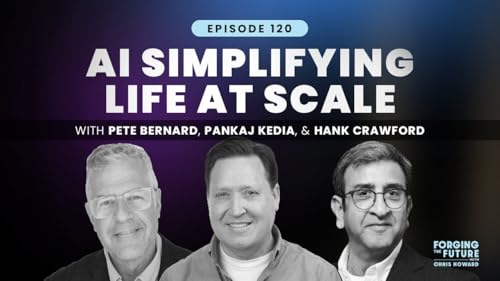
Forging The Future with Chris Howard Podcast Por Chris Howard arte de portada

Forging The Future with Chris Howard

Forging The Future with Chris Howard

De: Chris Howard
Escúchala gratis

Join Chris Howard, Founder and CEO of Softeq, as he interviews knowledgeable leaders in the innovation spectrum, including CEOs, CTOs, R&D professionals, and start-up founders. Real conversations, technology, and processes of bringing new ideas to market.© 2022 All rights reserved. "Forging the Future" podcast, content, title, and logo owned by Softeq. Unauthorized use prohibited. Contact: ftf@speakerboxmedia.com. Respect our creativity. Economía
Episodios
  • AI Beyond Chatbots: 3 Experts on Edge, Robotics, and Real Impact
    Feb 19 2026
    This special CES 2026 episode brings together Pete Bernard (EDGE AI FOUNDATION), Pankaj Kedia (2468 Ventures), and Hank Crawford (Blue Collar Robotics) to explore how AI is moving from theory into everyday use. From cameraless sensing to edge-powered devices that listen, measure, and respond in real time, it’s clear that AI is becoming embedded in our everyday lives. Pete, Pankaj, and Hank all share one common goal: to have AI to solve real problems and simplify life at scale. For Pete, that means building collaborative edge AI ecosystems that work reliably outside the cloud. For Pankaj, it’s unlocking applied AI that delivers real ROI in the healthcare, education, and automotive industries. And for Hank, it’s rethinking grocery shopping by using virtually controlled robotics to tackle labor shortages without replacing people. The future of AI isn’t abstract or far off, it’s already at work in the real world. 🎧 Episode Highlights ● [01:15] Why Edge AI is bigger than TinyML and how physical, generative, and agentic AI are converging ● [04:36] Cameraless AI: using signals and radio waves to sense environments without cameras ● [16:52] Why AI shouldn’t just match human performance but exceed it in safety-critical systems like self-driving and robotics ● [27:47] Applied AI as the real ROI driver across healthcare, education, and mobility ●[39:38] How human-in-the-loop robotics for grocery fulfillment provides global labor opportunities 🔑 Key Takeaways: ● The most impactful AI isn’t happening in massive data centers, it’s happening where systems can sense, interpret, and act in real time. From cameraless perception to signal-based sensing, edge AI enables intelligence in environments where latency, privacy, and connectivity matter most. ● AI must outperform humans in safety-critical systems to matter. Matching human performance isn’t enough when lives, health, or infrastructure are at stake. Whether in autonomous driving, healthcare triage, or robotics, the bar for AI is being meaningfully safer, more consistent, and more reliable than human decision-making. ● The most scalable AI systems don’t replace people, they amplify them. Human-in-the-loop robotics and applied AI models solve labor shortages, unlock global talent, and improve productivity while preserving human judgment, accountability, and trust. 👤 Guest Spotlight: Pete Bernard Pete Bernard is Executive Director of the EDGE AI FOUNDATION, advancing the development and adoption of edge AI across industries. With a background in embedded systems and machine learning, he focuses on building collaborative ecosystems that bring physical, generative, and agentic AI out of the cloud and into real-world deployment. He is known for translating complex technical shifts into practical frameworks that enable reliable, scalable AI at the edge. Pankaj Kedia Pankaj Kedia is Managing Partner at 2468 Ventures, investing in AI, robotics, autonomy, and applied technology. He backs companies delivering measurable ROI across healthcare, education, mobility, and industrial sectors, with a focus on systems that outperform humans in safety-critical and high-impact environments. Hank Crawford Hank Crawford is Founder of Blue Collar Robotics, developing human-in-the-loop robotic systems to address labor shortages. His work centers on remotely operated, task-specific robots that augment workers, beginning with grocery fulfillment and expanding into broader physical industries. Connect with Pete: Pete Bernard Connect with Pankaj: Pankaj Kedia Connect with Hank: Hank Crawford Connect with Chris: Chris Howard Explore past episodes: ftf.show Learn about Softeq: softeq.com Stay inspired and ahead of the curve by subscribing to Forging the Future. Share your thoughts on this episode with the hashtag #ForgingTheFuture or tag us online!
    Más Menos
    1 h y 3 m
  • Is The Smart Home Getting an Upgrade? Inside Amazon’s Push Toward Agentic AI
    Feb 16 2026
    At CES 2026 in Las Vegas, Olivier Bernard of Amazon sits down with Chris to talk about how IoT has evolved from simple device connectivity into intelligent tools, essentially becoming our “second brains.” He breaks down why many companies walked away from the IoT space, pointing to thin margins and limited standalone value, while Amazon found success by embedding IoT into a broader cloud ecosystem that includes data storage, machine learning, and agentic AI. Olivier shares his vision of the “invisible home,” where AI-powered devices configure, automate, and optimize how we live. In the end, he explains how the convergence of IoT and agentic AI turns dormant device data into actionable insights, delivering real ROI for both consumers and enterprises. 🎧 Episode Highlights ● [01:25]: Olivier Bernard introduces AWS IoT and smart home ecosystem ● [04:00]: Why many companies exited the IoT market and how Amazon survived ● [9:59]: The plateau of smart devices becoming a plug-and-play feature for homes ● [13:55]: The future of the “invisible home” and automated routines ● [32:36]: AWS re:Invent: Announcing new smart and generative AI devices 🔑 Key Takeaways: ● IoT only matters when it’s connected to outcomes. On its own, device connectivity produces cost and complexity, not value. When paired with AI and cloud infrastructure, IoT data becomes usable intelligence, driving better product decisions, operational efficiency, and customer experience. ● Agentic AI is the turning point for smart homes. Moving away from manual setup and rigid commands toward systems that understand context and adjust on their own removes the friction that held smart homes back. This kind of “invisible” automation is what finally makes smart homes accessible to everyone, not just early adopters. ● The real opportunity is distributed intelligence with measurable ROI. Placing AI across devices, edge, and cloud, while respecting latency, privacy, and trust, turns AI from experimentation into a durable business capability that scales across consumer and enterprise use cases. 👤 Guest Spotlight: Olivier Bernard Olivier Bernard is the Worldwide Go-To-Market Lead for AWS IoT Services at Amazon, where he connects customer needs, technology opportunity, and business strategy across the global IoT and edge ecosystem. He brings deep experience executing at scale across IoT, M2M, automotive, and connected-device platforms. Bernard blends engineering discipline with business leadership to turn emerging technologies into practical applications that open new markets and deliver measurable impact. Connect with Oliver: ⁠www.linkedin.com/in/ojbernard⁠ Connect with Chris: ⁠www.linkedin.com/in/techris⁠ Explore past episodes: ⁠Forging the Future Episodes⁠ Learn about Softeq: ⁠softeq.com Stay inspired and ahead of the curve by subscribing to Forging the Future. Share your thoughts on this episode with the hashtag #ForgingTheFuture or tag us online!
    Más Menos
    32 m
  • 90% of Startups Fail… Hello Alice Aims to Help Startups Survive and Thrive
    May 22 2025
    90% of startups fail. Not from lack of ideas, but lack of funding for small businesses. Access to capital can make or break success, yet traditional funding still favors the few. What if technology could level the playing field, giving every entrepreneur a fair shot at business readiness? Kelsey Ruger, Chief Product & Technology Officer, helped build Hello Alice, a free online platform that helps businesses launch and grow, to remove barriers and give small businesses the tools they need to not only survive, but thrive. 🎧 Episode Highlights [00:00] Podcast Begins [01:58] Struggles of a Small Business: Breaking down barriers to startup success [07:26] Evolution of Business Readiness: Scaling business advising with AI expertise [11:10] What About Data? How Hello Alice improves with business health data [17:31] Lessons Learned in Scaling: Prioritizing the leadership gap in startups [19:35] What’s Next for Hello Alice? Refining AI & understanding customer needs 🔑 Key Takeaways All About Access: “It became very clear that access to funding really is about access to the entire network of things that you need as an entrepreneur.” Kelsey doesn’t shy away from the harsh reality of business and the barriers that keep entrepreneurs struggling; access to capital and lack of network support halts businesses in their tracks. Approaching the Leadership Gap: “The main thing you need as a business owner is good leadership skill, because so much of it is influencing other people.” As Hello Alice has scaled, Kelsey has realized that capital access is one barrier, while strong leadership and culture is another barrier impacting small businesses. AI Advice for Automated Tasks: “Honestly, my advice to our small business owners is to become really comfortable with AI because when you look at most of the time we spend in business, a lot of it could be automated.” When looking towards what’s next, Kelsey says Hello Alice will be refining AI tools to address increasing customer needs. 👤 Guest Spotlight Kelsey Ruger: Kelsey Ruger designs better businesses and experiences at the intersection of product, technology, marketing, and leadership. As Chief Product and Technology Officer at Hello Alice, Kelsey leads initiatives that connect small businesses with capital and opportunities, serving over 1.5 million entrepreneurs through our Business Health Engine and community platform. Kelsey’s approach combines human-centered design with strategic thinking to create solutions that work for real people. This has shaped successful products and programs at Hello Alice, where they're focused on equitable access to capital and resources for diverse entrepreneurs. Connect with Kelsey: LinkedIn: Kelsey Ruger Websites: Hello Alice | helloalice.com 🌟 Resources & Links Explore past episodes: Forging the Future Episodes Learn about Softeq: softeq.com Stay inspired and ahead of the curve by subscribing to Forging the Future. Share your thoughts on this episode with the hashtag #ForgingTheFuture or tag us online!
    Más Menos
    24 m
Todavía no hay opiniones