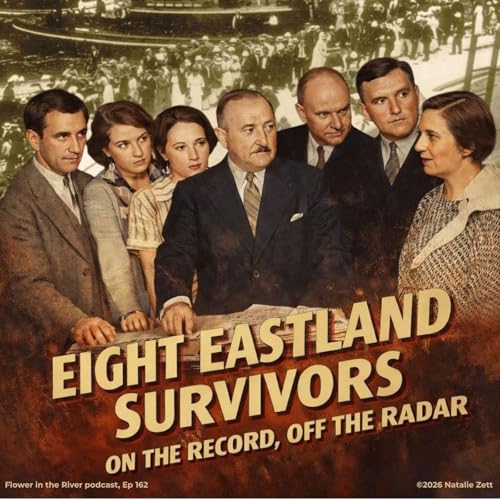
Flower in the River: A Family Tale Finally Told Podcast Por Natalie Zett arte de portada

Flower in the River: A Family Tale Finally Told

Flower in the River: A Family Tale Finally Told

De: Natalie Zett
Escúchala gratis

"Flower in the River" podcast, inspired by my book of the same name, explores the 1915 Eastland Disaster in Chicago and its enduring impact, particularly on my family's history. We'll explore the intertwining narratives of others impacted by this tragedy as well, and we'll dive into writing and genealogy and uncover the surprising supernatural elements that surface in family history research. Come along with me on this journey of discovery.

© 2026 Flower in the River: A Family Tale Finally Told
Espiritualidad Mundial
Episodios
  • Eight Eastland Survivors—On the Record, Off the Radar
    Apr 15 2026

    Send us Fan Mail

    A faded, barely readable newspaper scan kept the Eastland Disaster survivor stories tucked away for decades, hiding them in plain sight. When a clearer copy finally surfaced, it was like prying open a sealed time capsule. We dive into two interviews from 1935, marking twenty years since the SS Eastland tragedy in Chicago. What leaps from the page is vivid and unfiltered: a heated argument at the gangplank, the sharpest screams, the moment the deck lurches, and the heart-stopping decisions that separate survival from loss.

    We immerse ourselves in the voices of Western Electric workers and passengers—Rose Smoller, Walter H. Flinn, Lisle (Lysle) Goyette, Ethel Stephenson, Jennie Turbov, William Kaunt, Frank Terdina, and Charles Borovansky. Their memories shrink the disaster to the scale of white-knuckled hands clutching rails, bodies squeezing through cabin windows, and floating debris that transforms into lifelines. The trauma lingers, echoing for decades as nightmares and a lasting fear of water. The Berwyn Life account adds unforgettable color: Terdina pausing at the edge, reluctant to ruin his new suit, only to be ensnared by ropes underwater as the Eastland crashes down.

    Then we pause to face a sobering truth about the Eastland Disaster’s history: so many names have faded from the digital record, or appear without stories or sources, making them nearly impossible to trace. We share what we’ve uncovered, what still slips through our fingers, and how this podcast is becoming a living archive for the Eastland’s forgotten voices. If the Eastland Disaster, Chicago history, survivor stories, or the craft of family storytelling resonate with you, subscribe, share this episode, and leave a review to help keep these memories alive.

    Resources:

    • “The Eastland Disaster—20 Years Ago Next Wednesday: Survivors Recall the Deeds of Heroism,” by Joseph J. Dugan, Chicago Tribune (Chicago, Illinois), July 21, 1935, p. 3.
    • “Recount Harrowing Scenes: Twenty Years Ago Today-Horror of Eastland Disaster, Berwyn Life (Berwyn, Illinois), July 24, 1935, p. 1
    • Book website: https://www.flowerintheriver.com/
    • Substack: https://nataliezett.substack.com/
    • LinkedIn: https://www.linkedin.com/in/natalie-z-87092b15/
    • Instagram: https://www.instagram.com/zettnatalie/
    • YouTube: Flower in the River - A Family Tale Finally Told - YouTube
    • Medium: Natalie Zett – Medium
    • The opening/closing song is Twilight by 8opus
    • Other music. Artlist
    Más Menos
    30 m
  • The Ship That Rolled, the Stories That Didn't: More Voices from the Eastland
    Apr 9 2026

    Send us Fan Mail

    We explore three gripping firsthand accounts from eyewitnesses to the Eastland disaster, shared with the Dubuque Telegraph-Herald on July 26, 1915 — just two days after the tragedy. These accounts appeared once in print and then vanished from public memory for over a century.

    One witness represented an early film company, another worked for a garment company, and the third was employed by a lumber, sash, and door dealer. Three people from very different worlds who happened to be in Chicago on that fateful morning.

    Their words paint scenes of frantic rescue, packed bridges, and tense moments on the riverbank — revealing how trauma ripples outward, touching even those who had "no friend or relative in the catastrophe." Some accounts are graphic, and we want to be upfront about that. Yet to truly preserve history, we share these raw, lived experiences.

    I also explore why the roster of names and stories continues to grow. Now at 176 and counting, these are voices that have slipped through the cracks of modern retellings — and restoring them matters for public memory, genealogy, and family history. When we welcome these forgotten witnesses back, the Eastland disaster transforms from a distant headline into a shared story of lives forever altered in a single Chicago morning.

    One witness's connection to the United Photo Plays Company opened an unexpected window into Chicago's thriving early film scene. We explore the city's remarkably active studios, the impact of World War I on American filmmaking, and a question that lingers: Could this connection mean there are hidden photos or footage of the Eastland disaster still waiting to be found?

    Resources:

    • Encyclopedia of Chicago
    • Encyclopedia Dubuque
    • “Vivid Picture of Eastland Tragedy,” Dubuque Telegraph-Herald (Dubuque, Iowa), 26 July 1915.

    Additional Music:

    License: Title Kevin MacLeod (incompetech.com) Licensed under Creative Commons: By Attribution 4.0 https://creativecommons.org/licenses/by/4.0/

    • Book website: https://www.flowerintheriver.com/
    • Substack: https://nataliezett.substack.com/
    • LinkedIn: https://www.linkedin.com/in/natalie-z-87092b15/
    • Instagram: https://www.instagram.com/zettnatalie/
    • YouTube: Flower in the River - A Family Tale Finally Told - YouTube
    • Medium: Natalie Zett – Medium
    • The opening/closing song is Twilight by 8opus
    • Other music. Artlist
    Más Menos
    28 m
  • The Return of the Omitted: History Strikes Back!
    Apr 2 2026

    Send us Fan Mail

    History sometimes fades not from lack of evidence, but because the path connecting the pieces is broken. The Eastland disaster records are overflowing with accessible online material, yet large parts of this story have drifted out of modern retellings. I’ll share a research discovery that changed my entire plan for this week.

    I’ll take you inside the system I improvised to untangle the patterns that kept repeating before my eyes. Together, we’ll confront the problem of “thin” profiles that reduce real lives to mere names, and the Franken-article phenomenon, where pieces of biographical details are stitched together without verifiable sources. I’ll show how citations are not just technicalities, but the lifeblood of trust in history and genealogy. When citations vanish, so do the original voices behind every record, making it nearly impossible to advance the research. Then there’s the photo problem: images of Eastland victims and survivors circulate without credit, breeding mislabels and confusion.
    Then comes the most startling revelation: the people left out. By digging through sources like Chronicling America, FamilySearch, Google Books, and HathiTrust, so far, I have uncovered 158 witnesses, survivors, victims, journalists, photographers, and others who appear in original accounts but are missing from online platforms.
    This discovery raises a thorny question: how do we count the victims of major disasters—especially when the event took place over 100 years ago? At the very least, it should be a multidisciplinary conversation that includes historians specializing in labor, immigration, and maritime history, credentialed genealogists who know how to follow an evidentiary trail, and medical historians who understand trauma and delayed mortality. This responsibility should not rest with a single individual or organization. To illustrate this, I end with the story of Hancock Harmon, a first responder whose bravery was once celebrated, whose later illness was tied to the disaster, and whose name faded from history—until now.

    If you are interested in Chicago history, storytelling, and genealogy, tune in to this episode.

    Resources:

    • Buried by Omission: The Eastland Victim Who Disappeared
    • Survived But Not Saved: The Lingering Legacy of the Eastland Disaster
    • Additional Music: Kevin MacLeod (incompetech.com)
      Licensed under Creative Commons: By Attribution 4.0
      https://creativecommons.org/licenses/by/4.0/
    • Book website: https://www.flowerintheriver.com/
    • Substack: https://nataliezett.substack.com/
    • LinkedIn: https://www.linkedin.com/in/natalie-z-87092b15/
    • Instagram: https://www.instagram.com/zettnatalie/
    • YouTube: Flower in the River - A Family Tale Finally Told - YouTube
    • Medium: Natalie Zett – Medium
    • The opening/closing song is Twilight by 8opus
    • Other music. Artlist
    Más Menos
    34 m
Todavía no hay opiniones