Episodios

  • Casella Waste Systems: Waste. Recycling. Resource Empire of the Northeast.- $CWST
    Feb 1 2026

    From a single pickup in Rutland in 1975 to a multi-billion-dollar public company, this article traces how Casella Waste Systems survived a debt-fueled roll-up era and near-collapse to reinvent itself as the dominant waste and resource manager in the Northeast—leveraging scarce permitted landfill capacity, disciplined M&A, pricing power, and new revenue streams like renewable natural gas; it profiles the brothers’ blue-collar origins, the brutal lessons of the 2000s, the strategic pivot under CFO-turned-CEO Ned Coletta, and both the compelling upside (scarcity-driven margins and consolidation) and real risks (PFAS liabilities, valuation, labor, and integration). If you want a vivid business case study about how regional focus and owning the “hole in the ground” can create a durable moat—and why Casella’s next chapter matters—this one is for you!


    --

    Subscribe to our newsletter on LinkedIn https://www.linkedin.com/build-relation/newsletter-follow?entityUrn=7408775804387491842


    Follow us on X @emportop

    --


    Transcript https://empor.top/us/CWST


    • Introduction: The "Gold" in the Green Mountains
    • Origins: The Hustle & The Brothers (1975–1993)
    • The IPO and The "Wild West" Roll-Up Era (1997–2008)
    • The Turn: Crisis, Activism, and the Strategic Pivot (2015–2019)
    • The Moat: Why the Northeast is Different
    • Modern Era: Acquisitions & The Return to Growth (2020–Present)
    • Analysis: The Playbook & Powers
    • Leadership Transition: The Coletta Era Begins
    • Bear vs. Bull: The Risks and Opportunities
    • Key Metrics to Watch
    • Conclusion: Regional Dominance vs. National Mediocrity
    Más Menos
    45 m
  • Carter's: From Gold Rush Baby Clothes to America's Childrenswear Empire - $CRI
    Jan 31 2026

    From a Civil War–era knitting operation to a $2.8 billion childrenswear powerhouse, Carter’s is the surprisingly dramatic story of an unglamorous brand that became America’s default for baby clothes—surviving depressions, wars, near-bankruptcy in 2001, a private-equity rescue and reinvention, and the seismic shift to digital and Amazon-era retail. The company’s resilience rests on hard-earned trust—“baby’s first outfit” and multi-generational loyalty—plus a disciplined supply chain and an omnichannel play that balanced wholesale partners with growing direct-to-consumer capabilities; yet today it wrestles with structural headwinds like low fertility, fierce price competition, tariff-driven cost shocks, and the need to modernize its brand under new leadership. This story traces that long arc—founding, collapse, Berkshire Partners’ surgical turnaround, the OshKosh acquisition, the COVID-era acceleration to e-commerce, and the hard choices ahead—offering a compact case study in how legacy consumer brands survive (or fail) in a ruthless retail landscape.


    ---

    Subscribe to our newsletter on LinkedIn https://www.linkedin.com/build-relation/newsletter-follow?entityUrn=7408775804387491842


    Follow us on X @emportop


    Transcript https://empor.top/us/CRI


    • I. Introduction & Episode Roadmap
    • II. The Gold Rush Origins & Early Foundation (1865–1920s)
    • III. The Golden Age: Building Brand Equity (1930s–1980s)
    • IV. The Near-Death Experience: Bankruptcy and Decline (1980s–2000)
    • V. The Berkshire Partners Transformation (2001–2011)
    • VI. The Public Company Era: Scaling and Optimization (2011–2015)
    • VII. The Amazon + COVID Crucible (2016–2020)
    • VIII. The Modern Carter's: Digital, DTC, and the Next Chapter (2021–Present)
    • IX. The Business Model & What Makes Carter's Special
    • X. Strategic Frameworks: Porter's 5 Forces & Hamilton's 7 Powers
    • XI. Bull vs. Bear Case & Future Outlook
    • XII. Epilogue & Final Reflections
    • XIII. Further Reading & Resources
    Más Menos
    55 m
  • Badger Meter - The "Intel" of the Water Grid - $BMI
    Jan 30 2026

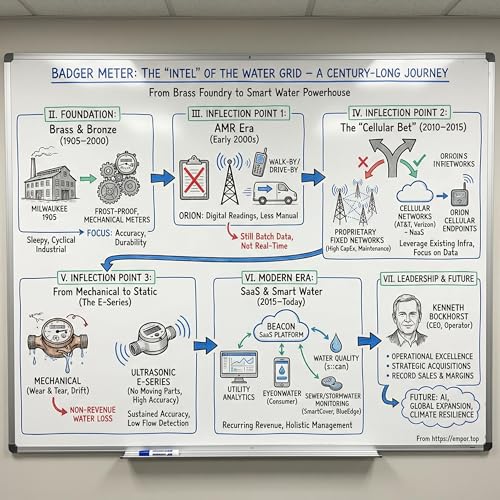
    Badger Meter’s unlikely rise from a 1905 Milwaukee foundry to a modern “intel” for the water grid is a compelling study in quiet reinvention: by moving beyond brass meters to build ORION AMR/AMI systems, betting on cellular networks instead of proprietary radios, launching ultrasonic E‑Series meters, and layering BEACON SaaS and targeted acquisitions. Under the BlueEdge platform, the company has turned measurement into recurring software-led value for utilities wrestling with leaks, aging pipes, and water scarcity. Under CEO Kenneth Bockhorst’s operational discipline, Badger has grown revenue and margins while creating strong switching costs tied to its huge install base—yet it still faces risks from municipal budget cycles, tariffs, and technology shifts. Whether you’re intrigued by a century-old maker becoming a digital compounder or want to weigh the bull and bear cases for an essential-infrastructure play, this story traces the strategic bets, product pivots, and market dynamics that turned a “boring” utility vendor into a smart water leader

    --

    Subscribe to our newsletter on LinkedIn https://www.linkedin.com/build-relation/newsletter-follow?entityUrn=7408775804387491842

    Follow us on X @emportop


    Transcript https://empor.top/us/BMI


    • I. Introduction: The Quiet Compounder
    • II. The "Brass & Bronze" Era: A Century of Flow (1905–2000)
    • III. Inflection Point 1: No More Clipboards (The AMR Era)
    • IV. Inflection Point 2: The "Cellular Bet" (2010–2015)
    • V. Inflection Point 3: From Mechanical to Static (The E-Series)
    • VI. The Modern Era: SaaS and "Smart Water" (2015–Today)
    • VII. Leadership: Kenneth Bockhorst and Operational Excellence
    • VIII. The Playbook: Lessons for Builders and Investors
    • IX. Analysis: Powers, Forces, and Competitive Dynamics
    • X. Bear vs. Bull: The Investment Thesis
    • XI. Key Performance Indicators for Tracking
    • XII. Conclusion: The Quiet Revolution
    • XIII. Carve Outs
    Más Menos
    45 m
  • Rent-A-Center: From Furniture Rental to Fintech Phoenix - $UPBD
    Jan 29 2026

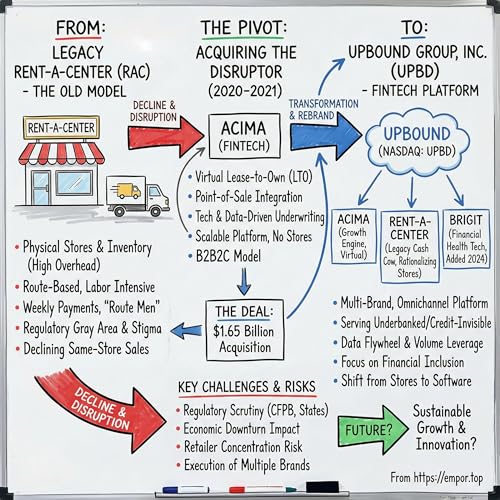
    What began as a surprising December 2020 gambit—Rent‑A‑Center buying fast‑growing fintech Acima for $1.65 billion—has become one of the more audacious reinventions in consumer finance: a storefront rent‑to‑own chain morphing into Upbound Group, a multi‑brand, tech‑driven platform (Acima, Rent‑A‑Center, Brigit) that generated $4.3B in 2024 and is pushing from merchandise financing into broader financial‑health products. The deal married Rent‑A‑Center’s capital, regulatory footprint and declining store base with Acima’s instant underwriting and checkout integrations, sparking fast Acima growth even as the legacy store fleet shrinks; management’s follow‑on purchase of Brigit signals a bet on subscription‑driven financial services for the underbanked. The story isn’t tidy—regulatory scrutiny, retailer power over distribution, and volatile customer economics are constant threats —which makes Upbound’s next chapters compelling: will this be a durable fintech platform or a rebranded echo of an old model?


    --

    Subscribe to our newsletter on LinkedIn https://www.linkedin.com/build-relation/newsletter-follow?entityUrn=7408775804387491842

    Follow us on X @emportop

    --


    Transcript https://empor.top/us/UPBD


    • I. Introduction & Episode Roadmap
    • II. The Rent-to-Own Industry Origins & Context
    • III. Rent-A-Center's Rise: The Roll-Up Era (1986–2006)
    • IV. The Decline: Death by a Thousand Cuts (2006–2016)
    • V. The Pivot: Birth of Acima and the Virtual Lease-to-Own Model (2013–2019)
    • VI. The Transformational Deal: Rent-A-Center Acquires Acima (2020–2021)
    • VII. The Transformation Unfolds (2021–Present)
    • VIII. The Controversy & Regulatory Landscape
    • IX. Business Model Deep Dive & Unit Economics
    • X. Strategic Positioning & Competitive Landscape
    • XI. Competitive Analysis Framework
    • XII. Bull vs. Bear Case
    • XIII. Key Metrics to Track
    • XIV. The Road Ahead
    • XV. Lessons for Founders & Investors
    • XVI. Epilogue: Escaping the Gravity of Legacy
    Más Menos
    58 m
  • D-Wave Quantum: The Unlikely Pioneer of Commercial Quantum Computing - $QBTS
    Jan 28 2026

    D-Wave’s twenty‑five year saga reads like a tech thriller: a scrappy Canadian startup that boldly shipped the world’s first commercial quantum machines, survived ridicule from academics, won skeptical customers from Lockheed to Google and NASA, went public via a SPAC, and now claims a hard-won “quantum advantage” as it rolls out the 5,000+‑qubit Advantage2 and a cloud service called Leap—all while wrestling with the core debate that has defined its fate: specialist quantum annealing versus universal gate‑based machines. The company’s story is as much about timing and temperament as it is about physics—engineering a usable product years before many believed it possible, pivoting from hardware sales to cloud access and hybrid solvers, raising fresh capital, and riding the AI-driven demand for optimization even as critics argue its performance gains may be narrow or fragile. Whether you see D‑Wave as a visionary who outlasted the skeptics or a niche play boxed in by the limits of annealing, the latest peer‑reviewed results, new customer wins, and surging stock make one thing clear: the debate is no longer “is this quantum?” but “does it matter?”


    --

    Subscribe to our newsletter on LinkedIn https://www.linkedin.com/build-relation/newsletter-follow?entityUrn=7408775804387491842


    Follow us on X @emportop


    Transcript https://empor.top/us/QBTS


    • I. Introduction & Episode Roadmap
    • II. Quantum Computing 101 & Why It Matters
    • III. Origins: From UBC Research to Startup Ambition (1999–2007)
    • IV. The Breakthrough Moment: First Commercial System (2007–2011)
    • V. Scaling Up: The NASA, Google, and Enterprise Era (2013–2018)
    • VI. The SPAC and Going Public: Timing and Turbulence (2019–2022)
    • VII. The Inflection Point: AI, Optimization, and Quantum's Second Act (2023–2024)
    • VIII. The Annealing vs. Gate Debate: Who Was Right?
    • IX. Business Model Deep Dive & Strategic Positioning
    • X. Porter's 5 Forces & Hamilton's 7 Powers Analysis
    • XI. Bull vs. Bear Case
    • XII. The Competitive Landscape & Future Outlook
    • XIII. Lessons for Founders, Investors, and Technologists
    • XIV. Epilogue & Recent Developments
    • XV. Further Resources
    Más Menos
    1 h y 11 m
  • Cargurus - From Harvard Square Townhouse to Automotive Marketplace Disruptor - $CARG
    Jan 27 2026

    From a cramped Harvard Square townhouse in 2006 to a public company with billions in market value, this deep-dive traces how Langley Steinert turned a TripAdvisor mindset—use data to bring transparency to an opaque market—into CarGurus, a search-and-algorithm-driven marketplace that made "Deal Ratings" and SEO its competitive edge; it’s a story of smart flywheels, razor-focused engineering, a brutal 2022 reckoning when risky moves into transactions nearly toppled the business, and a disciplined pullback that refocused the company on its profitable core while still betting on AI and dealer tools for growth.

    --

    Subscribe to our newsletter on LinkedIn https://www.linkedin.com/build-relation/newsletter-follow?entityUrn=7408775804387491842

    Follow us on X @emportop

    --

    Transcript - https://empor.top/us/CARG

    • I. Introduction & Episode Roadmap
    • II. Langley Steinert & The TripAdvisor Foundation
    • III. The Birth of CarGurus: Solving Information Asymmetry
    • IV. The Marketplace Flywheel: Getting Both Sides On Board
    • V. Growth & Scaling: Becoming the #1 Automotive Site
    • VI. The 2017 IPO: Public Market Success
    • VII. The Inflection Point: COVID & The Used Car Boom
    • VIII. The Crisis: 2022 Collapse & Leadership Turmoil
    • IX. The Turnaround & Digital Wholesale Evolution
    • X. The Competitive Landscape: Who Are The Real Threats?
    • XI. Business Model Deep Dive: How CarGurus Makes Money
    • XII. Playbook: Strategic & Investing Lessons
    • XIII. Porter's 5 Forces Analysis
    • XIV. Hamilton's 7 Powers Analysis
    • XV. Bull vs. Bear Case
    • XVI. The Road Ahead: Future Scenarios
    • XVII. Epilogue & Reflections
    Más Menos
    1 h y 11 m
  • Cirrus Logic - The Audio Silicon Story - $CRUS
    Jan 26 2026

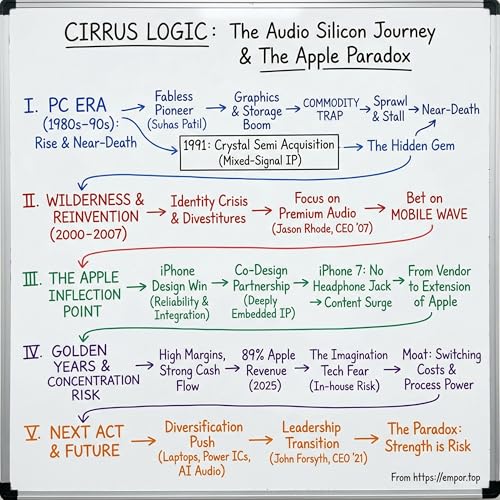
    Cirrus Logic’s improbable journey — from a fabless startup in Utah to near-collapse in the PC era, then a laser-focused reinvention as the audio brain inside Apple’s most iconic products — is equal parts engineering triumph and strategic gamble: a tiny technical win (removing two capacitors) helped pry open Apple’s door, and fifteen years of co‑design turned Cirrus into an indispensable partner that in 2025 still generated roughly 89% of its revenue from Cupertino. The payoff has been rich margins, strong cash on the balance sheet, and steady product expansion into amplifiers, power ICs, camera controllers, and laptop audio, yet the company remains haunted by the Imagination Technologies precedent and the perennial question of whether Apple could (or would) bring audio in‑house. This is a story about the upside of deep specialization, the downside of customer concentration, and the hard strategic choices that founders and investors must live with ...

    --

    Subscribe to our newsletter on LinkedIn https://www.linkedin.com/build-relation/newsletter-follow?entityUrn=7408775804387491842


    Follow us on X @emportop

    --


    Transcript - https://empor.top/us/CRUS

    • I. Introduction & Episode Roadmap
    • I. Introduction & Episode Roadmap
    • II. The Semiconductor Industry Context & Founding
    • III. The PC Audio Era: Rise and Near-Death
    • IV. The Wilderness Years: Searching for Identity
    • V. The Apple Inflection Point: The Bet That Changed Everything
    • VI. The Golden Years: Peak Apple Dependency
    • VII. The Reality Check: Navigating Platform Transitions
    • VIII. The Next Act: Beyond Smartphones
    • IX. The Business Model Deep Dive
    • X. Strategic Analysis: Porter's 5 Forces
    • XI. Strategic Analysis: Hamilton's 7 Powers
    • XII. Bull vs. Bear Case
    • XIII. Lessons for Founders & Investors
    • XIV. Epilogue & Future Outlook
    Más Menos
    53 m
  • Piper Sandler - From Regional Broker to Investment Banking's Trusted Advisor - $PIPR
    Jan 25 2026

    From a one-room commercial paper shop in 1895 Minneapolis to a focused, multi-sector middle-market investment bank, this piece traces Piper Sandler’s remarkable 130-year reinvention—through public listings, a fraught stint inside U.S. Bancorp, the counterintuitive sale of its retail brokerage, and a disciplined acquisition playbook that culminated in the transformative Sandler O’Neill merger. Along the way the firm learned that narrowing its scope—doubling down on healthcare, energy, public finance and especially bank M&A—created a durable competitive edge, while culture, careful integrations, and bold divestitures fueled growth: by 2024 revenues hit roughly $1.5 billion. Rich with human drama (including Sandler O’Neill’s 9/11 resilience), strategic lessons on focus and capability-building, and a clear roadmap for global expansion, the story explains why Piper Sandler now punches well above its Minneapolis weight...


    ---

    Subscribe to our newsletter on LinkedIn https://www.linkedin.com/build-relation/newsletter-follow?entityUrn=7408775804387491842

    Follow us on X @emportop

    ---

    Transcript https://empor.top/us/PIPR


    • I. Introduction & Episode Roadmap
    • II. The Minneapolis Origins & Early Evolution (1895-1970)
    • III. Going Public & Building the Regional Champion (1971-1997)
    • IV. The U.S. Bancorp Interlude: Loss of Independence (1998-2003)
    • V. The Strategic Transformation: Selling the Brokerage & Pivoting to Investment Banking (2006-2010)
    • VI. Building Sector Dominance: The Acquisition Playbook (2010-2019)
    • VII. The Sandler O'Neill Merger: The Defining Transaction (2019-2020)
    • VIII. Piper Sandler Today: The Modern Middle-Market Champion (2020-Present)
    • IX. Business Model & Strategic Analysis
    • X. Bear Case vs. Bull Case
    • XI. Epilogue & Lessons
    Más Menos
    53 m