Episodios

  • Can AI save nature, or will it cause more harm?
    Mar 17 2026

    In this episode of EY Sustainability Matters, David Rae, EY Global Lead for Technology, AI and Innovation at EY Climate Change and Sustainability Services, explores the complex intersection of artificial intelligence (AI) and nature. The host poses the question: Can technology solve the nature loss crisis, or will its resource-heavy footprint only accelerate the problem?

    Hear industry voices and activists debate whether AI is a necessary tool for nature's survival and offer holistic views on the risks and opportunities ahead, drawing on a hypothetical debate from The EY AI x Sustainability Exchange: from big questions to real solutions, where activists were asked to take opposing sides of the argument.

    Gilad Goren of the Nature Tech Collective argues that reversing nature loss is impossible without AI, which is essential for de-risking private sector investment and closing the nature finance gap. We also hear how companies, such as SAP, IBM, Treefera and others, are leveraging real-time data to track deforestation and optimize crop yields in hard-to-abate sectors.

    Conversely, activists Livia Pagoto and Fred Werner highlight the "shadow effect" — the skyrocketing energy and water demands of massive data centers. The conversation also explores ethical governance, questioning whether potentially biased algorithms can ever replicate human care required to protect the environment.

    • AI is already accelerating nature protection, from monitoring deforestation and biodiversity to improving climate risk assessment, supply‑chain transparency and renewable energy optimization.
    • However, AI's rapid growth is resource‑intensive, driving significant increases in energy and water use, and raising concerns about scalability, equity and environmental impact.
    • Progress requires collective action, combining human wisdom, inclusive governance, Indigenous knowledge and responsible innovation, to ensure that AI strengthens — rather than replaces — our relationship with nature.

    @2026 Ernst & Young LLP

    Más Menos
    17 m
  • How collaboration can open new opportunities to reduce emissions
    Feb 19 2026
    In this episode of the Sustainability Matters podcast, hosts Bruno Sarda and Anne Munaretto interview Ravi Annapragada, Director of Sustainability and Energy Strategy at Carrier, a global supplier of heating, ventilation, and air conditioning (HVAC) products. Together they discuss 'Joining forces for a sustainable future', a collaboration between Carrier customers, suppliers, and internal teams that aims to accelerate decarbonization and drive meaningful sustainability progress. The initiative, engaging 10 major customers across various sectors at different stages of their sustainability journey, highlights the benefits of moving away from isolated efforts toward partnership and co-creation. The discussion describes the HVAC giant's path to setting ambitious science-based targets, recognizing that most emissions stem from product use and realizing that addressing these challenges requires collaboration rather than a solely transactional relationship. The guests also emphasize the importance of internal alignment, especially with sales teams, and demonstrate that sustainability and business growth can be mutually reinforcing.
    Más Menos
    31 m
  • 2026: from climate pledges to measurable results
    Jan 15 2026

    In this episode of the EY Sustainability Matters podcast, hosts Elanne Almeida, EY LATAM Industrials and Energy Lead for Climate Change and Sustainability Services (CCaSS), and Matthew Handford, EY CCaSS Lead for Financial Services in the Americas, unpack the pivotal outcomes of COP30 and what they mean for the year ahead. This episode moves beyond the conference itself to focus on how its decisions are shaping business and policy strategies for 2026.

    Listeners will hear insights from global leaders and industry professionals on the shift from climate pledges to implementation, the rise of accountability frameworks, and the growing role of collaboration between the private and public sectors. Discover how new transparency requirements, ambitious national climate plans (NDCs) and innovative collaborations are setting the stage for measurable progress in sustainability — and why 2026 is poised to be a defining year for climate action worldwide.

    Más Menos
    35 m
  • What working in sustainability looks like in today's global market
    Nov 27 2025

    In this episode of the EY Sustainability Matters podcast, listeners will explore what it means to work in sustainability by hearing from three unique perspectives: Janine Osborne, CEO of Sustainable Seas Trust and marine conservation advocate; Alice Ashpitel, Sustainability Lead at Mercedes AMG Petronas Formula 1 Team; and Benjamin Okpara, Senior Consultant in EY Climate Change and Sustainability Services. Together, they reveal how sustainability for them is more than a job - it's a mission that spans advocacy, business innovation and advisory work.

    Listeners will hear how Janine drives systemic change across Africa's blue economy, how Alice embeds sustainability in the fast-paced world of Formula 1 and how Ben helps organizations navigate complex environmental challenges. The episode delves into the realities of the field: balancing ambition with practical constraints, the importance of collaboration, and the personal motivations and experiences that keep these leaders moving forward.

    0:00 - Exploring Diverse Roles in the Sustainability Ecosystem


    2:12 - Alice Ashpitel on Driving Sustainability in Formula 1


    13:41 - Janine Osborne on Marine Conservation and Advocacy


    26:00 - Benjamin Okpara on Consulting for Sustainable Business Practices


    37:03 - Connecting Advocacy, Practice, and Advisory for Impact

    @2025 Ernst & Young LLP

    Más Menos
    39 m
  • Why businesses are leaning in at Climate Week NYC 2025
    Nov 3 2025

    What happens when over a thousand climate-focused events converge in one city? At Climate Week NYC 2025, the private sector showed up in force, bringing bold ideas, collaborative energy and a clear shift from strategy to delivery. In this episode of EY Sustainability Matters, host Matthew Bell shares insights from leaders across various industries-utilities, consumer goods, technology and agriculture-as well as NGOs interviewed on the sidelines of EY-hosted events.

    Hear how artificial intelligence (AI) is transforming sustainability efforts, enabling smarter and faster decisions in the race against time. Discover why nature is no longer just an ethical concern but a material business priority. Learn how cross-sector partnerships are unlocking regenerative practices and reshaping supply chains.

    From boardroom strategies to landscape-level collaboration, this episode captures the pulse of NY Climate Week and the momentum building toward the upcoming COP30 in Brazil.

    • Collaboration and cross-sector partnerships can unlock scalable climate and nature solutions, especially in agriculture and energy.

    • Nature is now strategic, and businesses are integrating nature into core operations for resilience and profitability.

    • From predictive analytics to emissions reduction, AI is accelerating sustainability with speed and precision.

    @2025 Ernst & Young LLP

    Más Menos
    17 m
  • How to overcome fear in financing climate innovation
    Sep 29 2025
    This episode of the EY Sustainability Matters podcast is a rare opportunity to hear from two global thought leaders who have shaped sustainability strategies at the highest levels of business and international development, about the need for a move toward a regenerative economy, and the challenges and opportunities that will present. Nadia Woodhouse from the EY New Economy Unit (NEU) welcomes two distinguished thinkers: Sir Noel Quinn, former Chief Executive of HSBC, and Usha Rao-Monari, former Under-Secretary General of the United Nations Development Programme and member of the EY New Economy Unit Advisory Council. Both guests bring a wealth of experience from the worlds of global finance, development and industry, and currently serve as independent directors on the board of Fortescue, a global metal mining company at the forefront of commercial decarbonization. The conversation dives deep into the challenges and opportunities of building a regenerative economy. Noel shares insights from his tenure at HSBC, emphasizing the importance of economic case-making, transparency in target setting and overcoming organizational fear in driving change. Usha expands the discussion to the global scale, highlighting the push for better data, risk mitigation, and collaboration between public and private sectors — especially in emerging markets. Together, they explore the roles of policy, finance and innovation in accelerating the transition to a sustainable future, offering practical insights for leaders navigating the complexities of climate action and systemic transformation. Read more about the EY New Economy Unit here.
    Más Menos
    35 m
  • How national climate plans can reshape global investments
    Aug 28 2025

    Host Matt Bell explores the pivotal role of Nationally Determined Contributions (NDCs) in shaping climate policy and investment strategies. He interviews four experts to get their insights.

    Joanna MacGregor, a senior advisor at the UN Climate Change (UNFCCC), explains how NDCs have evolved into comprehensive national climate plans that can drive economic growth and resilience. Antonina Scheer, Policy Fellow at the London School of Economics and Research Project Manager at the Transition Pathway Initiative Centre, discusses the challenges of financing climate action in emerging markets and introduces a tool that helps assess the credibility and ambition of NDCs. Pablo Carvajal, Director in the Climate Change and Sustainability Services team at EY UKI, shares insights from his work with governments and banks, highlighting the disconnect between policy targets and business implementation. Claudia Gollmeier, Managing Director at Colchester Global Investors, emphasizes the importance of investors considering NDCs and the rise of innovative financial instruments like sustainability-linked bonds.

    Together, the guests underscore the urgency of making NDCs investable and inclusive, involving businesses and investors in their design and execution. Despite delays in countries submitting their NDC plans, they remain optimistic about the potential of NDCs to unlock financial flows and accelerate the global transition to a low-carbon economy.

    • NDCs are evolving into powerful economic tools that can drive growth, resilience and clean energy transitions.
    • Businesses and investors play a crucial role in implementing NDCs, even though governments set the targets.
    • Transparent information and innovative financial products are helping bridge the gap between climate ambition and investable action.

    @2025 Ernst & Young LLP

    Más Menos
    25 m
  • How and why should CEOs put sustainability at the core of business
    Jun 30 2025

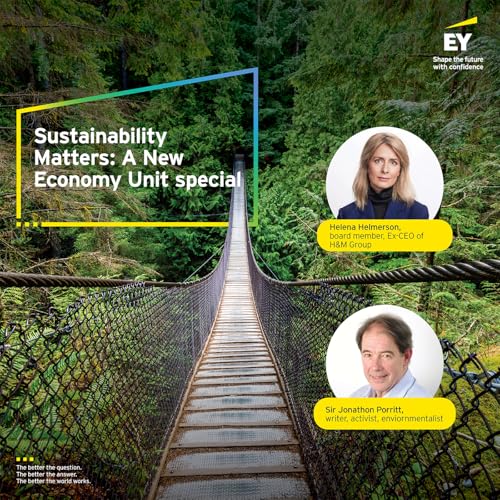
    This special episode of the EY Sustainability Matters podcast is introduced by Nadia Woodhouse from the EY New Economy Unit (NEU), which focuses on the long-term, systemic shifts toward a new, regenerative economy.

    Nadia presents a thought-provoking dialogue with two influential leaders in sustainability: Helena Helmersson, former CEO of the fashion giant H&M Group, and Jonathon Porritt, a writer, environmentalist, advocate for sustainable development and a member of the advisory council for the NEU. The discussion centers around the pressing need for businesses to adopt regenerative practices in the face of escalating sustainability challenges and the crucial role of CEOs in driving that change.

    The conversation delves into critical themes, such as the tension between profitability and sustainability, the importance of structural changes within large organizations, and the importance of forming deep, cross-industry coalitions. Both guests emphasize the need for greater inclusion of sustainability professionals in decision-making roles, the need for appropriate regulation, and urge CEOs to view sustainability not just as a responsibility, but as a core business imperative that drives innovation and competitiveness.

    Read more about the EY New Economy Unit here.

    • CEOs' commitment to sustainability can drive significant organizational change and inspire collective action at all levels of the business.
    • Immediate and decisive actions are essential for companies to transition toward sustainable practices and mitigate the drastic impacts of climate change.
    • Companies should align their economic objectives with sustainability commitments to foster innovation and resilience in an increasingly resource-constrained world.

    © 2025 Ernst & Young LLP

    Más Menos
    40 m