

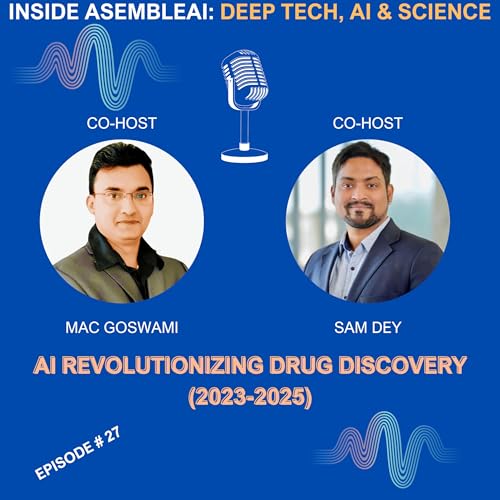
EP 27: AI Revolutionizing Drug Discovery (2023 - 2025)
No se pudo agregar al carrito
Add to Cart failed.
Error al Agregar a Lista de Deseos.
Error al eliminar de la lista de deseos.
Error al añadir a tu biblioteca
Error al seguir el podcast
Error al dejar de seguir el podcast

EP 27: AI Revolutionizing Drug Discovery (2023 - 2025)
-
Narrado por:
-
De:
The pharmaceutical industry is experiencing its most significant transformation in decades. AI is slashing drug development timelines from 10-15 years to 18-24 months and reducing costs from $2.6 billion to tens of millions—making previously impossible treatments financially feasible.
Sam and Mac explore how AI is fundamentally changing drug discovery. Traditional methods required screening millions of compounds through physical laboratory testing, costing billions with a 90%+ failure rate. AI transforms this by simulating molecular interactions computationally, predicting which compounds will bind effectively to target proteins, and identifying promising candidates from virtual libraries containing billions of potential molecules. What took years in wet labs now happens in days.
The impact extends beyond economics. AI is enabling treatments for rare diseases that pharmaceutical companies traditionally ignored due to small patient populations. When development costs drop from billions to millions, diseases affecting 50,000 patients globally become economically viable to address. AI serves as a true partner to scientists—identifying patterns in biological data humans would never detect, suggesting novel molecular structures chemists wouldn't intuitively design, and predicting side effects before human testing.
However, significant challenges remain. Data quality is the most critical obstacle—AI models are only as good as their training data, and pharmaceutical research data is often messy, incomplete, or inconsistent. The "black box" problem poses another challenge: deep learning models make predictions through complex transformations that scientists can't interpret, creating tension between efficiency and understanding. Ethical considerations around algorithmic bias, data ownership, and equitable access demand careful attention.
The regulatory landscape adds complexity. The FDA is still developing frameworks for evaluating AI-discovered drugs, and regulatory uncertainty can slow translation from discovery to approved therapy. Despite these challenges, investment in AI drug discovery has surged to record levels, with AI-discovered drugs progressing through clinical trials and validating the technology's potential.
The future of drug discovery will heavily rely on AI innovations, but success requires thoughtful integration with attention to data quality, algorithmic transparency, ethical practices, and regulatory compliance. The pharmaceutical industry stands at an inflection point where today's decisions about responsible AI implementation will shape healthcare outcomes for decades.