Episodios

  • DH Ep:56 Brain Candy
    Jan 9 2026
    In this special episode of Disturbing History, we step away from ancient mysteries and infamous crimes to confront something far closer and far more unsettling: the forces shaping our thoughts, behavior, and attention right now. This is not a story about the past. It is a story unfolding in real time, in your hands, on your screen, and inside your mind.We begin with a simple observation: most of us carry a device more powerful than all the computers used to reach the moon, yet we spend hours a day trapped in endless, hypnotic scrolling.

    This is not accidental. It is the system working exactly as designed. To understand how we got here, we trace the origins of modern manipulation back to Edward Bernays, the father of public relations, who used psychological insight to shape mass behavior without people ever realizing they were being guided. From his early campaigns to his chilling concept of an “invisible government,” Bernays laid the foundation for an economy built on influence rather than truth.As television rose, attention itself became the product. Networks sold viewers to advertisers, rewarding content that provoked fear, conflict, and emotional intensity over nuance or accuracy.

    The internet promised liberation from this model, but instead created an attention crisis, where infinite content competes for finite human focus. Design choices like infinite scroll quietly removed moments of choice, turning engagement into compulsion and regret into an afterthought.Social media perfected the formula by exploiting our deepest social instincts. Likes, notifications, and algorithmic feedback loops mirror the mechanics of addiction, a fact later acknowledged by the very people who helped build them.

    Platforms optimized for engagement inevitably favor outrage, misinformation, and emotional extremes, not because people crave lies, but because the system rewards whatever keeps us hooked.We explore how these same psychological techniques dominate retail environments, media ecosystems, and digital spaces, all rooted in dopamine-driven anticipation rather than satisfaction. Over time, this constant stimulation reshapes the brain, eroding focus, increasing anxiety, and fueling cycles of craving and withdrawal.

    The effects are especially severe for children and adolescents, where rising rates of depression, anxiety, and suicide closely track the spread of smartphones and social media, despite companies knowing the harm their products cause. The episode also examines shrinking attention spans, declining cognitive measures, and the concentration of media power into the hands of a few dominant platforms that quietly decide what billions of people see, believe, and argue about. Identity itself has shifted from something lived to something performed, curated for an invisible audience, leaving many feeling more connected than ever and yet profoundly alone.As shared reality fractures and misinformation thrives, even the basic foundations of democracy begin to erode.

    When facts are contested and outrage is profitable, persuasion, compromise, and truth lose their footing. The episode closes by asking what resistance looks like in a world engineered for distraction, offering ways to reclaim agency, protect the vulnerable, and rebuild genuine human connection. This is not ancient history. This is the story of now. And the ending has not yet been written.
    Más Menos
    59 m
  • DH Ep:55 The Cold War
    Jan 4 2026
    On the night of September 26th, 1983, a Soviet lieutenant colonel named Stanislav Petrov sat in a bunker monitoring early warning systems when alarms signaled the launch of American nuclear missiles. Alone with the decision, he had mere minutes to determine whether to report the strike and unleash retaliation that could have ended civilization. Petrov hesitated, trusting his gut over the machine.

    He was right—the alert was triggered by sunlight bouncing off clouds. His quiet defiance may have saved the world, but almost no one heard his name for another fifteen years. This episode takes you inside the Cold War as you’ve never heard it—a conflict waged not just with tanks and treaties, but with secrets, sabotage, and surreal moments that brought us terrifyingly close to annihilation.

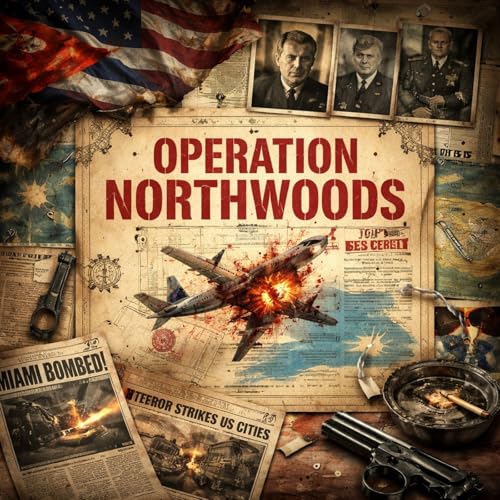
    We unravel how the United States imported Nazi scientists to build rockets, how the CIA toppled elected governments and plotted the assassination of foreign leaders with gadgets straight out of a spy film, and how the military once seriously considered faking terrorist attacks on U.S. soil to justify war with Cuba. We dive into the stories of individuals who defied orders and changed history, like the Soviet submarine commander who refused to fire a nuclear torpedo during the Cuban Missile Crisis.

    You'll learn about the bloody, U.S.-backed purge in Indonesia, the accidental toppling of the Berlin Wall, and the global chessboard of proxy wars from Korea to Vietnam. Along the way, we confront the rise of a domestic surveillance state that didn’t just target enemies abroad but turned inward on civil rights leaders like Martin Luther King Jr. This is a story of unimaginable weapons built by brilliant minds and placed in the hands of flawed men. It’s a story where accidents, miscommunications, and sheer luck averted catastrophe again and again. For forty-five years, the world hovered at the brink, holding its breath. This is how we made it through.
    Más Menos
    1 h y 30 m
  • DH Ep:54 The War On Drugs
    Jan 2 2026
    What if the War on Drugs was never really about drugs at all?In this episode of Disturbing History, we pull back the curtain on a devastating truth. For over fifty years, the U.S. government has waged a costly, brutal campaign that’s locked up millions, empowered police militarization, devastated entire communities—and yet, drugs are cheaper and more accessible than ever, with overdose deaths now surpassing 100,000 annually.

    If the goal was to stop drug use, it’s been an undeniable failure. But what if that wasn’t the real goal?We take you on a journey through time, beginning in 1875 San Francisco, where America’s first anti-drug law targeted Chinese immigrants, not opium. From there, we trace a pattern—how drug policy after drug policy has been rooted in racism, fear, and control. You'll hear how Nixon’s declaration of the War on Drugs, Reagan’s crackdown on crack cocaine, Clinton’s crime bill, and beyond, each added layers to a system designed less to protect public health than to marginalize and imprison.

    Along the way, we follow the money—into the pockets of private prisons, testing firms, and police departments incentivized by seizures and incarceration quotas. We dig into how the CIA’s covert dealings with drug traffickers, the practice of civil asset forfeiture, and the arming of local police forces created a system that punishes the vulnerable while shielding the powerful.Y ou’ll meet real people who paid the price—like Kemba Smith and Weldon Angelos—whose sentences make clear just how unforgiving and uneven this war has been.

    We contrast the punitive crack era with the more compassionate response to the opioid crisis and ask: who gets treated, and who gets punished? We don’t stop at America’s borders either. From Mexico and Colombia to the Philippines, we explore how U.S. policy has fueled violence and instability abroad, pushing other nations into our prohibitionist mold.

    But there’s hope. We highlight what’s working—from Portugal’s bold decriminalization model to harm reduction in Switzerland—and reflect on the slow but steady reforms happening here at home. Legalization. Sentencing reform. Rescheduling. Change is coming—but the machine hasn’t stopped.
    Más Menos
    1 h y 34 m
  • DH Ep:53 American Concentration Camps
    Dec 24 2025
    Disturbing History exists to sit with the parts of our past we’d rather avoid—the moments that force us to ask who we really are when fear takes over.In this episode, Brian walks through one of the darkest chapters in American history: the mass incarceration of Japanese Americans during World War II. This wasn’t something that happened under a foreign dictatorship.

    It happened here, carried out by our own government against its own people.In the spring of 1942, more than 120,000 men, women, and children of Japanese ancestry were forced from their homes along the West Coast and imprisoned in camps scattered across some of the most remote and unforgiving parts of the country. Two-thirds of them were American citizens. They weren’t charged with crimes. They weren’t given trials.

    Their only “crime” was their ancestry.Brian traces how this didn’t begin with Pearl Harbor. Anti-Asian racism had been building for decades—through the Chinese Exclusion Act, Alien Land Laws, Supreme Court rulings that barred citizenship, and immigration bans that made Japanese Americans perpetual outsiders. By the time Pearl Harbor happened, the groundwork for mass incarceration was already laid. The attack was just the excuse.

    We follow the panic-filled weeks that came next: FBI raids in the middle of the night, media-fueled hysteria, and political maneuvering that led Franklin D. Roosevelt to sign Executive Order 9066. Military leaders openly argued that the absence of sabotage proved guilt. Fear replaced evidence.

    Brian brings these places to life through survivor accounts: communal latrines with no privacy, schools behind barbed wire, armed guards watching children recite the Pledge of Allegiance.We also explore the damage that can’t be measured easily—the psychological toll on elders who lost everything, the identity fractures forced onto younger generations, and the loyalty questionnaire that tore families and communities apart. Resistance mattered too.

    Brian profiles Gordon Hirabayashi, Minoru Yasui, and Fred Korematsu, ordinary people who stood up to the government and paid the price, even as the Supreme Court failed them. The story doesn’t ignore the painful contradictions. Japanese American soldiers volunteered from behind barbed wire, forming the 442nd Regimental Combat Team, which became the most decorated unit in U.S. military history—fighting for freedoms their own families were denied. We follow the long, incomplete road to justice: decades of silence, inadequate compensation, the eventual exposure of government lies, and the Civil Liberties Act of 1988, which finally acknowledged what had been done.

    But apologies didn’t erase the losses, the trauma, or the precedent.

    Brian closes by looking at why this history still matters—how the same fears resurfaced after 9/11, how Korematsu remained standing law for decades, and how easily rights can be stripped away when fear is allowed to lead.

    The people who made this happen weren’t monsters. They were neighbors, officials, soldiers, and citizens who failed to stop it.As the survivors grow fewer each year, remembering becomes a responsibility. Their stories aren’t just history—they’re a warning. Never again has to mean never again for anyone.
    Más Menos
    1 h y 8 m
  • DH Ep:52 The Weird Meteor
    Dec 21 2025
    On the morning of December 14, 1807, the residents of southwestern Connecticut witnessed something that would change the course of American science forever. A blazing globe of fire, nearly two-thirds the apparent size of the full moon, streaked across the New England sky from Vermont to Fairfield County. Three thunderous explosions shook the frozen ground. And then, impossibly, stones began to fall from the heavens.In this episode of Disturbing History, we explore the full story of the Weston Meteorite, the first meteorite fall ever scientifically documented in the Americas.

    We follow Judge Nathan Wheeler on his early morning walk as the sky erupted in fire above him. We visit the farm of Elijah Seeley, where terrified cattle fled their enclosure and a strange warm stone lay smoking at the bottom of a fresh crater. And we meet Benjamin Silliman, the 28-year-old Yale professor who had never studied chemistry until he was hired to teach it, and who would go on to become the father of American meteoritics.But this is more than a story about a rock from space.

    It is a story about a young nation struggling to prove itself on the world stage, about the tension between scientific inquiry and religious interpretation, and about the bitter political divisions that colored how Americans viewed even the evidence of their own eyes. We examine the question of whether President Thomas Jefferson really dismissed the Yale professors' findings with the famous quip that it was easier to believe two Yankee professors could lie than to admit that stones could fall from heaven. The answer, as it turns out, is more complicated than the legend suggests.

    We also explore what happened after the fall, a tale that includes treasure-hunting farmers who smashed priceless specimens searching for gold, a wealthy Rhode Island collector who snatched the largest fragment before Silliman could acquire it, and an 18-year wait before that prize finally arrived at Yale. Of the approximately 350 pounds of meteorite material that fell that December morning, less than 50 pounds can be accounted for today.

    The rest was destroyed, lost, or simply thrown away by descendants who never understood what their ancestors had witnessed.The Weston Meteorite fundamentally changed how the world viewed American science. Silliman's careful investigation and chemical analysis was read aloud at the Royal Society in London and the Academy of Sciences in Paris. It established Yale as a center of serious scientific learning and launched a legacy that continues to this day at the Yale Peabody Museum of Natural History, where the largest surviving fragment remains on display.


    The Weston Meteorite is classified today as an H4 ordinary chondrite, an olivine-bronzite chondrite containing chondrules that formed more than 4.5 billion years ago in the solar nebula before the planets existed. To hold a piece of this meteorite is to hold something older than the Earth itself, a fragment of cosmic history that traveled through the void of space for eons before its path intersected with a small Connecticut farm town on a cold December morning.Stones fell around Weston on December 14, 1807. Two Yale professors proved they came from space. And American science was never quite the same.
    Más Menos
    1 h y 26 m
  • DH Ep:51 The Odyssey Project: Kids For Sale
    Dec 17 2025
    In August of 1973, Houston police were still pulling bodies from the dirt floor of Dean Corll’s boat shed when a frightened young man in Dallas picked up the phone and called the FBI. What he had witnessed inside a Cole Avenue apartment convinced him that the horrors unfolding 240 miles south were not isolated—and that the man he was living with might be part of something far larger.

    Days later, Dallas police raided the apartment. What they uncovered would expose one of the most extensive child trafficking operations ever documented in the United States: a mail-order network that sold access to children, servicing clients in at least thirty-five states and multiple foreign countries. The volume of evidence was staggering. It filled the bed of a pickup truck.

    Tens of thousands of index cards—estimates range from thirty thousand to over one hundred thousand—each meticulously cataloging the names, preferences, and payment histories of paying customers.Lieutenant Harold Hancock of the Dallas Police Department would later state publicly that the cards contained the names of prominent public figures and federal employees. Those cards were forwarded to the State Department. And then, without explanation, they were destroyed.

    Tonight on Disturbing History, we pull back the curtain on a story that links two of the most infamous serial killers in American history—Dean Corll and John Wayne Gacy—to a nationwide child exploitation network that operated openly, repeatedly resurfaced after arrests, and appeared to enjoy a level of protection rarely afforded to criminals of any kind. At the center of this story is John David Norman, a man arrested dozens of times over five decades, who continued running trafficking operations from behind bars, rebuilt his networks every time they were dismantled, and whose client lists somehow vanished before investigators could ever examine the names that mattered most.

    We follow Norman’s trail from the Odyssey Foundation in Dallas to the Delta Project in Chicago, where his closest associate, Phillip Paske, would later surface on the payroll of John Wayne Gacy. Prosecutors were aware of that connection. It was never introduced at trial.We examine congressional hearings that briefly exposed these networks, only for investigations to stall, evidence to disappear, and accountability to evaporate.

    We explore the connected operation on North Fox Island in Michigan and its potential links to the still-unsolved Oakland County Child Killer case. Across states and decades, the same patterns emerge: shared mailing lists, overlapping personnel, recycled victims, and systemic failure at every level meant to stop it.And finally, we ask the question that lingers beneath all of it—whose names were written on those index cards, and why were they destroyed by the very institutions tasked with uncovering the truth?

    A content warning before we begin: This episode contains detailed discussion of child sexual abuse, child trafficking, and serial murder. The material is deeply disturbing. Listener discretion is strongly advised.
    Más Menos
    1 h y 2 m
  • DH Ep:50 The Tuskegee Syphilis Experiment
    Dec 12 2025
    In 1932, the United States government told six hundred Black men in rural Alabama that they had "bad blood" and promised them free treatment. What these men didn't know—what they would never be told—was that they had just become subjects in one of the most horrifying medical experiments in American history. For forty years, the U.S. Public Health Service watched these men suffer and die from syphilis.

    They observed as the disease destroyed their bodies, attacked their hearts, invaded their brains. They took notes as men went blind, lost their minds, and were lowered into their graves. And when penicillin emerged as a miracle cure in the 1940s—a simple injection that could have saved every single one of them—the government made a calculated decision to withhold treatment and let the experiment continue.

    This is not a story from some distant, barbaric past. This happened in twentieth-century America. It was funded by taxpayer dollars, staffed by respected physicians, and published in prestigious medical journals. The system didn't fail. The system worked exactly as designed.

    In this episode, we go back to the dusty roads of Macon County, Alabama, where government cars pulled up to Black churches offering hope to men who had none. We meet the architects who designed this atrocity, the nurse who became its human face, and the whistleblower who finally brought it down. We hear from the survivors who spent their entire adult lives as unwitting guinea pigs, and we trace the long shadow this experiment still casts over American medicine today.

    The ghosts of Tuskegee are not just historical. They're still with us—in every vaccine hesitation, in every second-guessed diagnosis, in every Black patient who wonders whether they're being told the whole truth. This is their story. And America owes it to them to listen.
    Más Menos
    1 h y 23 m
  • DH Ep:49 The Civil War
    Dec 7 2025
    This is the episode we've been building toward. The one that sits at the very heart of what disturbing history means. Because nothing in the American story comes close to what happened between 1861 and 1865. Nothing. We're talking about a war that killed more Americans than every other conflict in our history combined. A war where brothers lined up across battlefields and shot each other dead. A war that reduced entire cities to ash and left a generation of young men rotting in fields from Pennsylvania to Georgia. This is the story of the American Civil War, and it is the darkest chapter this nation has ever written.The episode begins where all honest examinations of the Civil War must begin. With slavery. Not as some abstract economic system, but as the original sin woven into the very foundation of the republic. We trace the poison from 1619, when the first enslaved Africans arrived in Virginia, through the compromises that the Founding Fathers made with evil itself.The Three-Fifths Compromise. The Fugitive Slave Clause. The deals that kept the Union together while guaranteeing that future generations would pay the price in blood. We explore how the cotton gin, a machine that should have reduced the need for enslaved labor, instead caused an explosion in human bondage. How the South became a one-crop economy utterly dependent on the institution. How the North industrialized and began to see slavery not just as a moral abomination but as economic competition. Two nations under one flag, drifting further apart with each passing decade.The road to war is paved with failed compromises. The Missouri Compromise of 1820, which drew a line across the continent and temporarily preserved the peace. The Compromise of 1850, which gave the South the monstrous Fugitive Slave Act and forced every American to become complicit in slavery's machinery. The Kansas-Nebraska Act, which tore up the Missouri Compromise and unleashed guerrilla warfare in Bleeding Kansas. John Brown hacking pro-slavery settlers to death with broadswords. The Dred Scott decision declaring that Black Americans had no rights which the white man was bound to respect. And then John Brown again. Harpers Ferry. The raid that failed but lit the fuse. Brown walking calmly to the gallows, certain that the crimes of this guilty land would never be purged away but with blood. He was right. Lincoln's election. Secession. Seven states leaving the Union before he even took office. The Confederacy forming with white supremacy as its explicit cornerstone. Fort Sumter. The first shots. And then the country descended into hell.We take you inside the reality of Civil War combat. Not the sanitized version from movies. The real thing. The soft lead minié balls that shattered bones and tore through organs. The field hospitals where surgeons worked for days straight, amputating limbs and stacking them head-high outside the doors. The disease that killed two out of every three soldiers who died. The camps where men perished from typhoid and dysentery and measles before they ever saw the enemy. First Bull Run, where Washington society packed picnic baskets to watch the battle and found themselves engulfed in a panicked rout. Antietam, where 22,000 Americans became casualties in a single day. The Sunken Road that became Bloody Lane. The cornfield that changed hands fifteen times and ended up carpeted with corpses.The Emancipation Proclamation and how it transformed the war from a fight for union into a crusade for freedom. Nearly 200,000 Black men serving in Union blue. The army becoming an engine of liberation wherever it marched.Fredericksburg, where wave after wave of Union soldiers charged up Marye's Heights into Confederate rifles and fell in rows. Chancellorsville, where Lee gambled everything on a flanking march and won his greatest victory, but lost Stonewall Jackson forever.And Gettysburg. Three days in July 1863 that decided the fate of the nation. Little Round Top and the desperate bayonet charge that saved the Union left. The Wheatfield and the Peach Orchard soaked in blood. Pickett's Charge, twelve thousand men marching across a mile of open ground into the teeth of the Union line. The high-water mark of the Confederacy, reached and broken at a stone wall on Cemetery Ridge. Vicksburg falling on July 4th. The Mississippi in Union hands. The Confederacy cut in two. We don't look away from the horrors behind the lines. Andersonville, the prison camp where nearly 13,000 Union soldiers starved and sickened and died in conditions that defy description. The New York Draft Riots, four days of chaos and racial violence that required five army regiments to suppress. Families torn apart, brothers facing brothers, the social fabric of the nation shredding.Grant taking command in 1864 and beginning the relentless grinding campaign that would finally end the war. The Wilderness, where men burned alive in brushfires. Spotsylvania, where fighting was so intense ...
    Más Menos
    1 h y 24 m
adbl_web_global_use_to_activate_DT_webcro_1694_expandible_banner_T1