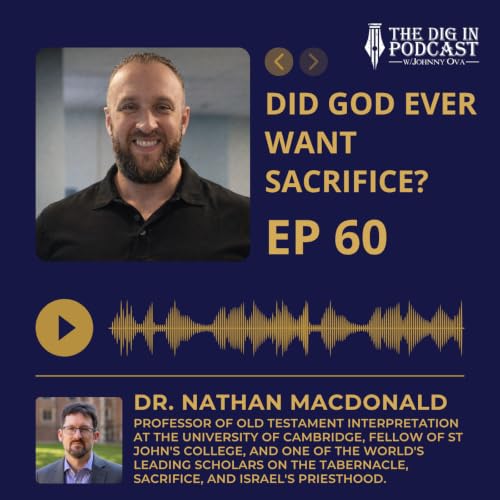
The Dig In Podcast w/Johnny Ova Podcast Por Johnny Ova arte de portada

The Dig In Podcast w/Johnny Ova

The Dig In Podcast w/Johnny Ova

De: Johnny Ova
Escúchala gratis

Dig In is hosted by Pastor Johnny Ova of Sound of Heaven Church. Each episode features thoughtful conversations with scholars, historians, and thinkers from all backgrounds as they explore the Bible through context, culture, and curiosity. Johnny invites guests to go beyond surface-level beliefs and into the deeper truths of Scripture, history, and the character of God. This is not a podcast for debate or division, but for those who want to grow, wrestle with tough questions, and discover the beauty of God's redemptive story. If you're ready to dig into the Bible with honesty and depth, this show is for you.

2026 Johnny Ova
Espiritualidad
Episodios
  • Babylon Before the Bible: What Mesopotamia Reveals About the Old Testament with Dr. Joshua Bowen
    Jun 8 2026

    The Old Testament was not written in a vacuum. It was written inside a world. A world of clay tablets and cuneiform, flood epics and creation myths, law codes carved into stone centuries before Moses climbed the mountain. Dr. Joshua Bowen has spent his career decoding that world. And what he found does not diminish Scripture. It puts it in focus.

    Dr. Bowen holds a Ph.D. in Assyriology from Johns Hopkins University and is the founder of Digital Hammurabi. He reads Sumerian, Akkadian, and Biblical Hebrew, and has spent years working the primary cuneiform sources that form the ancient backdrop of the Hebrew Bible. In this conversation, we cover the Mesopotamian parallels to Genesis, the flood traditions that predate Noah, the law codes that share striking overlap with the Torah, and the theological genius behind how Israel reworked those traditions to say something no surrounding culture was saying about God.

    In this episode you will learn:

    - Why the ancient Near East is essential background for anyone who takes the Bible seriously
    - How the Enuma Elish and Genesis 1 interact and what that interaction actually means
    - What the Gilgamesh Epic reveals about the biblical flood narrative and why borrowing an earlier story does not undercut the theology
    - How the Laws of Hammurabi, Ur-Namma, and Eshnunna relate to the legal material in the Torah
    - Why the goring ox law appears in nearly identical form across multiple ancient law collections
    - How Israel used surrounding mythology as a polemic, arguing theologically through the very stories the surrounding nations told
    - What Genesis 1 is doing in response to the Enuma Elish and why Yahweh does not even have to fight
    - How the Babylonian exile shaped Israelite identity and the final form of the Hebrew Bible
    - Why understanding these ancient texts deepens rather than destroys a serious reading of Scripture


    Get Dr. Bowen's book:

    Did the Old Testament Endorse Slavery?: https://www.amazon.com/Did-Old-Testament-Endorse-Slavery/dp/1734358629

    Explore Digital Hammurabi:
    https://www.digitalhammurabi.com

    Stay Connected with Johnny Ova:

    Website: https://johnnyova.com
    Subscribe on YouTube: https://www.youtube.com/@thejohnnyova
    Get Johnny's latest book:

    The Revelation Reset: https://www.amazon.com/Revelation-Reset-Johnny-Ova/dp/B0C9SFQX4J

    Más Menos
    1 h y 8 m
  • The Bible's Most Mysterious Figure and the Scribes Who Rewrote Him with Dr. Robert Cargill
    Jun 1 2026

    Melchizedek appears just three times in the entire Bible. Twice in the Hebrew Bible. Once in the New Testament. And yet entire priesthoods, theological systems, and centuries of Christian doctrine have been built on top of this one figure. So who was he really? And what if the text was changed to hide his true identity?

    Dr. Robert Cargill, Associate Professor of Classics at the University of Iowa, former editor of Biblical Archaeology Review, and one of the most recognized biblical archaeologists in the world, sits down to walk us through the evidence. His Oxford University Press book argues that Melchizedek was originally the king of Sodom, and that ancient scribes deliberately altered Genesis 14 to distance Abraham from a city God would later destroy. That single scribal edit sent ripple effects through the Psalms, into the book of Hebrews, and straight into the foundation of Christ's priesthood. This conversation takes you inside the Hebrew text, into the caves of Qumran, through the Dead Sea Scrolls and the Pseudepigrapha, and into the hard question of what archaeology can and cannot prove about the Bible.

    In this episode you will learn:

    - Why Melchizedek is one of the most leveraged figures in biblical history and how different groups used him for their own purposes
    - The textual and grammatical evidence that Melchizedek was originally the king of Sodom, not the king of Shalem
    - Why scribes changed a single word in Genesis 14:18 and how that edit reshaped centuries of theology
    - How the tithe in Genesis 14 may have gone the opposite direction from what English translations suggest
    - What the Dead Sea Scrolls actually are and why they changed how scholars read the Bible
    - What the Pseudepigrapha (1 Enoch, Jubilees, the Genesis Apocryphon) reveal about what Second Temple Jews actually believed
    - How the book of Enoch rewrites the flood story to solve an ethical problem in Genesis 6
    - The most common types of bogus archaeological claims and how to spot them
    - Real archaeological discoveries that illuminate the biblical text, from the seal of Hezekiah to the Tel Dan inscription
    - Why Dr. Cargill believes archaeology should never be used as a tool for evangelism
    - The story of the Greek Orthodox archaeologist whose answer about faith and science changed everything


    Dr. Robert Cargill's Books:
    Melchizedek, King of Sodom: How Scribes Invented the Biblical Priest-King (Oxford University Press) - https://a.co/d/0e3LmMWE
    The Cities That Built the Bible (HarperOne) - https://a.co/d/04VqTMt6

    Dr. Cargill's Website: bobcargill.com
    Dr. Cargill's YouTube: https://www.youtube.com/@UC6TIKnUUWEhh1nspJ62komg


    Stay Connected:
    Website: Johnnyova.com
    Subscribe on Youtube: https://www.youtube.com/@thejohnnyova
    Get my book! The Revelation Reset: https://www.amazon.com/dp/B0DZSM695Y

    Más Menos
    50 m
  • What Your English Bible Can't Say w/ Dr. Alison Gray
    May 25 2026

    The Hebrew poets didn't write safe words. They stacked image on top of image, layered metaphor on metaphor, and built texts designed to hit you in the chest. But when those words crossed into English, something got lost. The raw emotional power. The vivid word pictures. The sounds, the rhythms, the physicality of a language that was built to be felt, not just read.

    In this episode, Dr. Alison Gray, Director of Studies in Old Testament Language, Literature, and Theology at Westminster College, Cambridge, pulls back the curtain on what your English Bible simply cannot deliver. From the spatial drama of Psalm 18, where height means safety and narrowness means despair, to the stunning revelation that the Hebrew word for compassion literally means "wombs," this conversation exposes an entire dimension of Scripture that most believers have never encountered.

    In this episode you will learn:

    - How metaphor functions as the backbone of Hebrew poetry, not decoration but the primary vehicle of meaning
    - Why the spatial imagery in Psalm 18 (high vs. low, wide vs. narrow) unlocks the entire emotional architecture of the poem
    - What "metaphor clusters" are and how Hebrew poets deliberately piled images to overwhelm the reader
    - The specific emotional and theological losses that occur every time Hebrew poetry is translated into English
    - How the Hebrew accent marks called "taste marks" shaped the oral performance of the Psalms
    - Why reading Job through the lens of trauma literature makes sense of its contradictions and fragmented voices
    - The dangerous church tradition of sanitizing lament and why the Psalms of agony were never meant to be resolved quickly
    - What the British Sign Language Bible Translation Project reveals about the physicality already embedded in Hebrew Scripture
    - How the Hebrew word for compassion (rachmayim) literally comes from the word for womb
    - Why "slow to anger" in Hebrew actually means "long of nose" and what that tells us about how the ancient world pictured emotion

    Dr. Gray's Book:

    Psalm 18 in Words and Pictures: A Reading Through Metaphor (Brill, 2014)
    https://brill.com/display/title/23722?language=en

    Westminster College:
    https://www.westminster.cam.ac.uk/academic-staff/dr-alison-gray

    Winter School in Ancient and Biblical Languages:
    https://www.westminster.cam.ac.uk/biblical-languages

    BSL Bible Translation Project:
    https://bslbible.org.uk/

    Stay Connected:
    Website: Johnnyova.com
    Subscribe on Youtube: https://www.youtube.com/@thejohnnyova
    The Revelation Reset: https://www.amazon.com/dp/B0DKSLQXWQ

    Más Menos
    42 m
adbl_web_anon_alc_button_suppression_t1
Todavía no hay opiniones