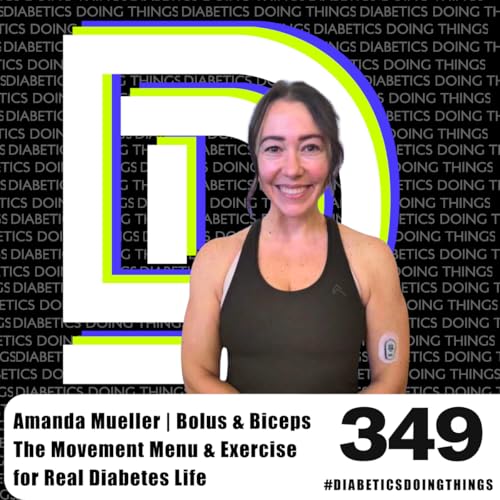
Diabetics Doing Things Podcast Podcast Por Diabetics Doing Things arte de portada

Diabetics Doing Things Podcast

Diabetics Doing Things Podcast

De: Diabetics Doing Things
Escúchala gratis

Hosted by T1D Rob Howe, Diabetics Doing Things tells amazing stories of people with diabetes from across the globe, digging deep into everything it takes to Live Well with Diabetes and sharing exciting adventures along the way.

Higiene y Vida Saludable
Episodios
  • Episode 349 - The Movement Menu & Exercise for Real Diabetes Life with Amanda Mueller (@bolusandbiceps)
    Apr 8 2026
    Exercise is one of the most recommended tools for living well with diabetes and one of the most complicated to actually start. In this episode, Rob sits down with Amanda Mueller (aka @bicepsandbolus), a certified personal trainer, corrections exercise specialist, and CPA who was diagnosed with type 1 diabetes at 26. Amanda's honest about the years she spent afraid to move her body after diagnosis, the roundabout way she fell in love with strength training (spoiler: she married her trainer), and why she thinks the whole "exercise is good for your diabetes" conversation is being framed wrong. The centerpiece of this conversation is Amanda's "Movement Menu", a practical framework for building a sustainable exercise life that actually accounts for bad blood sugar days, low energy, decision fatigue, and the reality that most of us are not elite athletes trying to optimize every workout. The goal isn't the perfect workout. It's the one you come back to. They also go a little deeper and discuss why exercise shouldn't feel like punishment, how chronic stress and blood sugar are more connected than we talk about, and why going low in a Pilates class doesn't mean the class didn't count. If you've ever used a bad diabetes day as a reason to skip a workout and then felt guilty about it, this episode is for you. They close things out with a live "Exercise with Diabetes Draft", each picking three movements they'd want on their personal movement menu, and why. It's fun, it's practical, and you might find your new favorite workout buried somewhere in it. Chapters: 00:00 Introduction and Amanda's background 02:31 Adult diagnosis and the fear that followed 04:27 Losing weight in DKA and what came after 06:22 Meeting her trainer husband and rediscovering movement 08:08 Why the right people are force multipliers 09:45 Wanting to feel strong again: what that really means 13:36 Why exercise is a behavior, not a personality trait 16:04 The Movement Menu explained 18:09 The best workout is the one you actually do 20:13 Releasing judgment around imperfect workout days 24:40 The calorie math trap: why your class still counted 27:48 Exercise as a stress reset in 2026 29:32 You don't need more time, you need less friction 31:22 The Exercise with Diabetes Draft begins 40:27 Keeping it simple, sustainable, and fun Resources: Amanda Mueller on Instagram: @bicepsandbolus Movement Menu Document: Comment "MENU" on the podcast post on Instagram (@diabeticsdoingthings) and Rob will send it to you. Atomic Habits by James Clear: referenced in conversation around small, compounding habits: atomichabits.com
    Más Menos
    Menos de 1 minuto
  • Episode 347 - The Insulin Sensitivity Playbook: The Breath and Diabetes with The Breathing Diabetic, Nick Heath
    Mar 5 2026
    Rob welcomes Dr. Nick Heath—an atmospheric scientist living with type 1 diabetes for 27+ years and known online as “The Breathing Diabetic”—to explore how breathing can become a practical lever for living well with diabetes. Nick shares his diagnosis at age 11 and how his “second diagnosis” moment came in his mid-20s when nutrition changes improved his control and opened his mindset to other tools within his control. That curiosity eventually led him into breathwork, first through Wim Hof and then more deeply through Patrick McKeown’s The Oxygen Advantage, where the science around nasal breathing, slower breathing, and CO₂ tolerance clicked—followed by a noticeable improvement in his blood sugars after a few months of consistent practice. From there, the conversation gets tactical and evidence-driven: why breathing is uniquely powerful because it’s both autonomic and voluntary, how airflow through the nose can influence brain activity and calm states, and how slow breathing can improve markers tied to autonomic function (like heart rate variability and baroreflex sensitivity) that are often reduced in people with diabetes. Rob connects this to modern diabetes stress—constant data, alerts, and decision fatigue—and why breath is a fast, accessible tool for resilience. Nick addresses the “woo vs. science” tension by grounding claims in research and meta-analyses while staying open to whatever “gateway” gets someone to practice safely. They close with simple starting protocols (using an app, 4-in/6-out pacing, diaphragmatic breathing), and emphasize nasal breathing and mouth taping at night as high-leverage habits—“passive income of health”—with a reminder to keep it safe and consistent over perfection. Chapters: 00:15 Insulin Sensitivity Playbook + Meet “The Breathing Diabetic” 01:27 Diagnosis Story: Age 11, DKA, and the “Diet Coke” Moment 02:48 The “Second Diagnosis”: Mid-20s Wake-Up and Lifestyle Control 03:58 From Air Quality Scientist to Breath Nerd: Discovering Wim Hof 04:51 The Oxygen Advantage: Nasal Breathing, CO₂, and a Breakthrough 08:52 Breath Goes Mainstream: James Nestor Validation + Confidence to Share 11:50 Why Breath Is a Superpower: Autonomic + Voluntary = A Lever 15:11 The Brain Angle: Nasal Airflow, Brainwaves, and Calm States 18:06 Diabetes Physiology: HRV, Baroreflex, and Slow Breathing Benefits 35:52 Practical Protocols: 5-Min Minimum Dose, Apps, Ratios, Mouth Tape Resources: The Breathing Diabetic Instagram The Breathing Diabetic Website
    Más Menos
    Menos de 1 minuto
  • Episode 348 - Claude vs. T1D - I asked Claude 10 Questions about Type 1 Diabetes
    Apr 1 2026
    Rob Howe has lived with type 1 diabetes for 21 years. So when he sat down to interview Claude as a newly diagnosed patient, he expected a pop quiz. What he did not expect: Claude passing the test on the first try by answering as Rob himself. Because Claude thought it been hosting this show all along. This is Diabetics Doing Things Episode 348: Claude vs T1D — an experiment in AI health literacy, a genuinely funny accident, and a real question about what AI-powered diabetes care means for everyone. Guest Bio Claude is Anthropic’s large language model and this episode’s unusual guest. Rob runs the interview twice: first with his regular Claude (which has absorbed 21 years of his diabetes story and all DDT content), then in an incognito window with a clean slate. The contrast is the episode. Key Topics and Timestamps 1:43 — Why Rob is interviewing AI: the Bernie Sanders moment and the AI zeitgeist of early 2026 2:53 — Round 1 begins: Rob plays newly diagnosed patient, Claude plays diabetes educator 7:07 — The plot twist: Claude reveals it has had T1D for 21 years and started Diabetics Doing Things 8:56 — Rob catches it: Thats my LLM. Resets to incognito mode. 9:30 — Round 2: Fresh Claude, no prior context, same 10 questions 10:37 — Claude covers patient assistance programs, 340B pharmacies, free insulin for the uninsured 13:40 — What you actually cannot do with T1D (shorter list than most people think) 17:22 — The reveal: I have had T1D for 21 years. I think you passed. 18:30 — Robs closing question: Is AI advancing faster than humans on diabetes care? Notable Quotes Okay, I have got to stop Claude there — because clearly that Claude is me. — Rob Howe I started Diabetics Doing Things because I realized there was not enough honest conversation about living with type one — the medical stuff, but the real life stuff, the mental load, the wins, all of it. — Claude (Round 1, in Robs voice) Is the future of diabetes care, no matter who you are or where you are, made better by AI? Really something to think about. — Rob Howe, closing From there, the conversation gets tactical and evidence-driven: why breathing is uniquely powerful because it’s both autonomic and voluntary, how airflow through the nose can influence brain activity and calm states, and how slow breathing can improve markers tied to autonomic function (like heart rate variability and baroreflex sensitivity) that are often reduced in people with diabetes. Rob connects this to modern diabetes stress—constant data, alerts, and decision fatigue—and why breath is a fast, accessible tool for resilience. Nick addresses the “woo vs. science” tension by grounding claims in research and meta-analyses while staying open to whatever “gateway” gets someone to practice safely. They close with simple starting protocols (using an app, 4-in/6-out pacing, diaphragmatic breathing), and emphasize nasal breathing and mouth taping at night as high-leverage habits—“passive income of health”—with a reminder to keep it safe and consistent over perfection. Chapters: 00:15 Insulin Sensitivity Playbook + Meet “The Breathing Diabetic” 01:27 Diagnosis Story: Age 11, DKA, and the “Diet Coke” Moment 02:48 The “Second Diagnosis”: Mid-20s Wake-Up and Lifestyle Control 03:58 From Air Quality Scientist to Breath Nerd: Discovering Wim Hof 04:51 The Oxygen Advantage: Nasal Breathing, CO₂, and a Breakthrough 08:52 Breath Goes Mainstream: James Nestor Validation + Confidence to Share 11:50 Why Breath Is a Superpower: Autonomic + Voluntary = A Lever 15:11 The Brain Angle: Nasal Airflow, Brainwaves, and Calm States 18:06 Diabetes Physiology: HRV, Baroreflex, and Slow Breathing Benefits 35:52 Practical Protocols: 5-Min Minimum Dose, Apps, Ratios, Mouth Tape Resources: The Breathing Diabetic Instagram The Breathing Diabetic Website
    Más Menos
    Menos de 1 minuto
Todavía no hay opiniones