Creative Science for Kids Podcast Por Creative Science Australia Pty Ltd arte de portada

Creative Science for Kids

Creative Science for Kids

De: Creative Science Australia Pty Ltd
Escúchala gratis

Explore science facts, intriguing scientific discoveries, and hands-on activities to try yourself at home. The perfect way to spark an interest in science and to feed the minds of science-curious children aged 8 to 12 years. Jenny Lynch is a science show presenter, writer, and science kit inventor, with a knack for making complicated scientific ideas fun, fascinating, and easy to follow.

Support the podcast and keep it ad-free! buymeacoffee.com/creativescience

Copyright 2023-2025 Jennifer Lynch
Ciencia
Episodios
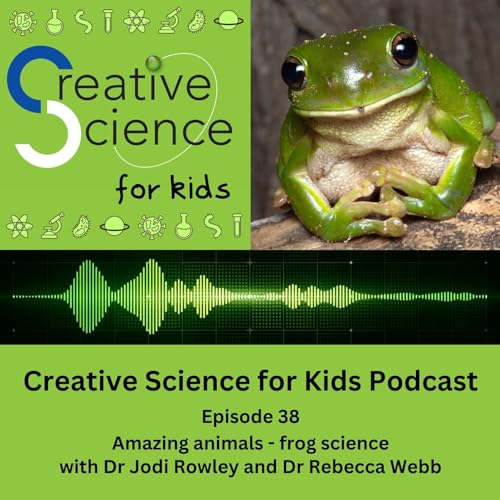
  • Amazing animals – frog science with Dr Jodi Rowley and Dr Rebecca Webb
    Mar 19 2026

    Let’s celebrate World Frog Day with five fun and fascinating fast facts about frogs, a chat with some froggy scientists, Dr Jodi Rowley and Dr Rebecca Webb, and a gooey chia seed frog spawn activity for you to try yourself at home.

    Presented by Jenny Lynch and Matilda. Written and produced by Jenny Lynch. Music by Purple Planet Music. Sound effects by Pixabay.

    Image: Green Tree Frog Litoria caerulea (Photo credit: Dr Jodi Rowley)

    Support the podcast to keep it ad-free! https://buymeacoffee.com/creativescience

    Join the email list: https://www.creativescience.com.au/contact/

    Creative Science: https://www.creativescience.com.au

    Facebook: @creativescienceaustralia

    Instagram: @creative_science_australia

    Episode content:

    00:00 Introduction and fast facts

    03:33 Interview with Dr Jodi Rowley

    11:19 Interview with Dr Rebecca Webb

    14:51 Chia seed frog spawn activity

    FrogID citizen science project led by Dr Jodi Rowley at the Australian Museum: https://www.frogid.net.au/

    Dr Rebecca Webb at the University of Melbourne: https://findanexpert.unimelb.edu.au/profile/962839-rebecca-webb

    Chia seed frog spawn activity

    You will need: cold water, a measuring cup, a tablespoon, 2 tablespoons of black chia seeds, and a spoon for stirring. Chia seeds are small seeds that you might be able to buy at a supermarket, a fruit and vegetable shop, or a health food store.

    1. Wash your hands with soap and warm water.
    2. Add half a cup of cold water to the measuring cup.
    3. Add two tablespoons of black chia seeds to the water.
    4. Stir the mixture and leave it to sit for about 5 minutes.
    5. Stir it again and then leave the mixture to cool down in the fridge for 2 hours.
    6. After 2 hours, take it out of the fridge and stir the mixture one more time.
    7. Make sure your hands are clean before picking up the mixture to play with it.

    When you take it out of the fridge, you will have a cup of gooey chia seed frog spawn.

    You can also try adding honey or maple syrup to the chia seed mixture to make a tasty snack!

    What’s happening?

    Chia seeds are the seeds of the plant Salvia hispanica which is native to Mexico and Guatemala. When the seeds are mixed with water, a slimy coating forms to protect the seeds until they have time to grow. The slimy coating on the seeds looks a lot like the gooey jelly in frog spawn that protects frog’s eggs until they are ready to hatch.

    Más Menos
    17 m
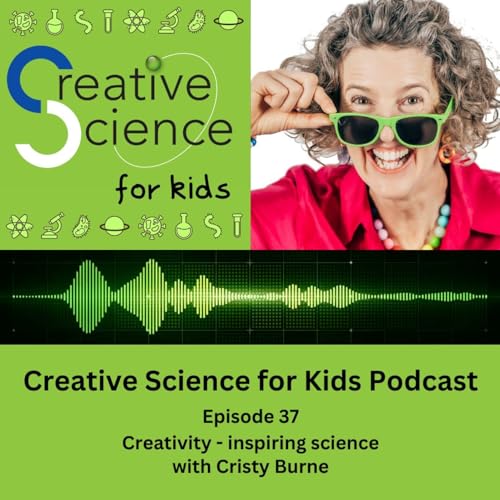
  • Creativity – inspiring science with Cristy Burne
    Feb 19 2026

    It’s time to widen your mind with five fun and fascinating fast facts about creativity, an interview with Cristy Burne, a storyteller who knows a lot about science and creativity, and an imaginative paper activity for you to try yourself at home.

    Written, presented, and produced by Jenny Lynch. Music by Purple Planet Music. Sound effects by Pixabay.

    Creative Science: https://www.creativescience.com.au

    Facebook: @creativescienceaustralia

    Instagram: @creative_science_australia

    Episode content:

    00:00 Introduction and fast facts

    04:02 Self-correcting science

    05:11 Interview with Cristy Burne

    11:14 Piece of paper activity

    Cristy Burne: www.cristyburne.com

    Piece of paper activity

    You will need: an ordinary piece of paper

    This activity starts with a couple of ideas of things to do with a piece of paper and then it will be up to you to come up with something new to do with the paper.

    1. Try rolling up the piece of paper to make a cylinder shape. Stand the cylinder on one end. Is it strong enough to support something? Which way did you roll the piece of paper? Was it a long cylinder or a short cylinder? Try rolling it the other way. Is it stronger now?
    2. Hold the piece of paper high above the ground and let if fall to the floor. Does the paper fall quickly or slowly? If you fold the paper in half, will it fall any faster?
    3. Now it’s your turn. What can you think of to do with the piece of paper? Give yourself a few minutes of thinking time to hold the piece of paper and imagine something to do with the paper that you have never thought of doing before.

    What’s happening?

    Creativity in science often involves thinking about existing ideas and imagining something new. Taking the time to look at familiar objects in new ways can lead to exciting new thoughts, inventions, and discoveries.

    Más Menos
    13 m
  • Fundamental forces – the Universe with Professor Lisa Harvey-Smith
    Jan 15 2026

    Let’s explore the nature of the Universe with five fun and fascinating fast facts about the four fundamental forces, an interview with Professor Lisa Harvey-Smith, an astrophysicist who knows a lot about the Universe, and a surprising paper folding activity for you to try yourself at home.

    Written, presented, and produced by Jenny Lynch. Music by Purple Planet Music. Sound effects by Pixabay.

    Creative Science: https://www.creativescience.com.au

    Facebook: @creativescienceaustralia

    Instagram: @creative_science_australia

    Episode content:

    00:00 Introduction and fast facts

    05:11 Interview with Professor Lisa Harvey-Smith

    11:29 Paper folding activity

    Professor Lisa Harvey-Smith: www.lisaharveysmith.com

    Future You: www.futureyouaustralia.com.au

    Paper folding activity

    How many times do you think you can fold a piece of paper in half?

    You will need: a long piece of toilet paper.

    1. Lay the toilet paper out on the floor and fold it in half lengthways. That’s one fold.
    2. Keep folding the toilet paper in half over and over again and remember to count each fold. After 4 or 5 folds, the bundle of paper will be getting fairly thick. Can you keep folding?
    3. Keep folding until you cannot fold the paper in half anymore.

    What’s happening?

    The toilet paper is pretty thin, but every time you fold it in half, the thickness of the bundle of paper doubles. After one fold, it is twice as thick as the original toilet paper. After the second fold, the bundle is 4 times as thick. After the third fold, the bundle is 8 times as thick, then 16 times, and then 32 times, and after the sixth fold, the bundle is 64 times thicker than a single sheet of toilet paper.

    The current world record for folding a piece of paper is 12 times and the record was set in 2002 by Britney Gallivan, a high school student in the United States. Britney used mathematical equations to work out the size and thickness of the paper she needed to achieve the record, and the tissue paper she used was over one kilometre long! After the 12th fold, the bundle of paper was 4,096 times as thick as a single layer of tissue paper.

    Más Menos
    14 m
Todavía no hay opiniones