Episodios

  • Hydrofluoric Acid and Anhydrous Hydrogen Fluoride - Part 2
    Apr 1 2026

    In this episode, the second installment of a two-part series, Bert Jennings, owner of Jennings Materials Consulting in Spring, Texas, rejoins co-hosts Heather Allain and Marc Cook to continue their discussion on hydrofluoric acid (HF) and anhydrous hydrogen fluoride (AHF) service. Building on Part 1, the conversation shifts to detection, materials, and real-world application. Bert outlines key NDE techniques for identifying cracking and hydrogen blistering, then dives into weld practices and the importance of proper stress relief in carbon steel systems. The group also explores alternative materials, including austenitic stainless steels, ceramics, and glass, along with a “learn from failures” story that highlights the consequences of small oversights. The episode wraps with insights on nickel alloys, welding challenges, and the role of FRP and fluoroplastics—reinforcing that success in HF service depends on both material selection and execution.

    This episode is sponsored by Tricor Metals and Rolled Alloys. Show Notes Related reference for MTI members: MS-4 Materials Selector for Hazardous Chemicals: Hydrogen Fluoride and Hydrofluoric Acid Non-members: Visit the MTI bookstore. Corrosion Chronicles is produced by Association Briefings.
    Más Menos
    42 m
  • Hydrofluoric Acid and Anhydrous Hydrogen Fluoride - Part 1
    Mar 4 2026

    In this episode, the first installment of a two-part series, Bert Jennings, owner of Jennings Materials Consulting in Spring, Texas, joins co-hosts Heather Allain and Marc Cook for a technical discussion on hydrofluoric acid (HF) and anhydrous hydrogen fluoride (AHF) service. Bert begins by outlining where HF is commonly used and addressing common industry tropes and misconceptions about how the fluid behaves in process environments. He explains what “anhydrous” truly means in practical terms, including how dry anhydrous hydrogen fluoride must be and why strict moisture control is essential. The conversation dives into the unique hazards associated with HF, particularly in carbon steel systems. Bert discusses hydrogen blistering, hydrogen-assisted stress corrosion cracking (HASCC), and the influence of hardness on material performance. He also examines how residual elements in carbon steel can affect corrosion resistance and cracking susceptibility, highlighting why small compositional differences can lead to significant performance impacts in HF service. The episode concludes with practical considerations for materials selection, inspection, and risk mitigation, setting the stage for deeper exploration in Part 2 of the series.

    This episode is sponsored by Tricor Metals and Webco Industries. Show Notes Related reference for MTI members: MS-4 Materials Selector for Hazardous Chemicals: Hydrogen Fluoride and Hydrofluoric Acid Non-members: Visit the MTI bookstore. Corrosion Chronicles is produced by Association Briefings.
    Más Menos
    43 m
  • Corrosion and Wear Materials Solutions
    Feb 4 2026

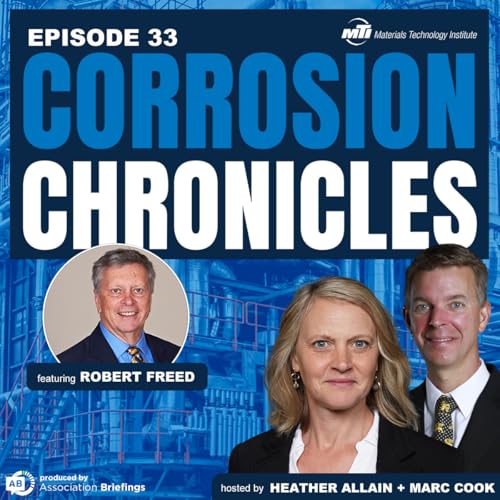
    In this episode, Robert Freed, Ph.D., FASM, Associate Director at the Materials Technology Institute, joins co-hosts Heather Allain and Marc Cook for a practical, materials-focused discussion on corrosion and wear. Robert helps clarify the differences between abrasion, adhesive wear, erosion, and cavitation, and explains how these damage mechanisms commonly show up in industrial equipment such as extruders and other high-wear components. The conversation explores key variables that influence wear performance, how wear can accelerate corrosion, and why factors like particle size matter. Robert also walks through methods for evaluating and ranking materials, including relevant ASTM wear tests, metals lab analysis, and the pros and cons of different overlay solutions—such as laser cladding, thermal spray, and weld overlay—as well as non-metallic options. The episode closes with insight into MTI-led research projects and practical considerations for selecting materials and processes to manage wear in demanding operating environments.

    This episode is sponsored by Tricor Metals and Webco Industries. Corrosion Chronicles is produced by Association Briefings.
    Más Menos
    54 m
  • Eddy Current Testing (ECT) of Heat Exchanger Tubes
    Jan 7 2026

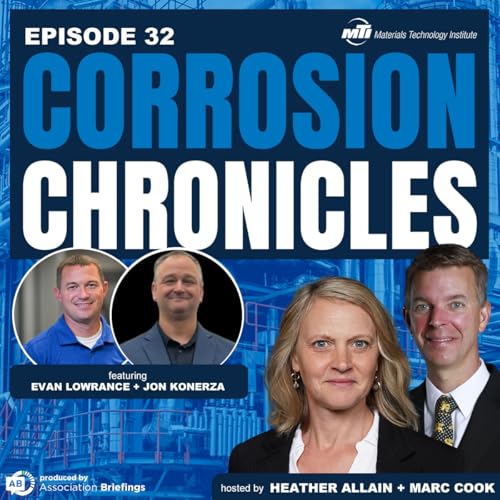
    In this episode, Evan Lowrance, Corporate NDT Engineer at Webco Industries, and Jonathan Konerza, Tubing Division Manager at Sentinel Integrity Solutions, join co-hosts Heather Allain and Marc Cook for an in-depth look at eddy current testing (ECT) of heat exchanger tubes. Together, they break down how ECT works, the differences between internal and external testing, and how factors like magnetism and material conductivity influence test results. The conversation explores how eddy current testing compares to IRIS testing, what types of defects ECT is best suited to detect, and where its limitations exist. Evan and Jonathan also discuss the importance of reference standards, technician qualification, and tailoring inspection programs to expected degradation mechanisms. The episode wraps with practical insight into evaluating NDE providers and recognizing warning signs that testing may not be delivering reliable results.

    This episode is sponsored by Tricor Metals and Webco Industries. Corrosion Chronicles is produced by Association Briefings.
    Más Menos
    55 m
  • Column Internals
    Dec 3 2025

    In this episode, Danny Mock, managing partner for M10 Process Equipment, Inc., joins co-hosts Heather Allain and Marc Cook to take listeners inside the world of column internals and the fundamentals that drive mass-transfer performance. Danny breaks down what mass-transfer equipment is and how internals efficiency is evaluated, offering practical insight into design considerations that influence reliability and long-term operation. He discusses the importance of selecting materials with appropriate corrosion allowances, how internals are attached and supported, and what engineers should know about bolted fasteners, dissimilar metals, tray flatness, and the risks associated with creep and thermal expansion. The conversation also covers column fires, static charge generation, and the role of random packing in modern column design. Whether you're troubleshooting existing towers or designing new equipment, this episode provides a comprehensive look at the details that matter most inside a process column.

    This episode is sponsored by Tricor Metals and Webco Industries. Corrosion Chronicles is produced by Association Briefings.
    Más Menos
    1 h y 1 m
  • Explosion Cladding
    Nov 5 2025

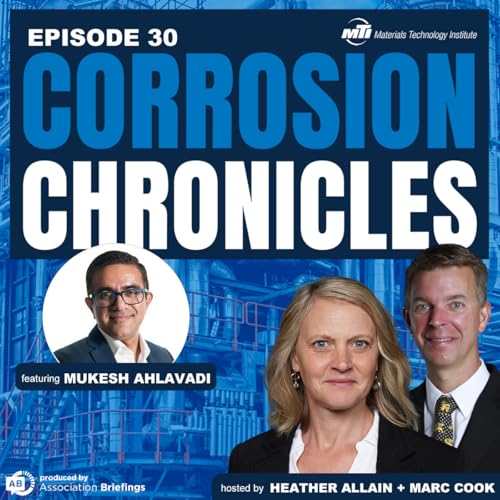
    In this episode, Mukesh Ahlavadi, Global Director of the Chemicals Market at NobelClad, joins co-hosts Heather Allain and Marc Cook to explore the world of metal cladding and its critical role in modern engineering applications. Together, they provide an overview of hot roll bonding versus explosion cladding, examining the key drivers behind each process and why industries turn to cladding for enhanced material performance and corrosion resistance. Mukesh walks through essential fabrication considerations, including the use of batten strips, interlayers, and post-cladding operations, while sharing insights into heat treatment, forming clad plate, and lessons learned from a 1990s clad failure. Listeners will gain a clear understanding of how explosion cladding was discovered, the mechanics of the process, and how the distinctive wave pattern at the clad interface reflects quality and bonding integrity.

    This episode is sponsored by Tricor Metals and Webco Industries. Corrosion Chronicles is produced by Association Briefings.
    Más Menos
    53 m
  • Gasketed Joints
    Oct 1 2025

    In this episode, Kevin Ganschow, materials & corrosion consultant at Mechanical Materials Engineering, LLC, joins co-hosts Heather Allain and Marc Cook to unpack the intricacies of gasketed joints. The discussion begins with a foundational look at flange assemblies as systems before diving into key factors such as gasket stress, bolt reuse, and lubrication. Kevin highlights best practices for bolted joint assembly and integrity programs, emphasizing the importance of assembler training, flange tagging, and condition assessment. The episode also explores advanced considerations including joint relaxation, hot tightening, hot bolting, and bolt relaxation, offering practical insights for engineers and operators aiming to enhance reliability and safety in their systems.

    This episode is sponsored by Tricor Metals and Webco Industries. Corrosion Chronicles is produced by Association Briefings.
    Más Menos
    1 h y 1 m
  • How a Materials Lab Works
    Sep 3 2025

    In this episode, Jennifer Larimore and Avery Boyer, Materials Engineers at Chemours, join co-hosts Heather Allain and Marc Cook to share an inside look at how a materials lab works. Jennifer and Avery walk through the step-by-step process of analyzing samples—from sectioning, cleaning, reviewing documentation and photographing through the final wrap up of documenting and communicating findings to the customer. They discuss analysis methods like nondestructive evaluation, XRF identification, hardness, fracture testing, polishing and metallography to uncover critical material properties. The discussion also explores the importance of turning technical findings into clear, actionable recommendations. Throughout the conversation, the guests highlight how these practices help solve real-world challenges, prevent failures, and ensure long-term reliability.

    This episode is sponsored by Tricor Metals and Webco Industries. Corrosion Chronicles is produced by Association Briefings.
    Más Menos
    54 m