Episodios

  • Late Night Chat with JeffWolverton: E&G: ”Overcoming Worry,” Mar 2, 2026, live BabaZoom
    Mar 3 2026
    Dear folks of Baba, Overcoming worry, which Baba repeatedly urged us to do, is an ongoing challenge of a lifetime. By comparison to many other weaknesses in ourselves, worry appears relatively harmless with few real consequences; we think of it as mainly our own problem, a minor botheration perhaps, and on the surface doesn’t seem to seriously affect others. For this reason, we often don’t treat it as a critical impediment in our inner life with Baba. Nothing could be further from the truth! Baba has said that there are few things that drain our psychic energy more than worry. He stated, “It substantially curtails the joy and fullness of life.” I was always amazed at how worry seemed to be absent from Darwin’s consciousness; he had a supreme trust and faith in Baba that I was unable to achieve myself. It was something to witness. He would quote Baba, “Don’t worry. Let Me do the worrying. I enjoy working things out. There is no need for both you and I worrying. If you are going to worry, then I won’t worry.” When we worry, Baba is saying, we are robbing Him of something He “enjoys”—"working things out.” There are things that Baba has said that aid us in overcoming worry, and the mandali with their many years of experience with Baba have also shared what has worked for them. Darwin has said that worry is actually one of the many manifestations of fear, but rather than facing our raw fear directly, we usually think of how we can protect ourselves by worrying rather than giving the fear in the moment to Baba. This approach is like clipping off the tops of weeds without digging down and eliminating the roots. The weeds will only grow back. Few people think to fully give the raw fear directly to Baba in the moment and let Him help us dissolve it at its source. When we experience fear, we are being given a rare opportunity with Baba to tackle the root cause of worry itself. Adding to the problem of worry, when faced with an unnerving situation, we often instantly view it within the perspective of time and space. How can we get out of the uncomfortable present and escape to somewhere else? We go to the past (memory) to see what we’ve done before to look for a solution, and we then go to imagination (the future) to implement what the past tells us to do. That is, we leave the present, the Now, where Baba and intuition are accessible with their creative, sometimes unprecedented and spontaneous solutions. If we look back on our life, there are many terrible things we thought would happen that never came to pass. Rarely do we hold our minds accountable, which is a serious mistake. We move on. We are not inclined to look back, but if we don’t, we tend to indulge in similar worries in the future. We are programing our subconscious minds to avoid dealing with negative situations. Therefore, we must strive to unfailingly hold our mind accountable for its misleading assertions, otherwise our worrisome mental patterns will only continue. From Darwin, we learned to discipline our subconscious to hold our mind accountable in all cases, large and small. As long as worry preoccupies our mind, the ego takes center stage and our focus on Baba is pushed to the background. But when Baba is in the foreground, when we return to Him again and again in thought, worries gradually dissolve in His loving presence. In remembering Baba in this moment, we are less vulnerable to being pulled down into a state of worry. Darwin said that “the antidote to worry is faith and trust in God … Counteracting worry through building our faith and trust opens up a vast new area of possibilities for self-improvement within and in our outer life.” A situation that causes us extreme worry can have a positive effect if it causes us to get down on our knees and ask Baba for help. It can link us up with Him. There is a quote that Mani, Baba’s sister, used to share, “I prayed to You for strength to carry out Your work. You gave me weakness so I would depend on You.” Eradicating worry is one of the last hurdles to be crossed in gaining control of the mind. It requires us not to make so much of the outer events of life so that they become secondary compared to the inner life; we have to become more profoundly aware of the deluding power of imagination. Mark Twain, the American humorist, once said, “I’ve been through many trials and tribulations in this life, and most of them … never happened!” Whatever you do, though, don’t worry about worrying. I once asked Meherjee Karkaria, one of Baba’s intimate mandali, what method he had for overcoming worry. He gestured with his hands circling around his head, as if besieged by thoughts, “Around Baba, I was always worrying!” Yet he didn’t worry about worrying! “Love will control the future, so why worry? Do not think: feel My love.” Meher Baba In His love, Jeff
    Más Menos
    1 h y 25 m
  • Late Night Chat with JeffWolverton: E&G: ”reprogramming our experience,” Feb 23, 2026, live BabaZoom
    Feb 24 2026
    "Through unconscious programming—stocking our subconscious with limiting beliefs—we have schooled our minds in limitations, and our minds have become tyrannical. Because of this, we put conditions on Baba’s ability to bring about changes in us, and we also place limitations on our own ability. All these limitations we believe to be real are entirely self-programmed.” Darwin Shaw In the above quote, Darwin encapsulates a profound insight into one of our major impediments to an expansive and harmonious life. In what he gathered from Baba, Darwin often spoke in-depth about how we have been programmed to live with countless limitations, many of which we imbibed and bought into in early childhood before we were fully aware and mature. To give a few examples: we imbibed the belief that we are separate beings, and others and the world are outside of us. We were often told that what we are looking for in life is in the future, and that the present moment is just a stepping stone to some future existence. We may have taken on the belief that God disapproves of us if our behavior fails to follow a prescribed set of values and standards. We may have been made to feel that if we don’t work hard, we will never amount to anything. There are countless false beliefs that limit the fullness of our lives. Sometimes the overall hidden impact of such beliefs that we have absorbed in growing up is that there is something wrong with us, we are insufficient, not enough, forever incomplete. Darwin stressed emphatically that we need to re-program ourselves in the light of the highest truths, the spiritual values that come from deeper within us, which are eternally available in this moment. Darwin encouraged us to take seriously Baba’s words: “Whatever you want to be, that you become.” That is, what we envision ourselves to be will come to pass, and so it is important to ponder deeply what we want to become. Darwin came from the tradition known as “the power of positive thinking." Darwin asserts unequivocally that our soul is intimately linked not only to Baba’s love, but to His omnipotence, to the Universal Mind as well as to His immediate personal Presence, and we can draw upon this eternal Source (sometimes called First Cause) to help change our experience from being one of continual limitation into the expansiveness and inclusiveness of the Divine. There are many speakers who advocate using this tremendous divine power to “manifest” abundance for themselves: wealth, position, a house, a lucrative job and the like. And it can work. But Darwin insisted that with Baba and this divine power in our hands, rather than being tempted to use it for selfish purposes, we can, through Baba’s grace, access it for fostering a more loving life dedicated to Him. We can let go of our narrow programming in favor of His unlimited programming. Baba has encouraged us to break up our old patterns and “insist on creating something new by our own inner vision.” We can actually be active participants in becoming more universally loving rather than using this divine power to be more successful in the world. In Darwin’s presence, it was clear that he was not only radiating Baba’s love, but he was also asserting from within Baba’s omnipotence which lifted him above the limiting and narrow conditions of this world. It was something to behold! Darwin insisted that if we approach Baba with how we would like to be, bringing Him our deepest longing and intention, the tremendous divine loving power, which is ever-present, will bring this about. We are bypassing our lower limitations and worldly conditions (our usual karmic timetable) and appealing to Baba’s omnipotence and the higher part of ourselves. There is nothing selfish in doing this. We are drawing not just on our love for Baba, but on our faith and conviction in His transformative power to intervene in our life. At a practical level, we can even bring the power of this supreme intention down into our everyday life. Through actively asserting Baba’s omnipotence within us and staying keenly aware, we can convert in the moment our negative reactions into loving responses to life, our better angels. Thus, our anger can be sublimated through loving intention into patience and tolerance, its opposite as Baba has said. Greed can be sublimated into generosity, its opposite, lust into purity, retaliation into forgiveness, and disinterest into empathy. Darwin said, “The truth is that we are unlimited spirit and one with God, so if we take our stand on the truth, this will manifest and become our experience…By thinking of Baba as God the Infinite (or Universal Mind), we are plugging into both the personal and impersonal avenues of power, energy, truth and reality.” Baba has said, ‘I am in you, and the Universal Mind can give anything, to anyone, at any time.” In His love, Jeff
    Más Menos
    1 h y 19 m
  • Baba’s Birthday Quotes sharing meeting, Feb 25, 2026, live on Baba Zoom
    Feb 25 2026

    Participants are invited to bring their Baba's Birthday Quotes to share, out loud!

    Personalized Quotes are sent out via email to anyone who is listed in the Baba Zoom Community Directory.

    If you did not receive one, feel free to bring any favorite Baba quote to share!

    Tech host Betty Lowman in CA

    This event was recorded live. To be first to be notified of a new video on this channel, please hit the red subscribe button, then the notifications bell. To join future live events, see www.babazoom.net. Please join our Facebook group: www.facebook.com/groups/meherbabafamily

    Más Menos
    1 h y 26 m
  • ”Celebrating the Humanity of the Divine Beloved” Charles Haynes, Feb 22, 2026, live on Baba Zoom
    Feb 22 2026

    "Celebrating the Humanity of the Divine Beloved" a talk by Charles Haynes for Baba's birthday.

    Hosted by Betty Lowman in CA

    This event was recorded live. To be first to be notified of a new video on this channel, please hit the red subscribe button, then the notifications bell. To join future live events, see www.babazoom.net. Please join our Facebook group: www.facebook.com/groups/meherbabafamily

    Más Menos
    1 h y 43 m
  • Late Night Chat with JeffWolverton: E&G: ”Harm of Judging ourselves,” Feb 16, 2026, live BabaZoom
    Feb 19 2026

    The Topic: The Harm of Judging Ourselves

    Dear folks of Baba,

    Darwin was very insistent that we give up judging ourselves negatively, maintaining that it is one of the most insidious traps of the ego. We were young in Baba, and this was welcome news, because most of us had grown up regarding judging ourselves as a normal thing to do. Darwin has said, “Baba is not judgmental in any way, nor does He hold our weaknesses against us.” We had never met anyone who was like this, although for many of us, our mothers may have come the closest to this kind of love. In reading about Baba’s training of the mandali, we might conclude that He was often judging and disapproving of their behavior, but in fact He was only acting in their best interests. He is like a music teacher with perfect pitch pointing out that a student’s guitar strings are sharp or flat, which is interfering with their performance. Although Baba’s love is unconditional and not judgmental, from our side we must do our part by developing self-compassion and self-acceptance (two qualities, as Marion says, we must have in our “tool box”). Darwin would say, when we are hard on ourselves, we are interfering unnecessarily in our reception of Baba’s love which He is ever-ready to shower on us. Our receptivity is infinitely more crucial to our life with Baba than we could ever imagine. We must be absolutely accepting of His love and not buy into all our psychological and moral limitations. Baba is inviting us to be more loving, to truly love ourselves as He does, and each effort we make toward becoming more loving is His victory in us.

    Why is it so difficult to refrain from judging ourselves? Among the many ways we do this, there are two that are particularly difficult to avoid. It seems only natural to hold ourselves accountable when we are selfish or do something “wrong”. It is our habit. And we must continue to make efforts to be more loving. But Baba says in His description of the provisional ego, which He encourages us to adopt, that we must think it is “Baba doing everything.” He says, even when we do something wrong, we should think it is Baba doing wrong. That for me was one of the greatest hurdles I have had to rise above and still struggle with. I would think to myself that Baba would never be as critical of others and as petty-minded as I am! Too often, we unquestioningly take credit for what we do, good and bad, but Baba insists that He is the sole doer. We must continue to strive to live by the most loving values we are capable of, but unfortunately much of the struggle in our lives is due to the fact that we are often trying to improve our personality self exclusively, our lower identity, rather than thinking more and more of Baba and aligning ourselves with Him who is our higher Self.

    One of the most surreptitious contributors to negative self-judgement is our mental ideals that we have bought into, which are set too high for what we are really capable of achieving. We wind up always falling short and even after decades, we may find that we are still harboring the thought, “I’m not good enough. I feel so inadequate.” Our negative self-judgment may even be secretly masquerading as humility. One thing I learned from the mandali is that our ideals should be practical—what is the next baby step we can take—not the impossible achievement of the highest ideal. We don’t learn patience or forgiveness overnight. The ego has a way of colluding with the mind to guilt-trip us when we fall short of our mental ideals. On the other hand, the ideals formed in the heart are much more compassionate, not so black-and-white. The heart knows just what we are capable of in the present, our next step. In fact, the ego is fighting a battle for the supremacy of our attention, and it is a victory for it when the ego can get us thinking negatively about ourselves instead of remembering Baba and others with love. The ego can also hide in feeling superior to those who have a healthy attitude toward themselves, seeing their attitude as naive and an expression of the ego! Or the ego can hide out in envy of others, rather than having a positive appreciation of the valuable qualities they express.

    All the time we spend thinking critically of ourselves, we all know, is time spent away from thinking about Baba and responding to the love He’s asking us to share with others and this world. In judging ourselves, we are clearly not fully in the present where Baba is most found, but rather we are mentally in the past or the future. And consequently, we are not really in a receptive state in the present moment either to Baba or to others.

    Rumi has said,

    “We are so obsessed with the bad stitching on our sleeve

    That we’re blind to the magnificent beauty of our own garment.”

    In His love, Jeff

    Más Menos
    1 h y 12 m
  • Sahavas for Everyone: guest Latka Thompson, Feb 19, 2026 live on Baba Zoom
    Feb 20 2026

    Sahavas for Everyone.

    Avatar Meher Baba is in each one of us. And His Love is the focus of this gathering. Open discussion with each session having a topic or theme. Hosted by Laurent Weichberger in SC.

    Jai Baba!

    This event was recorded live. To be first to be notified of a new video on this channel, please hit the red subscribe button, then the notifications bell. To join future live events, see www.babazoom.net. Please join our Facebook group: www.facebook.com/groups/meherbabafamily

    Más Menos
    1 h y 19 m
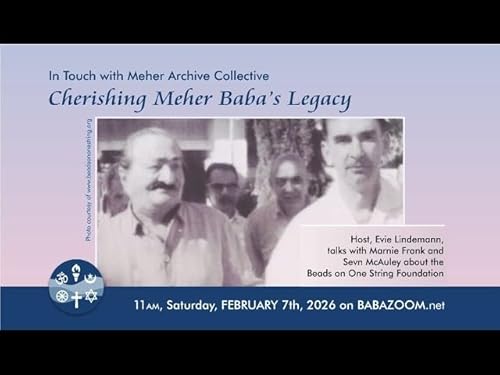
  • In Touch with the MAC: a conversation about Beads on One String, Feb 7, 2026 live on Baba Zoom
    Feb 10 2026

    Join host Evie Lindemann and guests Marnie Frank and Sevn McAuley as they talk about the history and work of the Beads on One String Foundation, whose mission is dedicated to the exploration and expression of the Oneness that lies at the heart of all.

    Hosted by Evie Lindeman and Ashley Lowe in NC

    This event was recorded live. To be first to be notified of a new video on this channel, please hit the red subscribe button, then the notifications bell. To join future live events, see www.babazoom.net. Please join our Facebook group: www.facebook.com/groups/meherbabafamily

    Más Menos
    1 h y 47 m
  • Late Night Chat with Jeff Wolverton: E&G: ”Ascending Spiral of the Path,” Feb 9, 2026, live BabaZoom
    Feb 10 2026
    Dear folks of Baba, Darwin would sometimes describe life with Baba using the metaphor of an ascending spiral encircling Him to depict the spiritual path. It starts at the outer ring, and spirals upward and very gradually narrows around Baba until, sooner or later (usually a lot later), we are face-to-face with our Beloved! There are walls that separate the ever-narrowing spiral. To expand on what Darwin describes: in the beginning, as we move along the outer ring, we revolve through all the many repetitious experiences we have to face in life: our diverse emotional complexes, desires, tests, bindings, breakthroughs, relationships, disappointments, failures and successes. Taking, as an example, one complex such as the fear of public speaking: at the beginning of the spiral, say, we have to give a talk before a class in college. We go through all the agony in anticipation, extremely fearful that we might lose the thread of what we want to say. We try to give the whole ordeal to Baba as best as we can in our agitated state. In the actual talk, we find ourselves stumbling over our words, struggling to remember what we planned to say, and in the end, we embarrass ourselves. We are left with a painful memory. We now avoid public talks in any way we can, but suppose a year later we have to again give a talk which is unavoidable. We go through all the incredible mental turmoil like the previous time. We say to ourselves, “Not this again!” And the talk goes about the way it did the year before—poorly. We conclude that we’re not making any progress whatsoever. This goes on year after year. We do get better, but not enough to call it a substantial progress. What Darwin would say is that unknown to us, each time we face this fear, we have made a circuit of the spiral and are dealing with the fear at a higher level. We are facing our complex at a more refined elevation even though it seems like the same “stubborn old problem”. Again and again, we have to work intensely with the fear, and we surrender a little more of the complex to Baba. Every time we deal with such difficult situations in our life, we are really working at a higher level, and at the same time, we are moving closer and closer to Baba who is ever-present at the center of the spiral. That is, we are making headway even if it doesn’t seem so at all. Going around and around the spiral, rising slightly and often imperceptibly higher each time, we are, Darwin would say, gradually freeing ourselves of our sanskaras (our past karma). But there comes a point when we see that we can burn through the wall of the outer spiral where we are and into one of the inner spirals, and bypass the longer outer route. This is when we make Baba the center of all our aspirations, when we are facing directly toward Him and are turned away from all our emotional complexes that we have had to face along the outer spiral. Darwin calls this a “spiritual bypass”. Through Baba’s grace, we can actually burn through the walls of the outer spirals one by one, and we find ourselves closer and closer to His immediate presence and facing away from the presence of the world and all our karmic complexes. This greatly speeds up our progress toward merging with our Beloved. We are facing the sun, as Baba says, with our backs now turned away from our shadow, the world and our many issues with it. In a Rumi quote liked by Darwin, he says, “On the spiritual path, effort is required. But grace is a thousand times greater than effort. When the morning sun appears, the candle of self-effort can be blown out.” I have always found Darwin’s metaphor of the inner path very helpful and hopeful and which confirms that we are really drawing closer to Baba all the time through our seemingly muddling efforts! Baba, in a profoundly encouraging message, says in His Discourses, “The aspirant is generally conscious of the manner in which he has been responding to the diverse situations in life, and rarely conscious of the manner in which he makes progress towards self-knowledge. Without consciously knowing it, the aspirant is gradually arriving at self-knowledge by traversing the Inner Path through his joys and sorrows, his happiness and suffering, his successes and failures, his efforts and rest, and through his moments of clear perception and harmonized will as well as through the moments of confusion and conflict. These are the manifestations of the diverse sanskaras which he has brought from the past, and the aspirant forges his way towards self-knowledge [towards Baba] through the tangles of these sanskaras like the traveler threading his way through a wild and thick forest.” Does Darwin’s metaphor of the inner life clarify how we proceed on the path? Is it clear how turning directly to Baba within can be a spiritual bypass of our otherwise slow karmic journey? In His love, Jeff P.S. We are continuing on page 68
    Más Menos
    1 h y 17 m