Constructive Voices Podcast Por Jackie De Burca arte de portada

Constructive Voices

Constructive Voices

De: Jackie De Burca
Escúchala gratis

Constructive Voices is an award-winning global platform that aims to break down silos in the built environment to accelerate positive change. Through global conversations with change-makers, we inform our audience about some of the most important concepts and solutions of today. The Constructive Voices team investigates topics such as green building, biodiversity, renewable energy, nature-positive solutions, AI, resilient building and more. Hosts to date have included Jackie De Burca, Henry McDonald, Peter Finn, Steve Randall, Emma Nicholson and Sarah Austin. Our vision is to partner with as many companies and individuals as possible to feature the positive work that they are doing. Making Constructive Voices the Go-To resource for global information and ideas on positive methods for a more sustainable built environment and world. Our team is dedicated to exploring and promoting sustainability, biodiversity and innovation. We talk to world-renowned experts, local people, businesses and students in our quest to document and inspire positive, historic changes required for these challenging times.© 2023 Constructive Voices Economía
Episodios
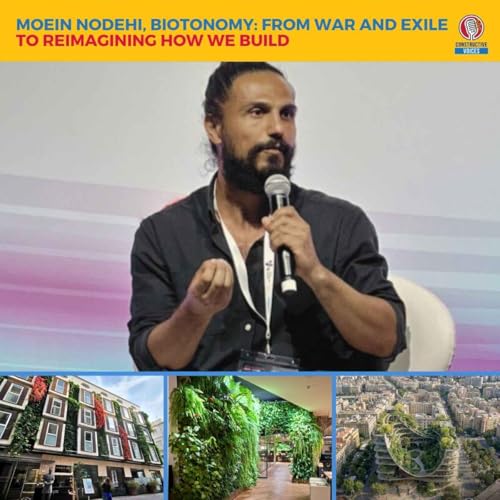
  • Moein Nodehi: From War and Exile to Reimagining How We Build
    Mar 17 2026

    “I grew up with my parents telling me stories about the ancient Persian civilisation… and I created this huge passion for ancient civilisations.” Moein Nodehi

    Moein Nodehi Constructive Voices Podcast Cover

    He was born in the middle of war.

    As conflict tore through Iran, Moein Nodehi’s family fled in search of safety, eventually ending up in an immigration camp in Sweden.

    But even in those uncertain early years, another world was being built inside him.

    His parents kept hope alive by telling stories of ancient Persia — its gardens, palaces, civic systems and extraordinary buildings. Those stories stayed with him. So did the contrast he later witnessed when he returned to Iran as a boy: the visible scars of war set alongside the brilliance of ancient architecture.

    That collision of destruction and civilisation shaped him.

    It made him question how we build, why we build, and what kind of world our buildings are really creating.

    “What happened to me in the pyramids was deeper than what I can really explain with words.” Moein Nodehi

    Biotonomy's visual of green walls

    Years later, that questioning would take him from engineering school to major construction projects in Dubai, and then far beyond the mainstream industry altogether. Disillusioned by what he saw — buildings celebrated as symbols of innovation while human and environmental costs were ignored — Moein chose a different route.

    He walked away, travelled widely, learned from grassroots projects around the world, and eventually founded Biotonomy: a company focused on nature-based architecture that treats buildings as living systems rather than machines.

    “I was really obsessed about how we are building our buildings, our cities, and really our civilisation.” Moein Nodehi

    In this episode of Constructive Voices, Jackie De Burca speaks with Moein about exile, ancient wisdom, modern cities, water, heat, resilience, and why nature may hold many of the answers we’ve forgotten.

    Moein Nodehi Biotonomy aerial view of green roofs

    “The design decisions that we take for our cities, for our buildings, have a direct impact on our brain waves and our wellbeing.” Moein Nodehi

    In this episode

    Jackie and Moein explore how buildings can work with nature rather than against it — and why that shift matters not just for carbon and climate, but for

    Más Menos
    1 h y 6 m
  • Neurosustainability: How the Built Environment Shapes Brain Health, Ageing & Resilience
    Feb 24 2026
    What if “healthy ageing” isn’t just about genes, diet, or healthcare — but also about the streets you navigate, the air you breathe, the noise you sleep through, and the buildings you spend 90% of your life inside?

    “This conversation makes the case for a shift: from sustainability as a materials-and-energy conversation, to neurosustainability — designing environments that protect sleep, reduce stress load, support movement, and build cognitive resilience across the lifespan.” Jackie De Burca

    Host: Mohamed Hesham Khalil – Creator of the Neurosustainability theory, architect and neuroscience researcher, and a PhD candidate at the University of Cambridge.

    Guest: Professor Agustín Ibáñez — Director of Global Research Networks at the Global Brain Health Institute (Trinity College Dublin) and Scientific Director of the Latin American Brain Health Institute

    Guest: Burcin Ikiz — Neuroscientist and brain health advocate working at the intersection of climate, equity, and brain outcomes

    Podcast cover

    Brain health isn’t only personal. It’s environmental. And the places we live, move, and work in can either build resilience — or quietly chip away at it.

    “The built environment… is the space where we most of the time live, move, think and also thrive or become sick.” — Professor Agustín Ibáñez

    In the third part of this mini-series about neurosustainability, Cambridge scholarship student, Mohamed Hesham Khalil sits down with Professor Agustín Ibáñez and Burcin Ikiz to connect the dots between climate, inequality, urban design, and the ageing brain.

    They unpack the exposome and zoom into the built environment as the missing middle layer we can actually change.

    “Scientists sometimes we use strange words for simple things.” — Professor Agustín Ibáñez

    What is the exposome?

    The exposome is the full set of environmental influences (physical, social, and economic) that shape our health and behaviour over time — and why the built environment is the missing “mesoscale” link between global forces (like climate change and inequality) and individual brain outcomes (like cognition, dementia risk, and mental health).

    “I always see that the built environment itself maybe hasn’t been given the same attention… because… people spend around 90 percent of time indoors.” Mohamed Hesham Khalil

    Th...

    Más Menos
    46 m
  • Neurosustainability: Designing Places Where Brains Can Thrive
    Jan 30 2026
    Neuro-Sustainability: Designing Places Where Brains Can Thrive

    What if sustainability wasn’t only about carbon, materials, and energy — but also about the human brain?

    In this second episode of the mini-series about neuro-sustainability, neuroscience and architecture meet in a conversation that feels both urgent and surprisingly practical.

    We investigate the work of Cambridge scholarship student, Mohamed Hesham Khalil, which we believe should be integrated into planning and architecture around the world.

    “We can change diet, can change habits, but we cannot change a built environment. It’s built once and it lasts for tens of years.” Mohamed Hesham Khalil

    In this episode, he is joined by Burçin Ikiz, who brings a climate-and-health lens to brain wellbeing across the lifespan.

    Mohamed Hesham Khalil brings a design-and-research lens focused on environmental enrichment — and what our homes, streets, workplaces, and neighbourhoods are doing to us every day, whether we notice it or not.

    This is not a theoretical chat. It’s about how we design environments that help brains thrive — especially as heat, pollution, and chronic stress become part of daily life for millions.

    Why this episode about neuro-sustainability matters

    We like to think of brain health as something personal: sleep, diet, exercise, mindset. But the built environment is a long-term exposure — and it’s stubbornly permanent.

    If your surroundings make movement hard, keep you indoors, overwhelm your senses, trap heat, or load the air with pollution — you don’t just “feel it.” Your brain does too.

    What you’ll learn

    1) What “environmental enrichment” means in the real world

    This conversation translates neuroscience into design language: environments that support movement, stimulation, connection, and recovery.

    “Don’t use it, you lose it. Just kind of like our muscles in our bodies.” Burçin Ikiz

    2) The indoor reality we rarely talk about

    If buildings are designed mainly for convenience and comfort, what happens to stimulation, mobility, and everyday brain engagement?

    “When we spend like around 90 percent of time indoors… almost no chance for cognitive stimulation or physical activity through the building…” Mohamed Hesham Khalil

    3) Heat, buildings, and brain function

    As the climate warms, poorly adapted buildings become neurological stressors — not just uncomfortable boxes.

    “If most of our buildings… have not been created for this increasingly warming world, it can be very, very hot indoors and that can really affect our brains.” Burçin Iki...

    Más Menos
    48 m
Todavía no hay opiniones