Episodios

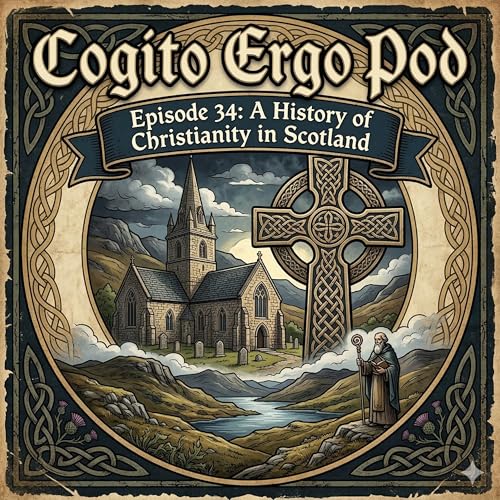
  • Episode 34: A History of Christianity of Scotland
    Apr 6 2026

    From the rain-swept hermit cells of Iona to the fiery pulpits of the Reformation, the story of Christianity in Scotland is one of rugged faith and fierce independence. In this episode of Cogito Ergo Pod, Daniel journeys through nearly 2,000 years of spiritual evolution.

    We explore the "heavyweights" of the faith, including St. Ninian and St. Columba, and witness the radical shift from mystical Celtic Christianity to the structured Roman reforms of Queen Margaret. We’ll also dissect the explosive arrival of John Knox, the democratic birth of Presbyterianism, and the "Killing Time" of the Covenanters, where faith was often signed in blood.

    Finally, we bring the story into the 21st century. How does a nation with such a deep religious DNA navigate a modern landscape where "No Religion" is now the majority? Join us as we delve into the theology, philosophy, and grit that shaped the Scottish soul.

    Key Topics:

    • 563 AD: Columba, Iona, and the first "Nessie" sighting.

    • The 1560s: John Knox vs. Mary, Queen of Scots.

    • The Disruption of 1843: Why a third of the Church walked out.

    • The 2022 Census: Understanding the modern spiritual makeup of Scotland.

    Más Menos
    13 m
  • Episode 33 - Origen of Alexandria: The Brilliant Heretic
    Mar 16 2026

    How does a man go from being the Church's greatest intellectual defender to its most famous condemned heretic? In this episode of Cogito Ergo Pod, we dive into the radical life and mind of Origen of Alexandria.

    Born into a world of Roman martyrs and Greek philosophers, Origen didn't just study theology—he invented the way we do it. From the staggering scholarship of the 6,000-page Hexapla to his legendary (and painful) acts of devotion, Origen’s life was as intense as his intellect.

    We explore his most controversial theories, including the pre-existence of souls and the "cosmic hospital" of Apokatastasis—the radical belief that in the end, God’s love is so powerful that even the Devil will be restored. Join us as we unpack the legacy of a man who was tortured for his faith, only to be branded a villain three centuries after his death.

    In this episode, we discuss:

    • The intellectual melting pot of 2nd-century Alexandria.

    • The "Body, Soul, and Spirit" of scriptural allegory.

    • The Hexapla: The greatest feat of ancient scholarship.

    • The controversial hope of Universal Salvation.

    Más Menos
    16 m
  • Episode 32 - The Horns of Moses
    Mar 5 2026

    Why does one of the most iconic figures in the Bible—the lawgiver Moses—frequently appear in medieval and Renaissance art with a pair of horns? In this episode of Cogito Ergo Pod, Daniel unpicks a fascinating historical "optical illusion" that started with a single Hebrew word and ended with some of the most famous sculptures in the world.

    We journey from the 4th-century translation rooms of St. Jerome to the Sistine Chapel, exploring how a possible mistranslation of the word qāran (to shine) led to a thousand-year tradition of "horned" iconography. We’ll discuss the linguistic detective work behind the Latin Vulgate, the darker shift toward antisemitic tropes in the Middle Ages, and how Michelangelo’s masterpiece eventually closed the chapter on this bizarre visual tradition. Is it a mistake, a metaphor, or a deliberate theological statement? Tune in to find out.

    Más Menos
    11 m
  • Episode 31 - Book of Tobit (For Michael)
    Feb 6 2026

    What happens when you mix ancient Jewish history, a string of mysterious wedding-night murders, and a very unfortunate encounter with a sparrow? You get the Book of Tobit. In this episode, Daniel takes us on an ancient road trip through the 8th-century BCE Assyrian exile to explore one of the most cinematic stories in the Deuterocanonical tradition.

    We follow the righteous but blind Tobit, the cursed Sarah, and the young Tobias as they navigate a world of demons, angelic disguises, and medicinal fish guts. But it’s not just a tall tale—we’re diving deep into the academic and historical bones of the text. From the influence of Persian Zoroastrianism to the groundbreaking textual discoveries in the Dead Sea Scrolls, we’ll look at how the "Short" and "Long" versions of this story changed the way we understand divine providence. Whether you’re here for the Archangel Raphael or the critical analysis of Second Temple literature, this episode has something for every thinker.

    Más Menos
    13 m
  • Episode 30 - The Celtic Church
    Jan 23 2026

    In this episode, Daniel navigates the "thin places" of the North Atlantic to uncover the gritty reality of Celtic Christianity. We move past the romantic myths to explore a radical world of monastic cities, oar-less voyages, and a philosophy that saw the entire natural world as a visible manifestation of the divine.

    From the high-level metaphysics of John Scotus Eriugena to the psychological depth of the Anmchara (Soul Friend), we examine how the "interlace" of the Celtic mind connected the human, the animal, and the sacred. Discover why this ancient, nature-centric expression of faith still haunts our modern imagination.

    In this episode:

    • Fact vs. Myth: Debunking the Victorian invention of the "Celtic Church."
    • Metaphysics: Eriugena’s fourfold division of Nature.
    • The Three Martyrdoms: Radical trust in the "Desert of the Sea."
    • The Interlace: Visualising the interconnectedness of all things through the Book of Kells.
    Más Menos
    12 m
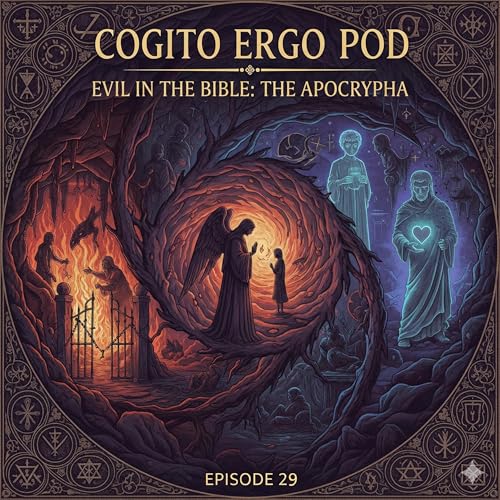
  • Episode 29 - Evil in the Bible: The Christian Apocrypha
    Jan 15 2026

    In this episode of Cogito Ergo Pod, your host Daniel explores the shadows of the early Christian and Jewish imagination. While the canonical Bible provides the foundation for Western views on morality, many of our most vivid images of the Devil, the architecture of Hell, and the nature of betrayal actually stem from the "Expanded Universe"—texts written between the 1st and 4th centuries CE that didn't make the final cut of the New Testament.

    We often think of the Bible as a complete manual, but for early believers, there were massive narrative gaps. How did Satan fall? What exactly happens to sinners in the afterlife? What was Jesus like as a child? In this deep dive, we dissect the non-canonical answers to these questions.

    Más Menos
    21 m
  • Episode 28 - Evil in the Bible: The Book of Revelation
    Jan 2 2026

    In this episode of Cogito Ergo Pod, Daniel dives into the most complex and controversial text in the Western canon: The Book of Revelation.

    Far more than a roadmap for the end of the world, Revelation serves as a profound "unveiling" of the systemic and cosmic forces that govern our reality. As the penultimate chapter in our series on Evil in the Bible, we move beyond simple archetypes to dissect the "Unholy Trinity"—the Dragon, the Beasts, and the False Prophet—and explore how this ancient text creates a scathing critique of political tyranny, economic coercion, and the deification of the state.

    In this episode, we explore:

    • The Symptoms: Why the Four Horsemen are the harvest of human ambition rather than just divine punishment.
    • The Source: The cosmic "Accuser" and the "wounded animal" theory of the Great Red Dragon.
    • The Power & The Propaganda: Dissecting the Beast from the Sea (Tyranny) and the Beast from the Earth (Ideology).
    • The Riddle of 666: Moving past modern myths to uncover the 1st-century reality of the Mark of the Beast and the Imperial Cult.
    • The Fall of Babylon: How Revelation defines evil as the commodification of "human lives and souls."
    • The Endgame: The trajectory of the Dragon and the philosophical implications of the "Second Death" in the Lake of Fire.

    Whether you approach this text through the lens of theology, history, or philosophy, join us as we do justice to John of Patmos’s visionary masterpiece. It is a story of resistance, a theatre of the mind, and ultimately, a defiant message of hope that evil—no matter how systemic—has an expiration date.

    Follow the Journey:

    • Listen: Available now on Apple Podcasts, Spotify, and all major providers.
    • Connect: Join the conversation and view our episode bibliography on Instagram @cogito_ergo_pod.
    Más Menos
    12 m
  • Episode 27 - Evil in the Bible: The Personal & Catholic Epistles
    Dec 18 2025

    In this episode of Cogito Ergo Pod, we continue to dive deep into a multi-faceted and often misunderstood subject: the anatomy of evil in the Bible. While many look to the dramatic imagery of the Gospels or Job, this episode shifts the lens toward the practical, "boots-on-the-ground" letters found at the end of the New Testament—the Pastoral and Catholic Epistles.

    Drawing from texts like James, 1 & 2 Peter, 1, 2, & 3 John, Jude, Hebrews, and the letters to Timothy and Titus, Daniel dissects how these second and third-generation communities defined the forces threatening to undo their mission. We explore evil not as a single, abstract monster, but as a three-dimensional threat:

    • The Evil Within: How disordered internal desires—pride, lust, and the "love of money"—serve as the "source code" for human destruction (James 1:14-15; 1 Timothy 6:10).
    • The Evil Between Us: The social collapse caused by favouritism, the "poison" of the tongue, and the absence of love within a community (James 2-3; 1 John 4:20).
    • The Evil From Outside: The terrifying rise of the "False Teacher," the ideological spirit of the "Antichrist," and the prowling "roaring lion" that seeks to devour the faithful (2 Peter 2; 1 John 2:18; 1 Peter 5:8).

    Whether you view these texts as sacred scripture or fascinating historical artefacts, this episode offers an accessible, scholarly, and engaging look at how ancient writers mapped the struggle for human goodness.

    Cogito Ergo Pod is available on most major podcast platforms, including Apple Podcasts and Spotify.

    Don't forget to subscribe and follow us on Instagram at @Cogito_Ergo_Pod for episode updates, and further explorations into theology, philosophy, and the esoteric.

    Más Menos
    15 m