CardCast Podcast Por Milan Veverka and Ged Roberts arte de portada

CardCast

CardCast

De: Milan Veverka and Ged Roberts
Escúchala gratis

Welcome to CardCast! Inspired by Milan Veverka’s habit of jotting insights on blank playing cards, this practice grew into a digital archive and now a podcast. Hosted by Ged and Milan, each episode takes one card as a prompt to spark conversation on leadership, communication, and the human side of growth. The idea is simple: one card, one prompt, one meaningful conversation.Milan Veverka and Ged Roberts Economía
Episodios
  • 32. The Don’t Do List with Milan Veverka and Ged Roberts
    Apr 6 2026

    Welcome back to CardCast! Today, we’re going to be talking about The Don’t Do List.

    We’re all great at building to-do lists. Adding. Expanding… But is anyone intentional about stopping?

    And that’s where the real leverage is.

    Because every low-value task we keep doing isn’t neutral, it’s actively stealing time and energy from something better. That’s the real cost. Not what we’re doing… but what we’re not doing because of it.

    The greatest thing about the “do not do” list is that it exposes hidden inefficiencies, and that the highest ROI move in most organizations isn’t adding something new, it’s removing what no longer matters.

    The takeaway is simple, but not easy:

    If you want better outcomes, don’t just ask what to do next. Ask what needs to stop.


    Key-Card points:

    • Low-value work creates hidden opportunity cost

    • Stopping often requires investment

    • The best organizations treat the don’t do list as ongoing

    • Even useful tasks can be harmful if they block higher-value work


    Links & Resources

    • The Don't Do List

    • Veverka.ca

    Connect with Milan

    • Veverka.ca

    • LinkedIn

    Connect with Ged

    • Crystalyzer.com

    • LinkedIn


    CardCast is produced by Lovemore Media.

    Más Menos
    17 m
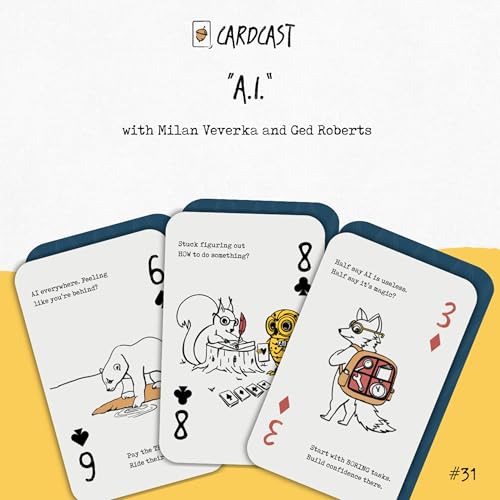
  • 31. On A.I. with Carter Jensen
    Mar 30 2026

    Welcome back to CardCast! Today's episode sees us joined by our second guest, Carter Jensen, and the topic couldn’t be more relevant today:

    Everything A.I.

    This episode brings three AI cards together: AI, Not How, How to AI, and Value of AI.

    AI isn’t just another hype cycle like past tech trends; it’s a fundamental shift. The real divide isn’t between companies using AI and those that aren’t; it’s between those using it well and those using it poorly.

    AI is quickly becoming a new kind of workforce, one that can take on repetitive, research-heavy tasks, freeing humans to focus on their actual zone of genius.

    When it comes to actually using AI, the answer is surprisingly simple: start. Don’t chase every new tool or trend, but bring AI into your day-to-day workflow. Treat it like a co-pilot.

    Every task becomes a prompt: “How could AI help with this?”

    The real value of AI is leverage. It gives individuals and teams access to a level of knowledge and capability that simply wasn’t possible before.

    The cost of ignoring AI isn’t standing still, it’s falling behind.


    Key-Card points:

    • AI is a who,” not a “how.”

    • AI should free humans to focus on their zone of genius

    • Treat AI like a co-pilot, not a shortcut

    • The winners are integrating AI into workflows

    • The biggest risk isn’t using AI wrong, it’s not using it at all

    Links & Resources

    • AI, not How

    • How to AI?

    • Value of AI

    • Veverka.ca


    Connect with Milan

    • Veverka.ca

    • LinkedIn


    Connect with Ged

    • Crystalyzer.com

    • LinkedIn


    CardCast is produced by Lovemore Media.

    Más Menos
    49 m
  • 30. Metric Ownership with Ged and Milan
    Mar 23 2026

    Welcome back to CardCast! Today, we’re going to be talking about Metric Ownership.

    For a long time, metrics have been treated as something that simply exists. A number on a dashboard. A graph trending up or down. Useful, yes, but passive.

    Something you observe, and maybe even predict. But ownership changes that entirely. A metric is no longer just reporting what’s happening; it’s telling someone whether they are winning or losing.

    So who owns it? Not the person compiling the data or maintaining the system that produces the number. That’s a support function. Ownership belongs to the person or team whose actions directly influence the result.

    They are the ones who must understand what drives the number and what needs to change when it’s off track.

    To own a metric is to live it. You shouldn’t be surprised by it in a meeting. You should already know where it stands and what you’re doing about it. You’re not there to stare at the gauges, you’re there to fly the plane. The metric simply tells you if you’re on course.


    Key-Card points:

    • A metric isn’t something you observe; it’s something you’re accountable for

    • Ownership belongs to the person who can influence the outcome

    • Every role should have a clear “this is how I’m doing” metric

    • If a metric is off track, the owner is responsible for changing the trajectory

    • You should never be surprised by your own number in a meeting


    Links & Resources

    • Metric Ownership

    • Veverka.ca

    Connect with Milan

    • Veverka.ca

    • LinkedIn

    Connect with Ged

    • Crystalyzer.com

    • LinkedIn


    CardCast is produced by Lovemore Media.

    Más Menos
    12 m
Todavía no hay opiniones