C.O.B. Tuesday Podcast Por Veriten arte de portada

C.O.B. Tuesday

C.O.B. Tuesday

De: Veriten
Escúchala gratis

C.O.B. Tuesday is a weekly one-hour talk show that serves as a knowledge pipeline for the energy industry and the energy curious. We host honest, timely, conversations with people we believe can improve the discussion, can provide new perspectives, can share unique insights into key energy issues, and can discuss inventive, pragmatic solutions for a stronger energy future. Produced by Veriten.

© 2026 Veriten
Economía Política y Gobierno
Episodios
  • "The Demand Is Real. It’s Coming." – Mary Anne Brelinsky (Alpha Gen) and Sean Kelly (Amperon)
    Apr 8 2026

    Today we had the unique opportunity to record COBT live from the Gulf Coast Power Association’s (GCPA) Annual Spring Conference in Houston. Joining us on stage were Mary Anne Brelinsky, President and Chief Commercial Officer of Alpha Generation, and Sean Kelly, CEO of Amperon. We were thrilled to explore the current power landscape with Sean and Mary Anne.

    In our conversation, we examine the growing complexity of operating in today’s power markets, with Mary Anne explaining how managing a multi-ISO portfolio requires constant coordination across operations, commercial teams, and real-time decision-making in the face of shifting weather patterns, fuel volatility, and evolving regulations. She emphasizes that forecasting remains one of the industry’s biggest challenges, as decisions are made daily with imperfect information and an increasingly dynamic grid where supply and demand must be balanced in real time. Sean builds on these themes by discussing how Amperon is using AI and machine learning to improve forecasting accuracy, streamline workflows, and help customers navigate volatility, noting that the sheer volume of data has made traditional approaches obsolete. We cover the rapid acceleration in power demand driven by AI, data centers, and broader electrification trends, with Sean highlighting that while not all projected load will materialize, the directional shift is real and significant.

    Mary Anne emphasizes the growing importance of reliability, resilience, and cybersecurity, noting that as more critical infrastructure becomes electrified, the stakes for keeping the grid secure and operational continue to rise. We discuss how the industry’s focus has shifted from improving efficiency to increasing output, with Mary Anne highlighting efforts to expand capacity at existing plants as one of the fastest and most practical solutions. Sean adds that capital is now flowing back into the power sector in a meaningful way, describing this as a structural turning point where electricity is finally being recognized as foundational to economic growth. We touch on increasing public and political attention on power markets, infrastructure bottlenecks, and the growing role of demand-side and behind-the-meter solutions in managing peak load. We close on the idea that while this may be one of the most challenging periods the industry has faced, it is also one of the most exciting, given the scale of opportunity and the critical role power will play in shaping the future.

    Mike Bradley kicked off the discussion by emphasizing that markets are extremely volatile and remain sharply focused on President Trump’s Iran deadline (Tuesday evening) and his threat to bomb strategic targets, including bridges and electric generation assets. From a bond market perspective, the 10-year yield was trading at ~4.3%, with bonds taking their cue from developments in the Iran war and the associated commodity price fallout. Bond investors appear to be largely ignoring upcoming economic reports, including March CPI, and are instead trying to better understand what the Iran war could mean for long-term inflation. From an oil market perspective, WTI closed at ~$110/bbl, up ~$8/bbl over the last five trading days. Seaborne barrels appear to be a better representative of the true “physical” oil market, with Dated Brent surging to over $140/bbl this week. Oil traders seem focused on how high prices might rise with further escalation, while long-term investors appear more focused on when and how far oil prices might plunge once the Strait of Hormuz is reopened. On the broader equity market front, the S&P 500 was up ~3.5% over the last week and appears to be pricing in some modest optimism for an off-ramp in the Iran war. Energy, however, was the worst-performing sector over the same period, down ~3.5%, with most Energy subsectors down 1% to 4%. On a YTD basis, though, Energy remains by far the best-performing S&P sec

    Más Menos
    50 m
  • "Russia Isn’t Interested In Any Fast Resolution Of The Hormuz Crisis" – Tatiana Mitrova, Center on Global Energy Policy
    Apr 1 2026

    Today we greatly enjoyed hosting Dr. Tatiana Mitrova, Global Fellow at the Center on Global Energy Policy, Director of the New Energy Advancement Hub, and Senior Research Fellow at the Oxford Institute for Energy Studies. Tatiana is an expert in energy systems, geopolitics, energy markets, and institutional decision-making, with particular emphasis on structural constraints, resilience, and risk. Born in Russia and now based in Cyprus, she brings a valuable perspective to the current turbulence involving Russia, Ukraine, Iran, and the broader global energy system.

    In our conversation, we explore how the Russia-Ukraine war has evolved into a form of energy warfare, with drone attacks and other strikes increasingly targeting refineries, export terminals, pipelines, and broader energy infrastructure, forcing Russia’s energy sector to shift from traditional energy security toward physical asset defense. We cover the interaction between the Ukraine war and the Iran conflict, particularly how higher oil prices, tighter global supply, and diverted U.S. attention are giving Russia additional strategic and financial breathing room, even as attacks on infrastructure create export constraints. Tatiana explains that the more realistic risk for Russia is not near-term collapse but gradual degradation, as the Kremlin continues to prioritize war spending over civilian welfare and relies on oil revenues, reserves, and social insulation to sustain the system. She also outlines why territorial gains in Ukraine remain essential to Putin’s domestic legitimacy, making a negotiated settlement far more difficult.

    We discuss the likely Russian summer offensive, Ukraine’s growing effectiveness in drone warfare, and the increasing vulnerability of Russian energy infrastructure. Tatiana walks through the domestic backdrop inside Russia, including war fatigue without viable opposition, a population shaped by a strong “fortress Russia” narrative, and a growing divide between insulated urban populations and regions bearing the human cost of the war. We touch on Russia’s longer-term positioning, including the ongoing pivot of energy exports away from Europe and toward China and India, the pricing and dependency risks embedded in that shift, and why Russia views the Iran conflict opportunistically rather than ideologically. She also explains how she thinks about the broader U.S.-China-Russia power dynamic, in which energy flows remain a central lever. We close by covering the longer-term social and economic consequences of the war inside Russia, including the implications of large-scale mobilization, reintegration challenges for returning soldiers, and the reality that the full costs of this conflict are likely to unfold over a decade or more rather than in the immediate term.

    For additional reading, Tatiana’s article, “Russia’s Hormuz Dividend: Revenue, Leverage, and Limits,” is linked here. Another recent article, “How the Iran War Is Changing Europe’s Energy Transition,” is linked here. It was an insightful discussion, and we can’t thank Tatiana enough for sharing her time and thoughts with us.

    Mike Bradley started the show by noting that U.S. equity markets were up 1.5% to 2.0% on the day, while the 10-year U.S. government bond yield was modestly lower and global oil prices were higher (Brent up ~$6/bbl and WTI up ~$2/bbl). He highlighted that the Iran war has entered its second month, provided a handful of monthly energy and equity market performance statistics, and noted that there still appears to be a real disconnect in oil markets (“physical” versus “financial/paper”) and between oil markets (up 55% to 65%) and U.S. equity markets (down ~7%).

    Más Menos
    1 h y 8 m
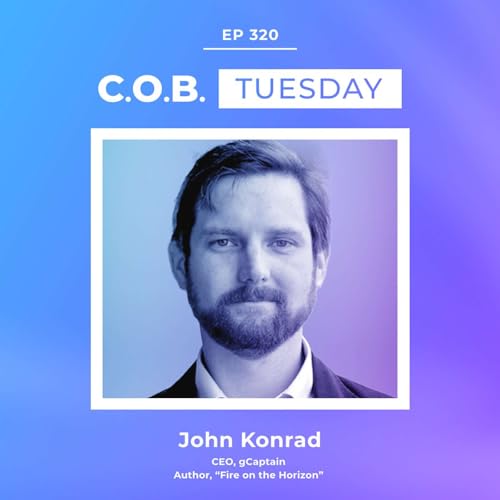
  • "Things Are Happening Now That Make Absolutely No Rational Sense" - John Konrad, gCaptain
    Mar 25 2026

    This week we were thrilled to welcome back Captain John Konrad, Founder and CEO of gCaptain and author of Fire on the Horizon. With the shipping situation in the Middle East rapidly evolving, John was the perfect expert to help us think through the many angles of this complex and multifaceted situation. As you will hear, this episode runs longer than our standard sixty minutes given the scope of the discussion.

    In our conversation, John shares his perspective on how the Strait of Hormuz crisis fits into a broader and longer-running pattern of maritime disruption, naval vulnerability, and rising geopolitical risk. He argues that the key issue is not whether the U.S. anticipated this scenario, but how difficult it is to reopen a chokepoint like Hormuz when insurance markets, shipowner behavior, naval constraints, and broader strategic calculations all intersect. We explore the importance of war-risk insurance and tanker availability, and why “hulls in the water” may be one of the most underappreciated variables in the global energy system today.

    John walks us through the cascading implications for LNG, fertilizer, desalination, and refined product markets, along with the growing regional fragmentation of energy prices as flows are disrupted. We discuss the role of operational surprise, the limits of European naval capacity, the complications associated with coalition rules of engagement, and why recent U.S. military effectiveness may, in part, reflect a more unilateral operating approach. We examine the broader maritime picture, including the decline of the U.S. merchant marine, the renewed push for American shipbuilding and maritime strategy, the key shipping and naval indicators John is watching most closely, and much more.

    Mike Bradley started the show by highlighting the apparent disconnect between “paper/financial” barrels and “physical” oil barrels. He noted that WTI oil price was up ~$3/bbl on the day, to ~$91/bbl, while Brent price was also higher by a similar amount (~$104/bbl). The Brent-WTI oil spread has blown out to a 10-year high ($13 to $15/bbl). Mike also pointed out that Oman oil barrels destined for Asia recently traded at ~$180/bbl, reinforcing the view that physical markets remain far tighter than paper prices suggest. He closed by noting that “financial” markets, both oil and equity, appear to be dialing in a much quicker and more optimistic resolution to the Strait of Hormuz closure than what may ultimately prove to be the case.

    About John Konrad
    Captain John Konrad is the founder and CEO of gCaptain, one of the world’s most-read maritime news websites, and a member of the Pentagon Press Corps. He holds a USCG Master Unlimited license. John studied naval architecture at the U.S. Naval Academy before graduating from SUNY Maritime College with a degree in Marine Transportation. His decade at sea included service aboard Military Sealift Command-operated ships, crude-oil supertankers running to Valdez, and dynamically positioned drillships supporting deepwater projects. In industry leadership roles, he participated in major offshore exploration and drilling campaigns, including the KG-D6 discovery with Reliance Industries and world record-setting deepwater work with Chevron. On April 20, 2010, John had finished overseeing the $750 million Deep Ocean Ascension newbuild project for BP when the Deepwater Horizon exploded. His seven years at Transocean and personal ties to members of the Horizon crew drove him to investigate the disaster, resulting in Fire on the Horizon (HarperCollins, 2011). In 2025, he co-authored Returning from Ebb Tide: Renewing the United States Commercial Maritime Enterprise for Marine Corps University Press. John has contributed to publications including Forbes, CIMSEC, Lloyd’s List, and the U.S. Coast Guard Compass, and has appeared on outlets including NPR and the BBC. He is an Associate Fellow of the Nautical Institute and a membe

    Más Menos
    1 h y 14 m
Todavía no hay opiniones