Episodios

  • How Voters React: Prof. Sergei Guriev Explains Backfiring Campaigns
    Apr 14 2026
    Professor Sergei Guriev, Dean of London Business School, discusses his research, Political Information and Network Effects, which explores why political campaigns can sometimes produce outcomes contrary to their original intentions. Professor Sergei Guriev, Dean of London Business School, presents groundbreaking research on how political information campaigns can unexpectedly backfire through social network effects. Drawing on a randomized controlled trial during Argentina’s 2023 presidential election, his work shows that a leaflet campaign criticizing Javier Milei’s education voucher proposal successfully reduced his support among directly treated voters, yet simultaneously increased support among untreated voters in the same precinct, leading to a net boost for Milei overall, exactly the opposite of what campaigners intended. Dr. Guriev and his co-authors explain this using the idea of a “vocal minority effect”, where a smaller group of outraged, unconvinced individuals becomes highly motivated to spread their views, overshadowing the quieter convinced majority through asymmetric communication in their social networks. The research highlights that campaigns only shift opinions when they provide genuinely new information, and that failing to account for heterogeneous reactions and spillover effects can turn apparently successful interventions into large-scale failures. Beyond elections, Prof. Guriev emphasizes that the same dynamics apply to corporate communication, organizational change, and policy rollouts, where ignoring vocal skeptics and informal networks can trigger backlash against otherwise well-designed proposals. This podcast is brought to you by Global Management Consultancy. For more information, please visit www.globalmanagementconsultancy.com. Disclaimer: A. The background music used in this video is the property of its respective developer and is protected by Copyright. Although it is a free version, Business Talk, Global Management Consultancy and Deepak Bhatt do not hold the rights to this music. B. On the Business Talk podcast, Dr. Sergei Guriev shared compelling insights from his research, ‘Political Information and Network Effects’. The uploaded video contains copyrighted material; therefore, any modifications to graphics, music, or the presence of the author or host are strictly prohibited.
    Más Menos
    31 m
  • Simply Better Marketing: Why Customers Don’t Care About Your ‘Unique’ Features
    Apr 12 2026
    Professor Patrick Barwise, Emeritus Professor of Management and Marketing at London Business School, joins us to discuss his influential book Simply Better: Winning and Keeping Customers by Delivering What Matters Most, which challenges much of today’s conventional marketing wisdom. Drawing on rich evidence from companies like Toyota, Procter & Gamble, and Orange, he explains why customers rarely buy because of unique features and instead choose brands that consistently deliver the basics a bit better than competitors. In this conversation, he distinguishes between “narrow” marketing focused on communications and “broad” marketing focused on the entire customer experience, showing that real advantage lies in operational excellence, reliability, and meeting fundamental needs. He also offers practical guidance for leaders, especially CEOs, marketers, and entrepreneurs, on using customer dissatisfaction data, 360-degree feedback, and direct time with customers to build a learning culture that relentlessly improves what matters most. This podcast is brought to you by Global Management Consultancy. For more information, please visit www.globalmanagementconsultancy.com. Disclaimer: A. The background music incorporated in this video is the intellectual property of its respective developer and is protected under applicable copyright laws. Notwithstanding that it is a free-to-use version, Business Talk, Global Management Consultancy, and Deepak Bhatt do not own, and expressly do not claim, any rights, title, or interest in or to this music. B. Dr. Patrick Barwise shared valuable insights from his book ‘Simply Better: Winning and Keeping Customers by Delivering What Matters Most’, during an engaging episode of the Business Talk podcast. The uploaded video contains copyrighted content, so changing any graphics, music, or on-screen appearance of the author or host is not allowed.
    Más Menos
    51 m
  • Can Ethics Really Pay Off in Business? Dr. Timothy Fort Explains
    Apr 12 2026
    Dr. Timothy Fort, Eveleigh Professor of Business Ethics at Indiana University’s Kelley School of Business, discusses the central ideas from his acclaimed book The Sincerity Edge: How Ethical Leaders Build Dynamic Businesses. Dr. Timothy L. Fort, Eveleigh Professor of Business Ethics at Indiana University’s Kelley School of Business, delves into the core ideas of The Sincerity Edge by showing how ethical leadership can be systematically built into everyday business practice. Drawing on his collaboration with Countess Alexandra Christina, he explains the Total Integrity Management model, which links strong compliance systems, aligned incentives, and real opportunities for people to act on their inherent desire to do the right thing. Through vivid cases such as the bug infested cookies incident and the Enron code-of-conduct suspension, he illustrates how misaligned incentives and double standards at the top can quietly erode trust, culture, and long-term performance. He also highlights decades of research and classroom experience demonstrating a striking consensus on core values like honesty, accountability, and resilience across age groups, cultures, and professions, challenging the notion that “we can’t agree on values.” Ultimately, Dr. Fort argues that while ethics may not always maximize short-term gains, companies that cultivate authentic tone at the top, design human-scale structures, and seek common ground in a polarized world are better positioned to build resilient, dynamic businesses over the long run. This podcast is brought to you by Global Management Consultancy. For more information, please visit www.globalmanagementconsultancy.com. Disclaimer: A. The background music incorporated in this video is the intellectual property of its respective developer and is protected under applicable copyright laws. Notwithstanding that it is a free-to-use version, Business Talk, Global Management Consultancy, and Deepak Bhatt do not own, and expressly do not claim, any rights, title, or interest in or to this music. B. Dr. Timothy Fort offered insightful perspectives from his book The Sincerity Edge: How Ethical Leaders Build Dynamic Businesses during a captivating episode of the Business Talk podcast. The uploaded video contains copyrighted content, so changing any graphics, music, or on-screen appearance of the author or host is not allowed.
    Más Menos
    41 m
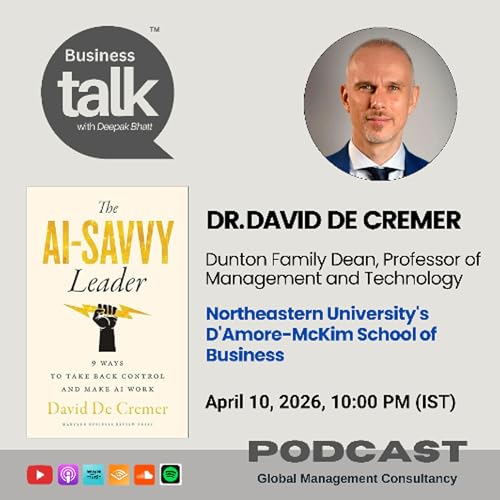
  • AI as Co-Worker, Not Employee: Dr. David De Cremer on Human-Centered AI
    Apr 12 2026
    Dr. David De Cremer, Professor of Management and Technology and Dunton Family Dean at Northeastern University's D'Amore-McKim School of Business, joins us to explore the key insights from his acclaimed book The AI-Savvy Leader: Nine Ways to Take Back Control and Make AI Work. In this conversation, he explains why 80–90 percent of AI initiatives fail, what it really means for leaders to become AI savvy rather than AI experts, and how treating AI as a co worker instead of an employee can unlock human centered, organization wide transformation. This podcast is brought to you by Global Management Consultancy. For more information, please visit www.globalmanagementconsultancy.com. Disclaimer: A. The background music incorporated in this video is the intellectual property of its respective developer and is protected under applicable copyright laws. Notwithstanding that it is a free-to-use version, Business Talk, Global Management Consultancy, and Deepak Bhatt do not own, and expressly do not claim, any rights, title, or interest in or to this music. B. Dr. David De Cremer shared valuable insights from his acclaimed book, “The AI-Savvy Leader: Nine Ways to Take Back Control and Make AI Work”, during an engaging episode of the Business Talk podcast. The uploaded video contains copyrighted content, so changing any graphics, music, or on-screen appearance of the author or host is not allowed.
    Más Menos
    51 m
  • No Free Lunch: Dr. John Quiggin Explains the Two Lessons of Economics
    Apr 11 2026
    Dr. John Quiggin, Professor of Economics at the University of Queensland, discusses the core insights from his acclaimed book Economics in Two Lessons: Why Markets Work So Well and Why They Can Fail So Badly. Dr. John Quiggin, Professor of Economics at the University of Queensland, joins The Business Talk podcast to unpack the big ideas from his book Economics in Two Lessons: Why Markets Work So Well, and Why They Can Fail So Badly. Drawing on his extensive body of work as a leading economist, he explains why opportunity cost is the central idea citizens need to understand, and then shows how and why market prices often fail to reflect the true social costs of our choices. Through examples ranging from pollution and congestion pricing to COVID-19 vaccines and the digital economy, he illustrates when markets deliver efficient outcomes and when targeted government intervention becomes essential. This podcast is brought to you by Global Management Consultancy. For more information, please visit www.globalmanagementconsultancy.com. Disclaimer: A. The background music incorporated in this video is the intellectual property of its respective developer and is protected under applicable copyright laws. Notwithstanding that it is a free-to-use version, Business Talk, Global Management Consultancy, and Deepak Bhatt do not own, and expressly do not claim, any rights, title, or interest in or to this music. B. Dr. John Quiggin shared valuable insights from his book “Economics in Two Lessons: Why Markets Work So Well and Why They Can Fail So Badly”, during an engaging episode of the Business Talk podcast. The uploaded video contains copyrighted content, so changing any graphics, music, or on-screen appearance of the author or host is not allowed.
    Más Menos
    21 m
  • Why Female-Backed Female Founders Struggle to Raise More Capital
    Apr 10 2026
    Dr. Isabelle Solal, Assistant Professor in the Management Department at ESSEC Business School, discusses her research titled “Does Investor Gender Matter for the Success of Female Entrepreneurs? Gender Homophily and the Stigma of Incompetence in Entrepreneurial Finance.” Dr. Isabelle Solal’s research disrupts the belief that venture capital is a pure meritocracy by showing how gendered perceptions shape which ventures get funded and grow. Focusing on the question of whether investor gender affects the success of female entrepreneurs, she finds that female-founded firms backed by female VCs are twice as likely to fail in raising follow-on funding compared to all other founder–investor gender combinations, revealing a specific penalty attached to the female founder–female investor pairing rather than to women founders or women investors on their own. Through a combination of large-sample field data and controlled experiments with MBA students evaluating identical startup pitches, her work demonstrates that observers implicitly downgrade the competence of female founders when their initial backing comes from a female investor, resolving cognitive dissonance by attributing the investment to gender-based favoritism rather than merit and thereby making the opportunity seem less attractive. This competence penalty, she argues, reflects automatic, unconscious bias rather than explicit intent and has broader implications for how women’s same-sex professional ties are perceived across domains like corporate promotions, academic careers, and professional services, underscoring the need for systemic solutions such as mixed-gender investment teams, shared responsibility for diversity work, and a fundamental reframing of gender gaps as a talent and resource allocation problem rather than a “women’s issue”. This podcast is brought to you by Global Management Consultancy. For more information, please visit www.globalmanagementconsultancy.com. Disclaimer: A. The background music incorporated in this video is the intellectual property of its respective developer and is protected under applicable copyright laws. Notwithstanding that it is a free-to-use version, Business Talk, Global Management Consultancy, and Deepak Bhatt do not own, and expressly do not claim, any rights, title, or interest in or to this music. B. Dr. Isabelle Solal shared valuable insights from her research titled “Does Investor Gender Matter for the Success of Female Entrepreneurs? Gender Homophily and the Stigma of Incompetence in Entrepreneurial Finance” during an engaging episode of the Business Talk podcast. The uploaded video contains copyrighted content, so changing any graphics, music, or on-screen appearance of the author or host is not allowed.
    Más Menos
    25 m
  • Team Hierarchical Adaptability: Research Insights from Dr. Lindy Greer
    Apr 9 2026
    Dr. Lindy Greer, Professor of Management and Organizations at the Stephen M. Ross School of Business and Faculty Director of the Sanger Leadership Center at the University of Michigan, shares key insights from her acclaimed research, “Team Hierarchical Adaptability: Benefits for Team Coordination and Performance.” In this conversation, Dr. Lindy Greer unpacks her research on team hierarchical adaptability using the vivid “hippo” metaphor, explaining how the highest-paid person in the room must know when to rise “out of the water” to provide clear direction and protection, and when to sink “underwater,” listening and creating space for equal participation. Drawing on examples from Navy SEAL teams, corporate, startup, and healthcare settings, she shows that the best-performing teams do not choose between flat or hierarchical structures but fluidly shift between them over time. Her multi-method research, combining field studies, lab experiments, and detailed video analysis, demonstrates that teams who can move intentionally between command-and-control and open, inclusive debate coordinate better, innovate more, and achieve higher performance across diverse contexts. This podcast is brought to you by Global Management Consultancy. For more information, please visit www.globalmanagementconsultancy.com. Disclaimer: A. The background music incorporated in this video is the intellectual property of its respective developer and is protected under applicable copyright laws. Notwithstanding that it is a free-to-use version, Business Talk, Global Management Consultancy, and Deepak Bhatt do not own, and expressly do not claim, any rights, title, or interest in or to this music. B. Dr. Lindy Greer shared valuable insights from her research, “Team Hierarchical Adaptability: Benefits for Team Coordination and Performance,” during an engaging conversation on the Business Talk podcast. The uploaded video contains copyrighted content, so changing any graphics, music, or on-screen appearance of the author or host is not allowed.
    Más Menos
    22 m
  • Unequal in the Spotlight: Why Top Boards Boost Men’s Careers More Than Women’s
    Apr 9 2026
    Dr. Isabel Fernandez-Mateo, Adecco Professor of Strategy and Entrepreneurship at London Business School, shares valuable insights from her acclaimed research, “Unequal in the Spotlight: Gender Differences in How Serving on Prominent Firms Affects Directors’ New Board Appointments.” Drawing on a rich dataset of FTSE 100 boards and in-depth interviews, this research uncovers a paradox at the very top of corporate leadership: while women are generally more likely than men to secure additional board appointments, this advantage disappears and even reverses on the most prominent boards, where visibility is highest and scrutiny is most intense. The study rules out standard explanations such as weaker competence signals or capacity constraints and instead points to hidden dynamics of prominence, including heavier informal demands, greater performance pressure, and a higher bar for women to be appointed in the first place. These findings suggest that prestigious board roles can function not only as powerful platforms but also as bottlenecks, highlighting the need for boards, headhunters, and policymakers to look beyond access and focus on how top positions shape future mobility and long-term career progression. This podcast is brought to you by Global Management Consultancy. For more information, please visit www.globalmanagementconsultancy.com. Disclaimer: A. The background music incorporated in this video is the intellectual property of its respective developer and is protected under applicable copyright laws. Notwithstanding that it is a free-to-use version, Business Talk, Global Management Consultancy, and Deepak Bhatt do not own, and expressly do not claim, any rights, title, or interest in or to this music. B. Dr. Isabel Fernandez-Mateo shared profound insights from her research, “Unequal in the Spotlight: Gender Differences in How Serving on Prominent Firms Affects Directors’ New Board Appointments”, during an engaging conversation on the Business Talk podcast channel. The uploaded video contains copyrighted content, so changing any graphics, music, or on-screen appearance of the author or host is not allowed.
    Más Menos
    23 m