Episodios

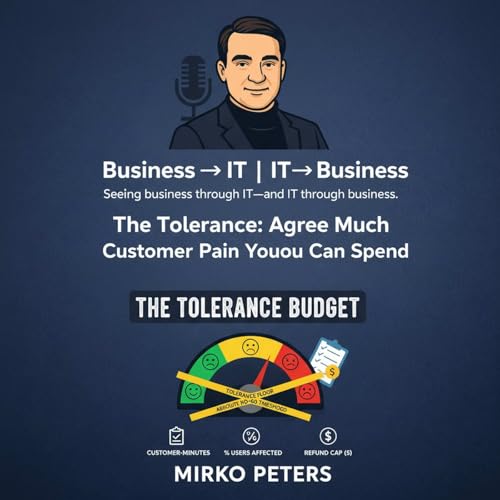
  • The Tolerance Budget: Agree How Much Customer Pain You Can Spend
    Mar 27 2026
    Business teams ask to move fast; engineering teams want limits that preserve customers and ops capacity. The Tolerance Budget is a small, copy‑paste artifact that makes that trade‑off explicit: a named budget owner, a clear currency (customer‑minutes degraded, % of users affected, or a dollar cap for remediation), replenishment rules, safe floors and absolute no‑go thresholds, and an automatic post‑spend readout. Mirko opens with a tight vignette where an experiment blew past informal risk, produced ad‑hoc refunds, and shredded trust. He contrasts what product leaders mean by 'acceptable risk' with engineers' operational reality, explains pragmatic defaults for three common currencies, and reads three filled examples aloud. Listeners leave with a short protocol to negotiate a budget for one product stream, a 7‑day pilot script to run and measure (budget spends, emergency rollbacks avoided, ad‑hoc compensation incidents), and clear governance guards so risk is a deliberate decision, not an accident. CTA: pilot a Tolerance Budget this week and leave a review.

    Become a supporter of this podcast: https://www.spreaker.com/podcast/business-it-it-business--6867401/support.

    To continue the conversation, follow Mirko Peters on LinkedIn, where more insights and real-world examples are shared from both business and IT perspectives.
    Más Menos
    12 m
  • Bot Contracts: Make Your Automated Agents Accountable
    Mar 13 2026
    Automations act like invisible teammates: they make requests, change state, and fail at odd hours—but rarely carry explicit responsibility. This episode introduces the Bot Contract: a tiny, copy‑paste artifact you attach to any automation so business expectations and operational realities meet before trouble begins. Mirko opens with a short vignette (a pricing-bot that retried customers into double‑charges), contrasts what business expects from an 'always-on' agent with what engineering actually needs to operate one safely, and reads a live one‑line Bot Contract on air (Intent; Owner; Retry policy; Observable signal; Human fallback; Cost cap; Sunset). Listeners leave with a 7‑day pilot: attach contracts to five automations, run an observability watch window, and measure incident count and mean time to human handoff. Practical, tool‑agnostic, and immediate: make your bots accountable and keep human attention where it matters. CTA: attach a Bot Contract this week and leave a review if it reduced surprise pages.

    Become a supporter of this podcast: https://www.spreaker.com/podcast/business-it-it-business--6867401/support.

    To continue the conversation, follow Mirko Peters on LinkedIn, where more insights and real-world examples are shared from both business and IT perspectives.
    Más Menos
    10 m
  • Feature Toggle Lifecycle: Make Flags First‑Class, Time‑boxed, and Observable
    Mar 12 2026
    Feature flags accelerate learning and staged rollouts but, when unmanaged, become hidden coupling, operational surprise, and long‑running debt. This episode prescribes a concise Feature Toggle Lifecycle you attach to each flag: Owner; Intent; Audience; Default; Rollout criteria; Observable metric; Kill‑switch; Sunset date; Minimal test path. We open with a short micro‑vignette of an orphaned flag that created costly investigation, then walk through three copy‑paste lifecycle templates (experiment, ops switch, gradual rollout), a one‑minute guest quote from a platform lead, and a practical 7‑day pilot plan. The pilot includes a measurable success plan (lifecycles attached, flags retired/scheduled, mean time to rollback) and low‑friction PR language you can paste into code reviews. Assets (one‑page lifecycle template, 7‑day checklist, and PR snippets) are available in the episode show notes. By the end you’ll have concrete steps, enforcement roles, and a measurement plan so adoption is visible and manageable.

    Become a supporter of this podcast: https://www.spreaker.com/podcast/business-it-it-business--6867401/support.

    To continue the conversation, follow Mirko Peters on LinkedIn, where more insights and real-world examples are shared from both business and IT perspectives.
    Más Menos
    11 m
  • Rollback Reserve: Budget the Capacity to Undo
    Mar 11 2026
    Teams plan delivery budgets but rarely budget the capacity to undo. That missing line turns rollbacks into emergency borrowing: all‑hands nights, hidden costs, and damaged trust. This episode introduces the Rollback Reserve: a compact planning artifact you write into change proposals and roadmaps that names the undo budget (minutes-to-undo target, on‑call allocation, cost cap, and acceptance criteria for rollback vs. remediate). Mirko contrasts the business trade-off (faster launches vs. the cost of potential reversals) with the operational reality (limited on‑call attention, stateful complexity, and reproducibility gaps). Listeners get an exact one‑line Rollback Reserve template to read aloud, a short ritual to include it in planning and sprint review, and a practical 7‑day experiment to pilot reserves on five changes. The result: fewer surprise all‑hands, clearer trade‑offs during prioritization, and a funded, measurable path to undo when things go wrong. CTA: attach a Rollback Reserve to your next ticket and leave a review if it reduced night pages.

    Become a supporter of this podcast: https://www.spreaker.com/podcast/business-it-it-business--6867401/support.

    To continue the conversation, follow Mirko Peters on LinkedIn, where more insights and real-world examples are shared from both business and IT perspectives.
    Más Menos
    10 m
  • Assumption First‑Aid: Rapid Triage to Stop Hidden Beliefs from Bleeding Work
    Mar 10 2026
    Hidden assumptions quietly trigger rollbacks, late nights, and weekend incidents. This episode reframes the practice as 'Assumption First‑Aid'—a fast triage to stabilize plans before they bleed. Mirko opens with a 20–30 second dramatized weekend outage vignette traced to a buried belief, then explains why a short ritual wins where checklists fail. Listeners get a copy‑paste Assumption Card example to read aloud: Assumption: 'Search API returns <100ms at 1k QPS'; Owner: Dana (PM); Signal: p95 latency >120ms; Quick test: 30‑min synthetic load to 1k QPS; Window: 7 days. The episode gives a 5‑minute drill script, a 7‑day pilot plan (validate five assumptions, run one quick test), and three concrete metrics to track in a single ticket column: assumptions validated %, mean time to validation, and surprises avoided per sprint. We point to a one‑page GitHub gist template and a 30‑second submission form in the episode notes so listeners can adopt, share results, and build momentum. CTA: run a drill this week, paste the card into a ticket, log the three metrics, submit one result via the form, and leave a review if it reduced surprises.

    Become a supporter of this podcast: https://www.spreaker.com/podcast/business-it-it-business--6867401/support.

    To continue the conversation, follow Mirko Peters on LinkedIn, where more insights and real-world examples are shared from both business and IT perspectives.
    Más Menos
    9 m
  • Flag Life: A 7‑Day Ritual + Contract to Stop Flag Sprawl
    Mar 7 2026
    Feature flags accelerate launches and experiments — until proliferation, orphaned ownership, and environment drift turn them into a fragile, incident-prone surface. This episode opens with a 60–90 second engineer/PM clip recounting a rollout regression caused by a stale flag to set stakes, then delivers an auditable Flag Lifecycle Contract (read aloud and provided as a downloadable GitHub gist) and a step-by-step 7‑day Tidy ritual teams can run live. We provide a verbatim owner-assignment script for cross-functional meetings, a short implementation walkthrough (screen-share audio) that models the tidy in action, and clear pilot metrics: percent flags cataloged, time-to-retire, and flag-related incident rate. Role-specific rules for PMs, engineers and SREs plus a conservative "graduate vs retire" decision rule with mandatory verification steps help prevent regressions. Listeners leave with copy-paste artifacts, a short script to reduce behavioral friction, and a concrete CTA to run the tidy on one release stream and track measurable impact.

    Become a supporter of this podcast: https://www.spreaker.com/podcast/business-it-it-business--6867401/support.

    To continue the conversation, follow Mirko Peters on LinkedIn, where more insights and real-world examples are shared from both business and IT perspectives.
    Más Menos
    10 m
  • Expectation Heatmaps: Map Where Business and IT Read Different Signals
    Mar 6 2026
    Business asks and engineering answers through different lenses; what looks urgent to product can be low‑impact for operations, and what IT treats as risky can feel like a blocker to sales. This episode teaches a lightweight, reproducible practice: the Expectation Heatmap. Mirko explains how to run a 30‑minute cross-role mapping session that produces a single shared visual (business‑perceived impact vs. IT‑perceived effort) plus a paired readiness flag. Listeners get the exact readout script, a five‑cell heatmap template to copy, and a 7‑day experiment: map five upcoming tickets, run the heatmap readout, and prioritize the visible mismatches. The episode contrasts business and IT mental models, shares a generalized consulting vignette showing how a one-page heatmap stopped a misrouted sprint, and delivers clear, role‑specific takeaways: what business must name before asking and what IT must disclose before estimating. The CTA challenges listeners to run the 30‑minute readout this week and leave a review if it shrinks misalignment.

    Become a supporter of this podcast: https://www.spreaker.com/podcast/business-it-it-business--6867401/support.

    To continue the conversation, follow Mirko Peters on LinkedIn, where more insights and real-world examples are shared from both business and IT perspectives.
    Más Menos
    11 m
  • False‑Ready Audit: Find When 'Ready for Production' Is a Performance, Not a Fact
    Mar 5 2026
    Organizations routinely call work 'ready' while hidden conditions—configuration drift, undocumented dependencies, stale runbooks, observability gaps, or untested rollback paths—leave launches fragile. This episode introduces the False‑Ready Audit: a compact, tool‑agnostic diagnostic you can run in 30–90 minutes to surface where readiness is performative rather than operational. Mirko contrasts the business impulse to mark progress (ship dates, demos, stakeholder signals) with IT's deeper readiness signals (dependency ownership, monitoring baselines, restoration plan). Listeners get a copy‑paste Ready Truth Table (owner alignment, critical dependencies, test surface, observability baseline, rollback rule, compliance check) and a reproducible 7‑day sampling experiment: score five recent 'ready' items, compute the truth gap, and prioritize fixes. A generalized consulting vignette shows a declared‑ready rollout that degraded service for a day; Mirko models scoring on‑air and gives clear, cross‑role actions to reduce surprise and make 'ready' mean the same thing for everyone.

    Become a supporter of this podcast: https://www.spreaker.com/podcast/business-it-it-business--6867401/support.

    To continue the conversation, follow Mirko Peters on LinkedIn, where more insights and real-world examples are shared from both business and IT perspectives.
    Más Menos
    10 m