Episodios

  • The Transformative Power of Music | "Can Beauty Save the World?"
    Mar 31 2026

    In this panel during the international symposium "Can beauty save the world?" held at McGill University, Oct 24-25 2025, Jean-Sébastien Vallée (McGill), Katie Bank (Birmingham), Rebekah Wallace (Oxford), Ian Corbin (Harvard), and Jonathan Berger (Stanford) explored the transformative power of music. The panel was moderated by Stephen Bullivant (St. Mary's London).

    We began with a performance by an acapella quartet from the Schulich School of Music (McGill).

    Jean-Sébastien described the conductor’s task as creating a sonic space where sound becomes meaning—a community where difference becomes harmony. One of his singers, who had just lost her husband, came to perform because “singing with my choir is the only way I can breathe right now.” Katie and Rebekah described how early modern thinkers saw music as acting on the whole person, not as external stimulus but as an activity of the soul. Ian reflected on the relevance of music to our longing for wholeness, which passes through failure, undoing, despondence. Jonathan discussed his fascinating research on the sonic signatures of sacred spaces, and how the balance between clarity and blur in sound transforms acoustics into awe.

    The event was sponsored by the John Templeton Foundation.

    Learn more at www.canbeautysavetheworld.com and www.beautyatwork.net

    #beauty #music #transformation #philosophy #musicology #spirituality


    Support the show

    Más Menos
    1 h y 21 m
  • Can Beauty Save the World? with Charles Taylor, Sean Kelly, Elaine Scarry, Richard Kearney
    Mar 25 2026

    This is the opening panel for the international symposium "Can beauty save the world?" held at McGill University, Montreal, Oct 24-25, 2025.

    We begin with introductions from Dan Cere (McGill), Brandon Vaidyanathan (Catholic University of America), Charles Taylor (McGill), and Tara Isabella Burton (Catholic University of America), followed by a panel discussion between Sean Kelly (Harvard), Elaine Scarry (Harvard), and Richard Kearney (Boston College), moderated by Bill Barbieri (Catholic University of America)

    Sean Kelly reflected that beauty moves us beyond ourselves. It saves us from the flattening of meaningful differences. To encounter beauty is to order one’s life around the object of love. When we long for others to share in that recognition, we glimpse beauty’s political potential—it calls us into conversation rather than conflict.

    Elaine Scarry deepened that insight, reminding us that the opposite of beauty is not ugliness, but injury. Beauty and justice both arise from a sense of fairness and the desire to repair harm. Beauty’s lasting impact, she noted, is generative—it makes us want to create.

    Richard Kearney drew on Gerard Manley Hopkins’s image of the “pied” world—speckled, varied, alive with difference. Beauty, he said, is not pure symmetry but aftering: it often arrives through suffering and loss, reconciling the universal and the particular.

    And Charles Taylor reminded us that beauty cannot be defined apart from itself. Its relation to truth is reciprocal, not hierarchical. To understand one, we must hold the other in view. “That,” he said, “is how beauty can save the world.”


    The symposium was sponsored by the John Templeton Foundation.

    Learn more at www.canbeautysavetheworld.com and www.beautyatwork.net

    #beautyatwork #beauty #aesthetics #philosophy #philosophyofbeauty

    Support the show

    Más Menos
    1 h y 25 m
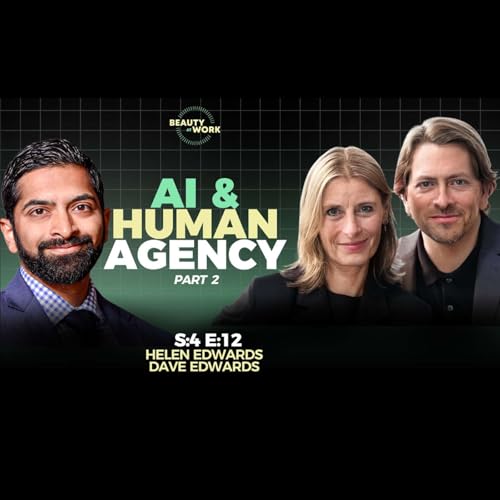
  • AI and the Future of Human Agency with Helen and Dave Edwards - S4E12 (Part 2 of 2)
    Mar 17 2026

    Helen and Dave Edwards are co-founders of the Artificiality Institute, a nonprofit research organization that helps people stay human in the age of AI. They explore how AI changes the way we think, who we become, and what it means to be human. Through story-based research, education, and community, they help people choose the relationship they want with machines, so they remain the authors of their own minds.

    Before founding the Artificiality Institute, they co-founded Intelligentsia.ai, an AI-focused research firm acquired by Atlantic Media. Helen previously led large-scale technology and transformation efforts in critical infrastructure, while Dave spent years shaping creative tools at Apple and investing in emerging technologies as a venture capitalist at CRV and an equity research analyst at Morgan Stanley and ThinkEquity.


    In this second part of our conversation, we talk about:

    1. Rethinking intelligence as something layered, embodied, and expressed in different forms
    2. The “SaaSpocalypse” moment on Wall Street
    3. The “Dust Bowl” metaphor and the risk of automating complex human systems too quickly
    4. Transition from the attention economy to the intimacy economy
    5. Dave and Helen’s reflections on what is lost when we use AI
    6. How AI systems uncover hidden structures in language, science, and the natural world
    7. Practical ways creators can decide where AI belongs in their creative process


    To learn more about Helen and Dave’s work, you can find them at:

    https://artificialityinstitute.org/


    Books and resources mentioned:

    The Artificiality, AI Culture, and Why the Future Will Be Co-Evolution (by Helen Edwards)


    This season of the podcast is sponsored by Templeton Religion Trust.


    Support the show

    Más Menos
    36 m
  • AI and the Future of Human Agency with Helen and Dave Edwards - S4E12 (Part 1 of 2)
    Mar 10 2026

    Artificial intelligence is not only changing what we can do, but may be changing how we think. As AI systems increasingly participate in writing, reasoning, and decision-making, it becomes more urgent to ask what it means to retain human agency and ensure we're not losing our fundamental capabilities.

    My guests today, Helen and Dave Edwards, have been working seriously on this question.

    Helen and Dave Edwards are co-founders of the Artificiality Institute, a nonprofit research organization that helps people stay human in the age of AI. They explore how AI changes the way we think, who we become, and what it means to be human. Through story-based research, education, and community, they help people choose the relationship they want with machines, so they remain the authors of their own minds.

    Before founding the Artificiality Institute, they co-founded Intelligentsia.ai, an AI-focused research firm acquired by Atlantic Media. Helen previously led large-scale technology and transformation efforts in critical infrastructure, while Dave spent years shaping creative tools at Apple and investing in emerging technologies as a venture capitalist at CRV and an equity research analyst at Morgan Stanley and ThinkEquity.


    In this first part of our conversation, we discuss:

    1. Helen and Dave's early childhood experiences of beauty
    2. The origin of the Artificiality Institute
    3. How AI is already reshaping the way we reason, write, create, and make decisions
    4. What happens to human reasoning and decision-making when AI becomes part of our thinking process
    5. The difference between “drift” and intentional authorship when working with AI
    6. Cognitive sovereignty as the central challenge of the AI era
    7. How can people use AI deeply and skillfully
    8. The concept of symbolic plasticity and how AI can reshape the frameworks we use to understand the world


    To learn more about Helen and Dave’s work, you can find them at:

    https://artificialityinstitute.org/


    Books and resources mentioned:

    The Artificiality, AI Culture, and Why the Future Will Be Co-Evolution (by Helen Edwards)


    This season of the podcast is sponsored by Templeton Religion Trust.


    Support the show

    Más Menos
    39 m
  • Innovation and Religion with Dr. Marco Ventura - S4E11 (Part 2 of 2)
    Mar 3 2026

    Dr. Marco Ventura is Professor of Law and Religion and Religious Diplomacy at the University of Siena in Italy. Trained in bioethics and biolaw at the University of Strasbourg, he has advised the European Parliament, the OSCE, and various governments on the intersection of religion and rights. He directed the Center for Religious Studies at the Fondazione Bruno Kessler in Trento and chairs the G20 Interfaith Working Group on Religion, Innovation, and Technology and Infrastructures.

    Marco is the author of numerous books, including From Your Gods to Our Gods and Nelle mani di Dio, la super religione del mondo che verrà. Over the past decade, he has helped shape the emerging field exploring the encounter between religion and innovation.

    In this episode, we explore Marco's work on bioethics and technoscience, their influential position paper mapping out this emerging field of religion and innovation, and what innovation really means in a religious context.


    In this second part of our conversation, we talk about:

    1. The language of innovation

    2. How do religious communities decide what kind of change is desirable?

    3. Innovation, markets, and technology as rival meaning systems

    4. Resistance movements as responses to innovation

    5. Politicization and polarization in debates about markets and capitalism


    To learn more about Marco’s work, you can find him at:

    • https://credo.unisi.it/about/secretariat-and-experts/person/marco


    Links Mentioned:

    • Religion, Innovation, Position paper, FBK 2019 - https://isr.fbk.eu/en/about-us/position-paper/
    • Fondazione Bruno Kessler – https://www.fbk.eu/
    • G20 Interfaith Forum – https://www.g20interfaith.org/
    • Organisation for Security and Cooperation in Europe (OSCE) – https://www.osce.org/


    This season of the podcast is sponsored by Templeton Religion Trust.

    Support the show

    Más Menos
    29 m
  • Innovation and Religion with Dr. Marco Ventura - S4E11 (Part 1 of 2)
    Feb 24 2026

    Dr. Marco Ventura is Professor of Law and Religion and Religious Diplomacy at the University of Siena in Italy. Trained in bioethics and biolaw at the University of Strasbourg, he has advised the European Parliament, the OSCE, and various governments on the intersection of religion and rights. He directed the Center for Religious Studies at the Fondazione Bruno Kessler in Trento and chairs the G20 Interfaith Working Group on Religion, Innovation, and Technology and Infrastructures.

    Marco is the author of numerous books, including From Your Gods to Our Gods and Nelle mani di Dio, la super religione del mondo che verrà. Over the past decade, he has helped shape the emerging field exploring the encounter between religion and innovation.

    In this episode, we explore Marco's work on bioethics and technoscience, their influential position paper mapping out this emerging field of religion and innovation, and what innovation really means in a religious context.


    In this first part of our conversation, we discuss:

    1. The balance between tradition and contemporary art
    2. The story of St. Francis and “repair my church” as a metaphor for renewal
    3. Catholic Church’s response to reproductive technologies
    4. Why “innovation” was chosen instead of simply “technology.”
    5. Distinction between technological innovation and social innovation
    6. Two categories of innovation
    7. Why religious actors want a voice in innovation-driven global agendas
    8. The use of innovation in a religious context


    To learn more about Marco’s work, you can find him at:

    • https://www.venturamarcoart.com/


    Links Mentioned:

    • Religion, Innovation, Position paper, FBK 2019 - https://isr.fbk.eu/en/about-us/position-paper/
    • Fondazione Bruno Kessler – https://www.fbk.eu/
    • G20 Interfaith Forum – https://www.g20interfaith.org/
    • Organisation for Security and Cooperation in Europe (OSCE) – https://www.osce.org/


    This season of the podcast is sponsored by Templeton Religion Trust.


    Support the show

    Más Menos
    30 m
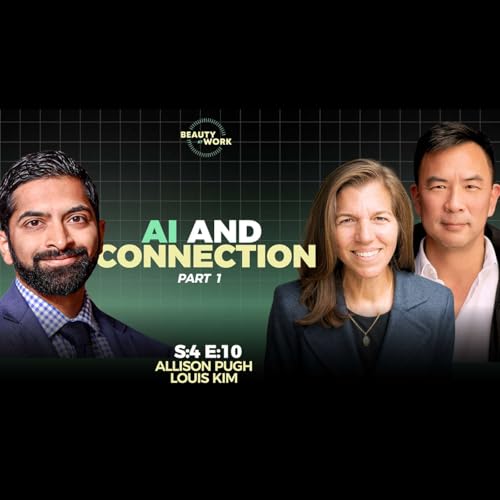
  • Can AI Replace Human Connection? with Dr. Allison Pugh and Louis Kim - S4E10 (Part 2 of 2)
    Feb 17 2026

    Dr. Allison Pugh is Professor of Sociology at Johns Hopkins University and author of The Last Human Job, winner of the 2025 Best Book Award from the American Sociological Association. Her work examines how automation, efficiency, and quantification reshape work that relies on presence, dignity, and visibility. She introduces the concept of connective labor—the mutual, human work of recognizing another person and reflecting that understanding to them.

    Louis Kim is a former Vice President at Hewlett-Packard, where he led teams in developing AI-enabled technologies for healthcare and other industries. After decades in corporate leadership, he is now pursuing a Master of Divinity at Duke Divinity School, focusing on hospice and palliative care. Alongside his theological training, Louis participates in Vatican-sponsored conversations on principled AI in healthcare, exploring where technology can assist care and where it must not replace human presence.


    In this second part of our conversation, we talk about:

    1. Why calling AI “inevitable” can obscure human agency and choice
    2. The rapid adoption of AI scribes in medicine
    3. Two aspects of the inevitability of AI
    4. AI and ethical dilemmas in healthcare ethics
    5. The limits of “better than nothing” as a moral framework for AI
    6. The painful beauty of unpredictability in human relationships
    7. Shame, vulnerability, and why AI feels easier than people
    8. The risk of bypassing growth through technological shortcuts
    9. Safeguarding dignity and belonging for the future of work


    • To learn more about Allison’s work, you can find her at: https://www.allisonpugh.com/
    • To learn more about Louis’s work, you can find him at: https://www.linkedin.com/in/louisjkim/
    • Books and Resources Mentioned: The Last Human Job: The Work of Connecting in a Disconnected World (by Allison Pugh)

    This season of the podcast is sponsored by Templeton Religion Trust.


    Support the show

    Más Menos
    35 m
  • Can AI Replace Human Connection? with Dr. Allison Pugh and Louis Kim - S4E10 (Part 1 of 2)
    Feb 10 2026

    Dr. Allison Pugh is Professor of Sociology at Johns Hopkins University and author of The Last Human Job, winner of the 2025 Best Book Award from the American Sociological Association. Her work examines how automation, efficiency, and quantification reshape work that relies on presence, dignity, and visibility. She introduces the concept of connective labor—the mutual, human work of recognizing another person and reflecting that understanding to them.

    Louis Kim is a former Vice President at Hewlett-Packard, where he led teams in developing AI-enabled technologies for healthcare and other industries. After decades in corporate leadership, he is now pursuing a Master of Divinity at Duke Divinity School, focusing on hospice and palliative care. Alongside his theological training, Louis participates in Vatican-sponsored conversations on principled AI in healthcare, exploring where technology can assist care and where it must not replace human presence.


    In this first part of our conversation, we discuss:

    1. What in-depth interviewing reveals about being truly seen
    2. How experiences of death shape our understanding of accompaniment
    3. The difference between emotional labor and connective labor
    4. How automation and standardization threaten dignity and belonging
    5. Why institutions rely on checklists, data, and control
    6. The factors driving institutional challenges to connective labor
    7. Why human connection is defined by unpredictability
    8. The role of moral formation in resisting depersonalization


    • To learn more about Allison’s work, you can find her at: https://www.allisonpugh.com/
    • To learn more about Louis’s work, you can find him at: https://www.linkedin.com/in/louisjkim/
    • Books and Resources Mentioned: The Last Human Job: The Work of Connecting in a Disconnected World (by Allison Pugh)

    This season of the podcast is sponsored by Templeton Religion Trust.


    Support the show

    Más Menos
    38 m