Episodios

  • What Does Illinois Law Say About Hiding Assets During Divorce? - Caesar & Bender, LLP
    Apr 16 2026

    From Caesar & Bender, LLP - What Does Illinois Law Say About Hiding Assets During Divorce? explores how Illinois law governs financial disclosure obligations and the serious consequences tied to concealing property during a divorce. Centered in Chicago and Cook County, the discussion highlights how the Illinois Marriage and Dissolution of Marriage Act (750 ILCS 5/501) and Cook County Court Rule 13.3.1 require both spouses to provide complete and sworn financial affidavits detailing income, assets, debts, and liabilities.

    The episode dives into the many ways asset concealment occurs, from underreporting income and transferring funds to third parties, to hiding cryptocurrency and undervaluing business interests within Chicago’s financial landscape. It also outlines warning signs such as unexplained withdrawals, sudden spending changes, and secretive financial behavior. Drawing on the experience of Molly E. Caesar and Michael Ian Bender, the conversation reflects how cases in the Circuit Court of Cook County and the Domestic Relations Division often uncover these tactics through detailed investigation.

    Listeners will also gain insight into the legal and financial consequences of hiding assets under Illinois law, including penalties under 750 ILCS 5/503 and 750 ILCS 5/508(b), potential perjury charges under 720 ILCS 5/32-2, and the risk of contempt of court. The discussion explains how judges may award a greater share of marital property to the honest spouse, shift attorney fees, or even reopen a finalized divorce under 735 ILCS 5/2-1401 and 735 ILCS 5/13-215 if fraud is later discovered.

    Finally, the episode walks through the legal tools used to uncover hidden assets, including interrogatories, subpoenas, depositions, and the role of forensic accountants in complex financial cases. With references to the Richard J. Daley Center and the broader Cook County legal system, this conversation provides a clear view of how transparency, compliance, and accountability shape property division outcomes in Illinois divorce proceedings.


    Caesar & Bender, LLP

    150 N Michigan Ave #2130 Chicago, IL 60601

    (312) 236-1500

    https://www.google.com/maps?cid=10482794179944044586

    Más Menos
    3 m
  • Harassment Charges in Bronx Domestic Violence Cases - David Mejia Colgan, Esq.
    Apr 16 2026

    From David Mejia Colgan, Esq. - Harassment Charges in Bronx Domestic Violence Cases explores the legal realities individuals face when accused of harassment within domestic violence situations in New York. This episode breaks down how harassment is charged under New York Penal Law, what qualifies as a domestic relationship under CPL § 530.11, and why even minor disputes in the Bronx can escalate into serious legal consequences handled in Bronx Criminal Court.

    Drawing on more than 30 years of experience, former Assistant District Attorney David Mejia Colgan provides insight into how the Bronx County District Attorney's Office approaches these cases. The discussion covers the distinctions between harassment in the second degree (§ 240.26), harassment in the first degree (§ 240.25), and aggravated harassment in the second degree (§ 240.30), along with the potential penalties ranging from violations to Class A misdemeanors. Listeners will also gain clarity on how orders of protection are issued at arraignment and how they can immediately impact housing, communication, and family relationships.

    The episode also examines the broader consequences of domestic violence charges beyond the courtroom, including probation, immigration risks, firearm restrictions, and long-term orders of protection. It walks through how cases move through the Bronx Criminal Court at 215 East 161st Street, the role of the Special Victims Division, and how parallel proceedings in Bronx Family Court or Integrated Domestic Violence (IDV) Court at 851 Grand Concourse can complicate outcomes.

    Finally, this episode outlines practical defense strategies such as challenging intent, addressing false or exaggerated allegations, and identifying weaknesses in the prosecution’s evidence. With guidance rooted in real courtroom experience across New York City, Westchester County, Nassau County, and beyond, this discussion provides a grounded understanding of what to expect and how to respond when facing harassment charges in a Bronx domestic violence case.


    David Mejia Colgan, Esq.

    910 Grand Concourse Suite 1F Bronx, NY 10451

    (718) 484-8820

    https://www.google.com/maps?cid=10458568621536558650

    Más Menos
    4 m
  • Can You Get a DUI If You Are Not Driving When the Officer Stops You? - Anna R. Yum
    Apr 15 2026

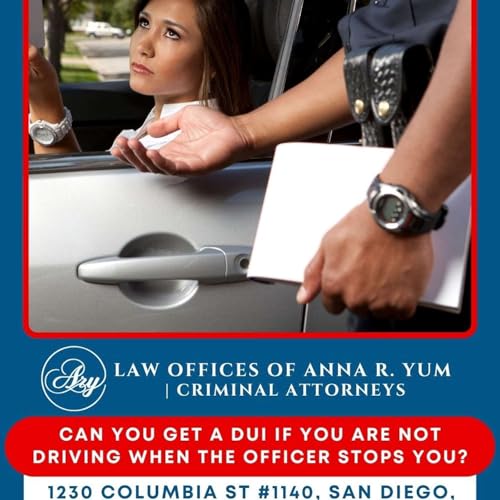
    From Law Offices of Anna R. Yum - Can You Get a DUI If You Are Not Driving When the Officer Stops You? explores how California law approaches DUI charges in situations where no one actually saw you behind the wheel. This episode breaks down the legal standards under California Vehicle Code Section 23152 and explains why prosecutors in San Diego can still pursue charges using circumstantial evidence instead of direct observation.

    Listeners will gain a clear understanding of how cases are built, drawing on insights tied to Mercer v. Department of Motor Vehicles and the concept of “volitional movement.” The discussion highlights how details like engine temperature, key placement, vehicle location, and even statements made to law enforcement can shape a DUI case. The episode also contrasts California’s stricter requirement of proving actual driving with other states that rely on “physical control” of a vehicle.

    The conversation also features the background and perspective of Anna R. Yum, whose experience with the Riverside County District Attorney's Office informs how these cases are approached and challenged. It dives into defense strategies such as the “no-driving” defense, lack of probable cause, and rising BAC arguments, while explaining how subtle facts—like sitting in the back seat or parking legally—can significantly influence outcomes.

    Finally, the episode walks through the real-world consequences of a DUI charge handled in the San Diego Superior Court system, including penalties, DMV hearings, and long-term impacts. It closes by outlining practical steps individuals can take to reduce risk and protect themselves, offering listeners a grounded, informative look at what happens when DUI charges arise—even when no driving was observed.

    Law Offices of Anna R. Yum

    1230 Columbia St #1140 San Diego, CA 92101

    (619) 233-4433

    https://www.google.com/maps?cid=1268592708793668998

    Más Menos
    3 m
  • How Does the DRL 240(1-b) Child Support Formula Work and Can We Deviate in Mediation? - Ryan Besinque
    Apr 15 2026

    From The Law Office of Ryan Besinque - How Does the DRL 240(1-b) Child Support Formula Work and Can We Deviate in Mediation? explores how the Child Support Standards Act (CSSA) shapes child support calculations across Manhattan and New York City, and how parents can navigate these rules through mediation. This podcast breaks down DRL 240(1-b), explaining how courts in Supreme Court and Family Court apply the “presumptively correct” formula while still allowing flexibility through negotiated agreements.

    Listeners will gain a clear understanding of how combined parental income is calculated under the CSSA, how statutory percentages are applied, and how thresholds like the CPI-U-adjusted income cap influence outcomes. The discussion highlights key legal frameworks found in both DRL 240(1-b) and Family Court Act 413, while also examining how courts interpret these rules in real-world cases throughout Brooklyn, the Bronx, Queens, Westchester County, and Nassau County.

    The episode also dives into the practical side of mediation, showing how parents can responsibly deviate from guideline amounts by referencing statutory factors and meeting strict legal requirements. Important case law, including Bast v. Rossoff from the New York Court of Appeals and Baraby v. Baraby from the Third Department, is woven into the conversation to illustrate how shared custody and income disparities are handled in modern child support determinations.

    Featuring insights grounded in years of experience, Ryan Besinque of The Law Office of Ryan Besinque shares how families can structure agreements that reflect their financial realities while remaining enforceable in courts like the New York County Family Court and New York County Supreme Court. With a background that includes the Manhattan Assigned Counsel Panel and education from the University of San Diego School of Law, this episode offers a thoughtful look at balancing legal precision with practical family needs.


    The Law Office of Ryan Besinque

    115 W 25th St 4th floor, New York, NY 10001, United States

    (929) 251-4477

    https://www.google.com/maps?cid=3422990479581259264

    Más Menos
    3 m
  • Can Your Boss Take Your Tips? What Tipped Employees Need to Know - BT Law Group, PLLC
    Apr 15 2026

    From BT Law Group, PLLC - Can Your Boss Take Your Tips? What Tipped Employees Need to Know explains how the Fair Labor Standards Act (FLSA), as amended by the Consolidated Appropriations Act of 2018, shapes the rights of tipped employees across Florida and Miami. This podcast dives into the legal framework that prohibits employers, managers, and supervisors from keeping employee tips, while also unpacking complex areas like tip pooling, tip credits, and service charges. Listeners will gain a clear understanding of how federal and state wage laws intersect and what protections exist for workers in hospitality and service industries.

    The episode highlights key insights from BT Law Group, PLLC attorneys Jason D. Berkowitz and Anisley Tarragona, both of whom bring experience from the University of Miami School of Law and practice across Florida, including matters before the U.S. Court of Appeals for the Eleventh Circuit. Their perspective sheds light on how employers structure pay practices and where violations commonly occur. The discussion also explains how the U.S. Department of Labor and its Wage and Hour Division enforce these rules, especially in cases involving tip theft and wage discrepancies.

    Listeners will also learn how Florida-specific laws, including the Florida Minimum Wage Act, interact with federal standards, and how programs like the Miami-Dade County Wage Theft Program provide additional avenues for recovering unpaid wages. The podcast breaks down real-world scenarios involving tip pooling, credit card deductions, and service charges, helping workers distinguish between lawful practices and violations. It also explains evolving regulations and recent legal developments that impact tipped employees throughout South Florida.

    Finally, the episode explores what workers can do if their rights are violated, including filing claims with the Wage and Hour Division or pursuing legal action under the FLSA. With a focus on empowerment and clarity, BT Law Group, PLLC outlines the steps employees can take to recover lost wages, protect themselves from retaliation, and hold employers accountable. This conversation is essential for anyone navigating tipped work in Miami or across Florida’s service economy.


    BT Law Group, PLLC

    3050 Biscayne Blvd STE 205, Miami, FL 33137

    (305) 507-8506

    https://www.google.com/maps?cid=1652198006057542154

    Más Menos
    3 m
  • Drunk Driving Accident Injury - Keetick L. Sanchez
    Apr 15 2026

    From K L Sanchez Law Office, P.C. - Drunk Driving Accident Injury provides a detailed look at how victims in Queens can pursue compensation after being harmed by an impaired driver. The discussion highlights the serious impact of drunk driving crashes, referencing data from the New York State DMV showing nearly 30% of traffic deaths involve intoxicated drivers. It introduces Keetick L. Sanchez and emphasizes a client-centered approach with direct communication and a mobile law office serving clients across Queens, including Jackson Heights, Elmhurst, Flushing, Astoria, Long Island City, and Forest Hills.

    The episode breaks down how a drunk driving accident injury claim works under New York law, including the distinction between civil cases and criminal proceedings under Vehicle and Traffic Law Section 1192. Key legal concepts such as blood alcohol concentration (BAC), negligence per se, and the role of the New York Supreme Court in Jamaica on Sutphin Boulevard are explained in clear terms. It also explores offenses like DWI, Aggravated DWI, DWAI, and Leandra’s Law, outlining how penalties escalate based on impairment level, prior convictions, and circumstances such as having a child passenger.

    Listeners gain insight into the types of injuries commonly seen in Queens drunk driving collisions, including traumatic brain injuries, spinal cord damage, fractures, internal organ injuries, burns, and psychological trauma. The conversation connects these injuries to New York Insurance Law Section 5102(d) and explains how victims can move beyond the no-fault system to seek broader compensation. It also details economic damages, non-economic damages, and punitive damages, along with the importance of evidence like medical records, witness statements, and expert testimony.

    Finally, the podcast explores additional legal avenues such as dram shop liability under General Obligations Law Section 11-101 and related case law like Adamy v. Ziriakus. It outlines critical deadlines under Civil Practice Law and Rules Section 214, including the three-year statute of limitations and exceptions for wrongful death and claims involving New York City vehicles. Practical steps after a crash—such as calling 911, seeking medical care, preserving evidence, and contacting K L Sanchez Law Office, P.C.—round out the discussion, giving listeners a clear roadmap for protecting their rights after a drunk driving accident in Queens.


    K L Sanchez Law Office, P.C.

    37-06 82nd St #304, Jackson Heights, NY 11372, United States

    (646) 701-7990

    https://www.google.com/maps?cid=2729652254808699760

    Más Menos
    3 m
  • New York Divorce Statistics 2026 - Juan Luciano
    Apr 15 2026

    From Juan Luciano Divorce Lawyer - New York Divorce Statistics 2026 breaks down the latest data on divorce rates, legal trends, and family law developments shaping New York City. This episode explores how statewide averages compare to borough-level realities, highlighting the Bronx, Brooklyn (Kings County), Manhattan, Queens, and Staten Island (Richmond). Listeners will gain a clear understanding of how New York’s divorce rate compares to national figures, with insights drawn from the CDC National Center for Health Statistics and other authoritative sources.

    The conversation takes a closer look at the Bronx, where unique economic and demographic factors create one of the most distinct divorce patterns in NYC. With lower marriage rates and higher percentages of divorced residents, the borough stands apart. We examine how median household income, poverty levels, and social dynamics contribute to these outcomes, while also comparing trends across Manhattan, Queens, and Brooklyn. The episode connects these statistics to real-life implications for families navigating separation and custody.

    Listeners will also learn about the financial realities of divorce in New York, from filing fees to attorney costs, and how affordability challenges impact families—especially in the Bronx. Featuring insights tied to the work of Juan Luciano, this episode explains how divorce, custody, and support cases unfold across courts such as the Supreme Court in Bronx County, the Bronx County Clerk’s Office, and the Matrimonial Support Bureau. The discussion also touches on timelines, explaining why uncontested divorces may take months while contested cases can stretch over years.

    Finally, the episode highlights major legal updates in 2025 and 2026 that are changing how divorce cases are handled across the New York Unified Court System. From new venue rules to updated financial thresholds and shorter separation requirements, these changes directly affect families throughout NYC. With perspective shaped by Juan Luciano’s background and experience, including his ties to the Bronx Family Court Bar Association and education at the State University of New York at Buffalo School of Law, this episode provides a comprehensive look at how law, data, and real-world challenges intersect in New York divorce cases.


    Juan Luciano Divorce Lawyer - Bronx

    187 E 163rd St, Bronx, NY 10451, United States

    (718) 519-8336

    https://www.google.com/maps?cid=12209259138199663041

    Más Menos
    3 m
  • Can the Jury Hear That I Wasn't Wearing a Seat Belt in My Connecticut Car Accident Case? - Dan Petroskey
    Apr 15 2026

    From DeFronzo & Petroskey, P.C. - Can the Jury Hear That I Wasn't Wearing a Seat Belt in My Connecticut Car Accident Case? breaks down how Connecticut General Statutes § 14-100a(c)(3) protects injured drivers and passengers by barring seat belt evidence in civil car accident lawsuits. Centered on Connecticut and the real-world impact this rule can have after a Waterbury car accident, this episode explains why juries cannot be told that a person was unbelted and how that rule helps keep the focus on the at-fault driver’s conduct.

    The episode explores the purpose behind Connecticut’s seat belt evidence rule, the legislature’s policy decision in Public Act 85-429, and the way courts have interpreted the law over time. It also examines the important appellate decision in Bower v. D'Onfro, 38 Conn. App. 685 (1995), showing how the Connecticut Appellate Court upheld the statute and reinforced that seat belt nonuse cannot be used to argue contributory negligence or reduce damages in a civil action.

    Listeners will also hear how this rule applies in practice, including what kinds of evidence are considered inadmissible, from police testimony and photographs to medical records referencing an unrestrained driver or unrestrained passenger. The discussion also covers child restraint systems under § 14-100a(d), the limited distinction between civil and criminal proceedings, the adult seat belt fine under § 14-100a(c)(5), and how Connecticut’s modified comparative negligence rule under § 52-572h still applies to other conduct that may have contributed to the crash.

    Featuring insight drawn from the experience of Waterbury car accident attorney Dan Petroskey, this episode highlights how DeFronzo & Petroskey, P.C. helps clients across Waterbury, New Haven County, and surrounding communities protect the full value of their injury claims. With references to Bank Street, insurance company tactics, trial strategy, and the importance of early legal guidance after a Connecticut car accident, this is a practical listen for anyone trying to understand their rights after a serious collision.


    DeFronzo & Petroskey, P.C.

    255 Bank St # 2b, Waterbury, CT 06702, United States

    (203) 756-7408

    https://www.google.com/maps?cid=2074756120617399372

    Más Menos
    2 m