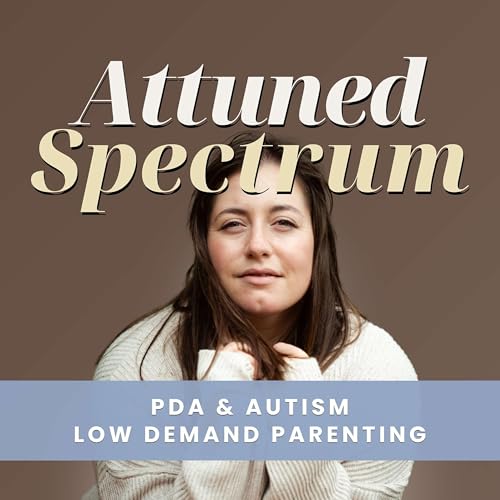
Attuned Spectrum: Pathological Demand Avoidance (PDA) Autism Parenting Support | Low Demand Parenting Podcast Por Chantal Hewitt - PDA Autism Support & Low Demand Parenting arte de portada

Attuned Spectrum: Pathological Demand Avoidance (PDA) Autism Parenting Support | Low Demand Parenting

Attuned Spectrum: Pathological Demand Avoidance (PDA) Autism Parenting Support | Low Demand Parenting

De: Chantal Hewitt - PDA Autism Support & Low Demand Parenting
Escúchala gratis

Is your home a constant battlefield of power struggles and emotional burnout?


Welcome to Attuned Spectrum, the podcast for parents navigating the complex reality of Pathological Demand Avoidance (PDA) and neurodivergent life.


Hosted by Chantal Hewitt, we move beyond "behavior management" to focus on nervous system safety. If you are searching for support with Pathological Demand Avoidance in children, you know that traditional parenting tools don’t work—but a low-demand parenting and lifestyle does.


We dive deep into the strategies that actually create peace at home: declarative language, co-regulation, and building autonomy. Whether you’re dealing with school refusal, autism meltdowns, or sensory overload, this show provides the neuroaffirming wraparound support you’ve been looking for.


Move from crisis to connection.


Subscribe & Follow to join a community that understands the PDA profile and the beautiful, complex reality of raising PDA children.

© 2026 © 2026 Attuned Spectrum: PDA & Autism Parenting Support
Crianza y Familias Desarrollo Personal Higiene y Vida Saludable Psicología Psicología y Salud Mental Relaciones Éxito Personal
Episodios
  • Autism Parenting with PDA: Practical Tips for Demand Avoidant Profiles: Boundary Setting and Better Parent Child Communication | Pathological Demand Avoidance Strategies
    Mar 13 2026

    In this episode, we unpack PDA within autism parenting and PDA as it's own neurodivergent profile and share practical tips in low demand parenting for demand avoidant profiles to reduce anxiety and improve parent and child communication. Learn how to set realistic boundaries in line with your family values, understand how to use declarative languge the right way, and strategies to support your child with PDA and autism spectrum needs.

    Declarative language is often misunderstood within low-demand parenting. However, if done correctly, it can significantly support the anxiety and the stress response within your PDA child, your demand avoidant child, leading to a calmer, more connected home and a more sustainable relationship."

    • What you’ll learn:
      • Understanding PDA within autism and what it looks like in daily life (autism spectrum, PDA autism parenting, neurodivergent parenting challenges, autism behaviour needs)
      • How to set the right boundaries that align with your family values
      • How to use declarative language properly to support autonomy not increase your child's threat response
      • Strategies to improve parent–child communication and connection
    • Key takeaways
      • Low demand parenting is a daily practice that is absolutely essential to your PDA child's wellbeing
      • Start with small, consistent boundaries that link to your specific family values to reduce anxiety triggers
      • Reframe behavior as communication from a needs-driven perspective.
    • Follow Attuned Spectrum Podcast on Spotify or your preferred listening platform!
    • Leave a review to share what resonated and help others discover it.
    • Join the waitlist for Raising PDA Children: chantalhewitt.com/waitlist

    The episode concludes with a teaser for a forthcoming masterclass on values-led parenting, where you’ll craft your own family values roadmap to move from burnout to relief. By the end, you’ll have a ready-to-use toolkit: a clear boundary framework, targeted language scripts, and a step-by-step plan to reduce eggshell-walking and create a calmer, more connected home for your PDA child and the entire family.

    Text me and tell me- What do you want to hear for future episodes?

    Support the show

    Explore these topics:

    • ⚡ Regulation & Safety: Understand why PDA is a Nervous System Response here.
    • 🗣️ PDA Foundations: Master the shift to Declarative Language & Safety here.
    • 🏫 Education & Advocacy: Navigating masking and School Refusal here.

    🔗 RESOURCES MENTIONED:

    Raising PDA Community: Join the Waitlist for wraparound support and an exclusive discount! (Next Opening March 2026!)

    Free PDA Language Guide: FREE GUIDE

    You are not failing and your child is not broken. If you're ready to establish deeper foundations and sustainable support, visit chantalhewitt.com for more resources.

    About the Show: Chantal Hewitt provides neuroaffirming strategies for Pathological Demand Avoidance (PDA) and Autism. Help for families navigating autistic burnout, family wellbeing and sibling dynamics, challenging behaviour, school refusal and autism meltdowns using low-demand parenting.

    Más Menos
    24 m
  • PDA Low Demand Parenting vs. Lazy Parenting: The Truth About PDA | Pathological Demand Avoidance
    Mar 5 2026

    Low Demand Parenting and PDA Autism are frequently misunderstood as "lazy" or "passive," but they are actually essential, safety-led strategies for the Autism Spectrum.

    I know the exhaustion of being judged for your parenting . When others see us lowering demands, they often mistake it for a lack of discipline, but PDA & Autism parenting is the furthest thing from lazy. It requires immense brain power to manage complex sensory needs, navigate meltdowns, and maintain constant nervous system regulation for the whole family.

    In this episode, I’m busting three massive myths that keep parents stuck in shame: the idea that we are "lazy," the fear that we have no boundaries, and the misconception that PDA is just "bad behaviour" or intentional defiance.

    We explore how an autonomy-focused approach actually builds a secure attachment by prioritising co-regulation over forced obedience.

    By shifting our lens, we can support our children to come out of burnout and finally thrive in a world that wasn't built for their neurotype.

    Key Takeaways:

    • Busting the "Lazy" Label: Why low demand parenting is an active, high-energy choice that requires more intentionality than traditional methods.
    • Values-Led Boundaries: How to set essential family boundaries without triggering a threat response or compromising your child's autonomy.
    • Reframing Defiance: Shifting from "bad behaviour" to seeing PDA as a nervous system-driven need for safety and control.
    • The Autonomy Threshold: Understanding how equity versus equality applies to your child's capacity for demands.

    Join the Raising PDA Community Waitlist:

    If you are seeking a judgement-free space, my community doors re-open soon! Members get 24/7 access to a supportive app, personalised coaching, and a "Support Squad" of parents who truly understand the PDA journey .

    Join the waitlist now at chantalhewitt.com/waitlist to secure an exclusive discount for your first three months.

    Text me and tell me- What do you want to hear for future episodes?

    Support the show

    Raising PDA Community: Join the Waitlist for wraparound support and an exclusive discount to get your started! (We open again in March 2026!)

    Join Our Supportive Community PDA Motherhood (for mothers)
    If you're a neurodivergent mother, this space is for you. You don’t have to walk this path alone. Come join us in the PDA Motherhood community—a safe, supportive space where you can unmask, reconnect, and rediscover who you truly are, separate from the demands of parenting.
    Join us here

    Free PDA Language Guide: FREE GUIDE

    You are not failing, and your child is not broken. If you're ready to establish deeper foundations around burnout and sustainability, visit chantalhewitt.com for more resources and 1:1 support.

    About the Show: Chantal Hewitt provides neuroaffirming strategies for Pathological Demand Avoidance (PDA) and Autism. We help families navigate autistic burnout, family wellbeing and sibling dynamics, challenging behaviour, school refusal and autism meltdowns using low-demand parenting.

    Watch on Youtube! 📺 @chantal.hewitt

    Más Menos
    21 m
  • Autism & PDA School Refusal: Why Your Child Can’t (Not Won't) Attend | Low Demand Parenting
    Feb 24 2026

    PDA School Refusal isn't about your child not wanting to go to school; it is about them being physically unable to attend within their bodies.

    If you have a PDA (Pathalogically demand avoidant) or child on the Autism Spectrum, who wants to learn but cannot actually attend, we need to strip back the layers and focus on nervous system safety and co-regulation techniques.

    In this episode, I explain why it is essential to ignore attendance for a moment and instead really understand how low demand parenting supports your child's capacity to not only learn, but to actually want to attend school.

    We dive deep into the "why" behind school refusal, moving away from forced compliance and toward parent-child connection strategies that prioritize your relationship over school rules. You'll learn how to identify the demands of a school environment—from sensory overload to social interactions—and why alternative schooling like Montessori or homeschooling might be the pivot your family needs.

    I also get honest about advocacy. It isn't the school's job to drive this change; as a parent, your attachment and co-regulation are the most impactful tools for your child’s long-term success.

    Main Takeaways

    • Can't vs. Won't: School refusal in PDA is a physiological inability to attend, driven by a lack of felt safety in the nervous system, not a choice or "defiance".
    • Capacity Over Compliance: Forcing attendance when a child is in burnout or high anxiety is counterproductive and damages long-term success.
    • The Invisible Demands: Beyond the classroom work, a 30-hour school week carries heavy demands in social interaction, sensory processing, and transitions.
    • The Parent as Lead Advocate: Because of the secure attachment and trust, the parent is the most impactful person to drive educational change and advocate for the child’s needs.
    • Pivoting is Okay: Traditional schooling isn't built for every brain; alternative environments or homeschooling can preserve a child's love for learning.

    Text me and tell me- What do you want to hear for future episodes?

    Support the show

    Raising PDA Community: Join the Waitlist for wraparound support and an exclusive discount to get your started! (We open again in March 2026!)

    Join Our Supportive Community PDA Motherhood (for mothers)
    If you're a neurodivergent mother, this space is for you. You don’t have to walk this path alone. Come join us in the PDA Motherhood community—a safe, supportive space where you can unmask, reconnect, and rediscover who you truly are, separate from the demands of parenting.
    Join us here

    Free PDA Language Guide: FREE GUIDE

    You are not failing, and your child is not broken. If you're ready to establish deeper foundations around burnout and sustainability, visit chantalhewitt.com for more resources and 1:1 support.

    About the Show: Chantal Hewitt provides neuroaffirming strategies for Pathological Demand Avoidance (PDA) and Autism. We help families navigate autistic burnout, family wellbeing and sibling dynamics, challenging behaviour, school refusal and autism meltdowns using low-demand parenting.

    Watch on Youtube! 📺 @chantal.hewitt

    Más Menos
    15 m
Todavía no hay opiniones