American Catholic History Podcast Por Noelle & Tom Crowe arte de portada

American Catholic History

American Catholic History

De: Noelle & Tom Crowe
Escúchala gratis

Telling the stories of Catholics on these American shores from 1513 to today. We Catholics have such an incredible history in what are now the 50 states of the United States of America, and we hardly know it. From the canonized saints through the hundred-plus blesseds, venerables, and servants of God, to the hundreds more whose lives were sho-through with love of God, our country is covered from sea to shining sea with holy sites, historic structures, and the graves of great men and women of faith. We tell the stories that make them human, and so inspiring.Copyright 2024 All rights reserved. Cristianismo Espiritualidad Ministerio y Evangelismo Mundial
Episodios
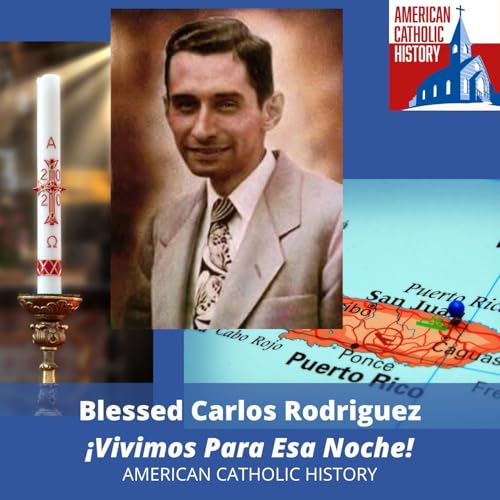
  • Blessed Carlos Rodriguez: ¡Vivimos Para Esa Noche!
    Mar 31 2026

    Carlos Manuel Rodriguez came from a humble but devout family in Puerto Rico. He suffered from a terrible illness for most of his life. He barely graduated high school and couldn't complete college. But he had a deep love of Christ and of the Liturgy, particularly the Easter Vigil. He would say of that liturgy, "¡Vivimos para esa noche!", "We live for that night!" He engaged in great catechetical works and organized groups at the University of Puerto Rico and in many parishes to discuss the liturgy. He believed that the faithful needed to be helped to learn about the liturgy, so they might know their faith better. He also advocated for small changes to the liturgy, including including the vernacular in places, and making it easier for the faithful to engage in full active participation. His health deteriorated in early 1963, when he was diagnosed with terminal cancer. He died in July 1963. Students who had learned from him carried on his legacy and eventually organized to promote his cause of canonization. A miracle was approved in 1999 which led to Pope John Paul II declaring him Blessed Carlos Manuel Rodriguez in 2001. He is the first Caribbean layman to be beatified, and only the second layman in the western hemisphere

    Más Menos
    17 m
  • Ben Franklin Taps John Carroll as First Bishop of Baltimore
    Mar 16 2026

    Benjamin Franklin and Father John Carroll, SJ became friends on an ill-fated mission to Canada in 1776 during the opening stages of the Revolutionary War. The Continental Congress sent Franklin, Charles Carroll of Carrollton, Samuel Chase, and Father John Carroll on a mission to try to persuade the Canadians to join in the rebellion. Franklin was already ill when the trip began, and his condition worsened. He chose to leave Canada early when it was obvious that the mission would not succeed, so Father John Carroll decided to accompany him to help nurse him on the voyage. Franklin credited Carroll's ministrations with saving his life, and he never forgot Carroll's kindness and care. Because of this friendship, when Ben Franklin was the American ambassador to France, and the Church was looking to establish a hierarchy in the new American nation, he was in a position to put in a good word for Carroll. In 1784 Carroll was named "Superior of the Missions," and then in 1789 he was named the first bishop of Baltimore. He became archbishop of Baltimore in 1808, and died in 1815

    Más Menos
    17 m
  • History of St. Patrick's Day Festivities
    Mar 4 2026

    The first St. Patrick's Day Festivities were held, oddly enough, in St. Augustine, Florida in 1600. More than 130 years later the first permanent St. Patrick's Day celebrations as we know them began in Boston, and then 25 years later in New York City, both in the 18th century. The first St. Patrick's Day Parade was held by Irish soldiers in the British army stationed in New York City, who got up on March 17, 1762 and paraded through the streets of Manhattan to a tavern for breakfast. The tradition has stuck. The celebration remained and grew because it was a way for Irish, particularly Irish Catholics, to assert their presence in the New World, and to celebrate their own native culture in this land where they were a minority, not always trusted, but who were intent on staying and being part of this new nation. Since the mid-20th century the American phenomenon of St. Patrick's Day celebrations has both returned to Ireland, where it is a major four-day event, and it has spread throughout the world wherever Irish can be found in large numbers.

    Más Menos
    21 m
Todavía no hay opiniones