Episodios

  • AI Across the Agile Engineering Lifecycle
    Apr 4 2026

    In this episode of the Agile Software Engineering Deep Dive, Alessandro Guida explores what happens when AI enters the Agile software lifecycle.

    AI is rapidly being adopted across discovery, design, development, testing, and operations. But while it can accelerate execution, it also introduces new risks - from shallow understanding to over-reliance on generated solutions.

    This episode examines how AI interacts with core Agile principles.

    Where it strengthens engineering practices. Where it can quietly weaken them. And why real value comes from augmentation - not replacement.

    Because Agile is not just about moving fast. It is about learning and making better decisions over time.

    And that is exactly what we need to protect.

    If you are working with AI in your teams - or considering how to introduce it - this episode offers a grounded perspective on how to do it thoughtfully.

    Please subscribe to the podcast if you find it useful.

    And if you want to go deeper, you can also read the full article in the Agile Software Engineering newsletter.

    Más Menos
    24 m
  • Hiring Madness - When Hiring Became a Numbers Game
    Mar 28 2026

    In this episode of The Agile Software Engineering Deep Dive, Alessandro Guida explores how modern hiring has evolved - and why that evolution may not be entirely positive.

    What used to be a deliberate process of evaluating a small number of candidates has gradually become a high-volume pipeline, driven by platforms, metrics, and automation. Applicant Tracking Systems and AI tools help manage scale, but they also shape how decisions are made.

    This episode examines the consequences of that shift.

    Why hiring is increasingly optimized for quantity rather than quality.

    Why generic job descriptions attract large volumes of candidates - but not necessarily the right ones.

    And why systems designed to filter applications often struggle to recognize real talent.

    The conversation also introduces a critical distinction between hiring for specialization and hiring for talent. While specialist roles require precision and clarity, identifying talent requires judgment, curiosity, and direct human interaction.

    Beyond processes and tools, this episode reflects on the broader responsibility of engineering leadership. Hiring is not only about filling positions. It is about shaping teams, culture, and long-term capability.

    And in the pursuit of efficiency, organizations may be unintentionally damaging their reputation with the very people they hope to attract.

    If you are a manager involved in hiring - whether early in your career or with years of experience - this episode offers a perspective on how to approach it more consciously.

    Because hiring is not a pipeline to optimize.

    It is a judgment to take seriously.

    If you enjoy thoughtful discussions about engineering leadership, decision-making, and the evolution of software engineering practices, this conversation is for you.

    Please subscribe to this podcast - it’s the best way to support it.

    If you are interested in the original article behind this episode, you can also subscribe to the Agile Software Engineering newsletter.

    Más Menos
    17 m
  • Inspiration as a Way to Growth - How deliberate exposure to inspiring inputs helps engineers mature professionally
    Mar 21 2026

    In this episode of The Agile Software Engineering Deep Dive, Alessandro Guida explores the role of curiosity and inspiration in engineering growth.

    Software engineering is often treated as a purely technical discipline — focused on frameworks, programming languages, architectures, and tools. Yet many of the ideas that shape engineering innovation originate far outside the software field.

    Throughout history, engineers and scientists have drawn inspiration from mathematics, physics, philosophy, literature, and even science fiction. These disciplines expand how we think about problems, systems, and possibilities.

    This episode reflects on why curiosity should be considered a professional capability — not just a personal trait. Engineers who explore widely often develop stronger problem-solving skills, more creative thinking, and a broader understanding of the systems they build.

    The conversation also touches on the role of engineering leadership. Creating high-performing teams is not only about processes and tools, but also about cultivating environments where curiosity, learning, and intellectual exploration are encouraged.

    Because innovation rarely comes from repeating what we already know.

    It comes from exploring what we don’t.

    If curiosity gives you the energy to push the limits of what others believe can be done, you are probably already on the right path.

    If you enjoy thoughtful discussions about how engineering ideas evolve — beyond frameworks and buzzwords — this conversation is for you.

    Please subscribe to this podcast — it’s the best way to support it.

    If you are interested in the original article behind this episode, you can also subscribe to the Agile Software Engineering newsletter.

    Más Menos
    17 m
  • Career Ladders for Software Professionals - and How to Make Salary Structures More Transparent
    Mar 14 2026

    In this episode of The Agile Software Engineering Deep Dive, Alessandro Guida explores why professional software engineering requires professional career structures.

    Career ladders are often perceived as rigid or bureaucratic. In reality, they provide clarity about expectations, scope of impact, and sustained behavior at each stage of an engineering career. Without that clarity, progression becomes ambiguous and growth conversations lose focus.

    Alessandro discusses how to define meaningful levels based on responsibility and influence rather than seniority alone, why roles such as Technical Lead should not automatically imply promotion, and how Individual Contributor and Management paths must remain structurally distinct yet equally senior.

    The episode also examines two unhealthy leadership extremes - the purely administrative manager who loses technical depth, and the over-involved “super engineer manager” who never truly transitions into leadership. Healthy engineering management requires technical credibility, product awareness, and organizational responsibility in balance.

    Finally, the conversation connects career ladders to salary transparency. When expectations are explicit and levels are well defined, compensation discussions move from negotiation to structural alignment.

    If you care about clarity, fairness, and long-term engineering professionalism, this episode is for you.

    Please subscribe to the podcast - it is the best way to support it.

    If you are interested in the full written article behind this episode, you can find it in the Agile Software Engineering newsletter on LinkedIn.

    Más Menos
    22 m
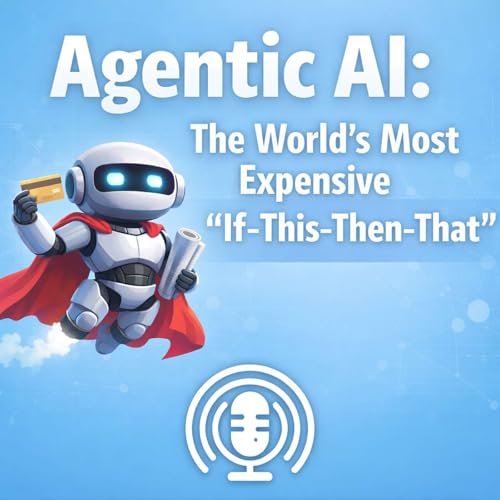
  • Agentic AI: The World’s Most Expensive “If-This-Then-That”
    Mar 7 2026

    In this episode of The Agile Software Engineering Deep Dive, Alessandro Guida explores the growing excitement around Agentic AI - and tries to separate engineering reality from marketing language.

    Across podcasts, conference talks, and LinkedIn posts, AI agents are increasingly presented as systems that can plan, reason, and autonomously execute complex workflows. The promise is compelling: software that not only generates text, but actively interacts with other systems and performs useful tasks on our behalf.

    But what actually happens under the hood?

    This episode takes a calm engineering look at what “agentic” systems really are. In many cases, they consist of language models connected to tools and services through APIs, operating inside orchestration loops that interpret goals, call tools, and iterate toward a result.

    Powerful? Absolutely.
    Magical? Not really.

    Alessandro walks through a simple practical example of how an AI agent might coordinate actions across email and calendar systems, and reflects on the engineering implications that appear once AI systems start interacting with real infrastructure.

    Because once an AI system can act - not just generate - questions about reliability, control, observability, and governance quickly emerge.

    The episode also reflects on a familiar pattern in the technology industry: new ideas often arrive surrounded by enthusiasm and bold claims before eventually settling into more realistic engineering practices.

    Agentic AI may well become an important part of future software systems. But as with many technologies before it, the real value will likely emerge when the hype slows down, and engineering discipline takes the lead.

    If you enjoy thoughtful discussions about how modern software engineering evolves - beyond the buzzwords - this conversation is for you.

    Please subscribe to this podcast - it’s the best way to support it.

    If you are interested in the original article behind this episode, you can also subscribe to the Agile Software Engineering newsletter.

    Más Menos
    24 m
  • WHAT HAPPENED TO QUALITY, USABILITY AND DOGFOODING? - The Engineering Discipline of Quality and Trust
    Feb 26 2026

    In this episode of The Agile Software Engineering Deep Dive, Alessandro Guida reflects on a question many of us quietly experience as users:

    What happened to quality?

    In the race to release faster, ship AI features, and stay ahead of competitors, software increasingly “almost works.” Small usability irritations, fragile integrations, and premature releases are becoming normalized.

    This episode is not about blaming a specific product or technology. It is about examining a broader cultural shift in engineering priorities.

    Alessandro revisits the discipline of “dogfooding” - the practice of using your own software before releasing it - and reflects on why reliability, usability, and professional testing rigor are not nostalgic ideals, but foundational responsibilities.

    The conversation also expands beyond apps and web platforms. As software moves into appliances, vehicles, and physical systems, quality becomes more than convenience. It becomes trust.

    This episode sets the stage for a deeper exploration of what Alessandro defines as the four pillars of software quality: Security, Reliability, Usability, and Performance.

    If you care about building systems people can truly depend on, this conversation is for you.

    Please subscribe to this podcast - it’s the best way to support it.

    If you’re interested in the original article behind this episode, make sure to subscribe to the Agile Software Engineering newsletter.

    Más Menos
    25 m
  • The beauty of Mastering Algorithms
    Feb 19 2026

    In this episode of The Agile Software Engineering Deep Dive, Alessandro Guida reflects on one of the most fundamental - and increasingly overlooked - pillars of professional software engineering: mastering algorithms.

    Modern software development makes it possible to assemble complex systems quickly through frameworks, libraries, integrations, and AI-assisted tooling. While this represents real progress, it can also blur an important distinction. There is a difference between building systems by combining existing components and understanding the principles that make those systems work.

    This episode explores why algorithmic thinking remains essential for long-term engineering maturity. Through a personal story from early in his career - where a geometric clipping algorithm resolved a real performance bottleneck - Alessandro illustrates how first-principles reasoning becomes decisive when abstractions break down.

    These reflections are not presented as an academic lecture or a rejection of modern tools, but as experience-based insights shaped by years of working with performance-critical and safety-conscious systems across different domains.

    The goal is not to romanticize the past, but to highlight a simple and durable truth: technologies evolve rapidly, but the underlying ideas endure. Engineers who understand algorithms and complexity are better equipped to design, evaluate, and adapt systems when ready-made solutions fall short.

    If you are a student, an engineer early in your career, or a manager responsible for growing technical depth within your team, this episode offers perspective on why mastering algorithms is not an academic luxury - but a professional foundation.

    Please subscribe to this podcast. It’s the best way to support it.
    If you’re interested in the original article behind this episode, make sure to subscribe to the Agile Software Engineering newsletter.

    Más Menos
    22 m
  • The User Manual for the Young Engineering Manager - or: the worst mistakes I made in my career
    Feb 14 2026

    In this episode of The Agile Software Engineering Deep Dive, Alessandro Guida reflects on the transition from engineer to engineering manager - and the mistakes he had to learn the hard way.

    When engineers step into management roles, they often bring with them the very strengths that made them successful: problem-solving speed, technical clarity, and the ability to see solutions quickly. While these qualities are valuable, they can quietly create unintended consequences. Discussions become shorter. Decisions become centralized. Teams grow dependent rather than autonomous.

    This episode explores several of the most impactful early-career management mistakes - including believing it was still his job to be the smartest person in the room, confusing speed with progress, and becoming “too central” in the system.

    These reflections are not presented as a leadership framework or a management theory, but as experience-based lessons shaped by years of building and leading engineering teams across different domains and levels of complexity.

    The goal is not to discourage engineers from moving into leadership, but to highlight a simple and often uncomfortable truth: leadership is less about brilliance and more about restraint.

    If you are a young engineering manager - or considering the transition - this episode may help you avoid strengthening your team’s dependence when you actually intend to build their autonomy.

    Please subscribe to this podcast. It’s the best way to support it.
    If you’re interested in the original article behind this episode, make sure to subscribe to the Agile Software Engineering newsletter.

    Más Menos
    16 m