Episodios

  • AMSEcast with guest Michelle Shocklee
    Mar 26 2026

    Author Michelle Shocklee discusses her novel The Women of Oak Ridge and the personal, historical, and emotional paths that led her to the story of the Secret City during the Manhattan Project. Growing up near Los Alamos and coming from a World War II family shaped her long-standing connection to the era, but a chance encounter with a reader ultimately sparked her discovery of Oak Ridge. Shocklee describes her deep research process, drawing on oral histories, archival photographs, museum resources, and firsthand accounts to authentically portray life inside a city built on secrecy. She explains how she weaves history into fiction by grounding the narrative in the lived experiences of her characters, particularly women whose wartime work reshaped their futures. The conversation highlights the challenges of secrecy, segregation, and stress faced by Oak Ridge residents, as well as the lasting impact of women entering the workforce during the war. Ultimately, Shocklee reflects on Oak Ridge as both a hidden chapter of history and a powerful source of human resilience and transformation.

    Más Menos
    24 m
  • AMSEcast Geoff deBeauclair
    Apr 8 2026

    AMSEcast launches a new series exploring America's nuclear navy and Oak Ridge's vital role in its history and future.

    From helping shape the legacy of Admiral Hyman G. Rickover to supplying nuclear fuel for today's fleet, Oak Ridge has long stood at the center of U.S. naval nuclear power. As the American Museum of Science and Energy prepares a new exhibit at the Wilcox K-25 Interpretive Center, this episode sets the stage.

    Our inaugural guest, Geoffrey deBeauclair, is a graduate of the United States Naval Academy and a 30-year Navy veteran who commanded a ballistic missile submarine and later led the Newport Division of the Naval Undersea Warfare Center. He shares his journey into the Navy's Nuclear Power Program, the demanding training and qualification process, and what it means to command a submarine at sea.

    Geoff offers a rare look inside daily life underwater, from relentless drills and rotating watch schedules to crew traditions, leadership challenges, and staying connected with family during long patrols.

    It's a compelling introduction to the people, discipline, and mission behind America's nuclear navy.

    Más Menos
    37 m
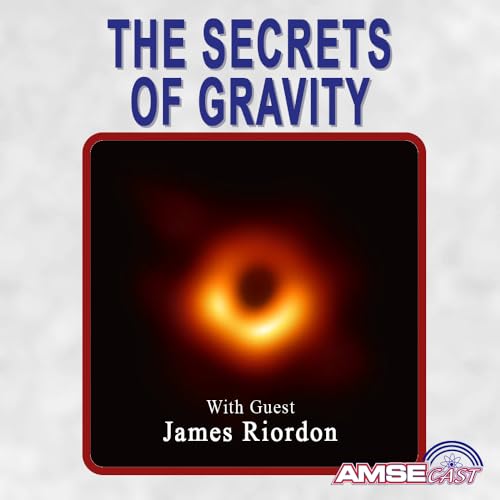
  • The Secrets of Gravity: AMSEcast with James Riordon
    Mar 11 2026

    In this episode of AMSEcast, host Alan Lowe welcomes back science journalist and NASA senior science writer James Riordon to discuss his new book Crush: Close Encounters With Gravity. Riordon explores the fascinating science of gravity, from Isaac Newton's groundbreaking laws to Albert Einstein's revolutionary theory of general relativity. The conversation dives into how gravity shapes everything from the structure of Earth to the behavior of black holes and gravitational waves. Riordon also explains the strange effects of weightlessness on the human body, the mysteries of dark matter and dark energy, and the possibility of exotic phenomena like wormholes. Blending history, physics, and cutting-edge discoveries, this episode offers an accessible look at one of the universe's most fundamental forces and the scientists who helped us understand it.

    Más Menos
    22 m
  • AMSEcast with guest Dr. Sam Schrell
    Mar 5 2026

    In this episode of AMSECast, Dr. Samantha Schrell explores the fascinating and often mysterious world of actinides—rare, radioactive elements with powerful applications in medicine, energy, space exploration, and national security. She explains what makes actinides unique, why they are difficult to study, and how elements like californium play a critical role in starting nuclear reactors and powering space missions. Dr. Schrell also discusses Oak Ridge National Laboratory's long-standing leadership in producing and researching heavy actinides through the High Flux Isotope Reactor. The conversation highlights the mission of the Glenn T. Seaborg Institute: building a pipeline of scientists and engineers trained to work in this highly specialized field. Through fellowships, collaboration across national labs, and cutting-edge research, the Institute is ensuring the future of actinide science. Ultimately, the episode reveals how curiosity, expertise, and education drive innovation at the atomic edge.

    Más Menos
    13 m
  • AMSEcast with guest Dr. Ahmed El-Mokadem
    Feb 5 2026

    In this wide-ranging conversation, Ahmed El-Mokadem explores the deep ideas behind mathematics' most mysterious numbers, revealing how concepts like zero, infinity, irrational numbers, and imaginary numbers challenge both logic and philosophy. He traces how constants such as π, e, the golden ratio, and the Feigenbaum constants appear universally across nature, physics, biology, and technology—suggesting they are discovered features of reality rather than human inventions. El-Mokadem highlights how mathematics repeatedly expands its own boundaries, from accepting imaginary numbers to assigning meaning to divergent infinities through Ramanujan's work. He shows that even chaos follows hidden numerical order, and that numbers long viewed as paradoxical often turn out to be indispensable. Throughout, mathematics emerges not as cold abstraction, but as a living language that reveals structure, mystery, and beauty in the universe. The discussion ultimately invites listeners to see math as a bridge between human curiosity and the deep order of the cosmos.

    Más Menos
    45 m
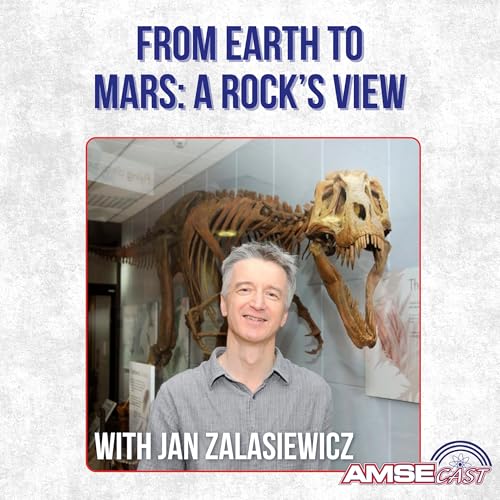
  • From Earth to Mars: A Rock's View with Jan Zalasiewicz
    Jan 21 2026
    From Oak Ridge, Tennessee, AMSEcast host Alan Lowe sits down with geologist and paleontologist Dr. Jan Zalasiewicz, chair of the Anthropocene Working Group and author of How to Read a Rock. Their conversation explores how rocks and minerals form and what they reveal about Earth's history, from the rock cycle and earthquakes to ancient climates recorded in stone. Jan explains how life, human activity, and materials like bricks and concrete have reshaped geology, and how coal, oil, and gas fit into Earth's carbon cycle. The discussion also looks outward to the Moon and Mars, where rocks offer clues to planetary history and the possibility of past life. Guest Bio Dr. Jan Zalasiewicz is a geologist and paleontologist and an emeritus professor of paleobiology at the University of Leicester. He serves as chair of the Anthropocene Working Group, which has played a leading role in advancing the idea of the Anthropocene as a new geologic epoch shaped by humanity's impact on Earth. A prolific and widely published author, Jan explores how rocks, fossils, and landscapes record the planet's deep history. His books include The Cosmic Oasis: The Remarkable Story of Earth's Biosphere, Discarded: How Technofossils Will Be Our Ultimate Legacy, and How to Read a Rock: Our Planet's Hidden Stories, which is the focus of today's conversation. Show Notes:
    • (1:34) The difference between a rock and a mineral
    • (2:38) How minerals form rocks
    • (4:51) How limestone and marble are formed
    • (6:33) Identifying faults based on rock strata and surface landscapes
    • (8:51) What rocks say about the structure and atmosphere of ancient Earth
    • (10:43) How materials can survive millennia without changing
    • (12:56) The ways animals and plants can affect the Earth's geology
    • (15:28) How concrete and bricks are created
    • (18:53) How hydrocarbons are formed
    • (21:47) What we've learned about the Moon and Mars from their samples
    • (25:15) What's next for Jan Zalasiewicz
    Links Referenced
    • The Cosmic Oasis: The Remarkable Story of Earth's Biosphere https://www.amazon.com/Cosmic-Oasis-Remarkable-Earths-Biosphere/dp/0198845871/
    • Discarded: How Technofossils Will be Our Ultimate Legacy https://www.amazon.com/Discarded-Technofossils-Will-Ultimate-Legacy/dp/0192869337/
    • How to Read a Rock: Our Planet's Hidden Stories https://www.amazon.com/How-Read-Rock-Planets-Stories/dp/1588347281
    Más Menos
    28 m
  • AMSE Science Report with Alan Chodos and James Riordon
    Jan 9 2026

    What if I told you that, no matter where you are or what you are doing, about 100 trillion neutrinos are passing through your body every second? Well, you might first respond, as I did, by asking what is a neutrino, and then wondering why we seem to have no awareness at all of their presence. I mean, if were one or two particles, sure, you might miss them, but 100 trillion every second? I needed to learn more so I spoke on our podcast, AMSEcast, with Alan Chodos and James Riordon about their fascinating book, Ghost Particle: In Search of the Elusive and Mysterious Neutrino.

    Más Menos
    4 m
  • Why We Go to Space: Curiosity, Innovation, and the Human Spirit with William Harris
    Dec 24 2025
    In this episode of AMSEcast, host Alan Lowe sits down with William Harris, President and CEO of Space Center Houston, to explore the past, present, and future of human space exploration and what it means for American innovation. As the official visitor center for NASA's Johnson Space Center, Space Center Houston serves as the public gateway to human spaceflight. William shares how the center uses historic artifacts, immersive experiences, and cutting-edge STEM programming to demystify space exploration and inspire the next generation of innovators. From Apollo and the Space Shuttle to Artemis, Mars, and the James Webb Space Telescope, this conversation dives deep into how humans have made the impossible possible, often with limited technology but unlimited curiosity. William also discusses workforce development, diversity in innovation, the power of failure, and why STEM truly is for everyone. If you're fascinated by space, innovation, education, or the future of exploration, this episode offers a powerful reminder of what humans can achieve when curiosity, collaboration, and courage come together. Highlights: (00:00) Introduction to Amse Cast (00:46) Guest Introduction: William Harris (01:44) Exploring Space Center Houston (03:12) Key Exhibits and Artifacts (06:24) STEM Education Initiatives (08:57) Innovation Gateway Programs (16:40) The Legacy of the Space Shuttle (18:56) Artemis and the Future of Space Exploration (23:18) Unmanned Missions and Their Impact (35:14) Conclusion and Future Plans
    Más Menos
    39 m