Episodios

  • Miriam Attwood & John Kinsley: Building community.
    Apr 16 2026

    Nine out of ten architectural practices in Europe are involved in designing private housing, according to the Architects Council of Europe, with the work generating 54% of the average practice’s turnover. But according to RIBA, in 2018 in the UK only 6% of housing was designed by architects. So housing is incredibly important to the economy of a profession which is very marginal to the production of housing in general. How did we get here?

    In this episode of the A is for Architecture Podcast I spoke to an architect and their client, or a client and their architect, about a project which perhaps illustrates another way of doing things. Working together, architect and Lecturer in Architecture Technology at Newcastle University, John Kinsley, and client (and Director at StorytellingPR) Miriam Attwood discuss their scheme for a collective custom build home in Leith, Scotland.

    It’s a good story well told of another image of housing, one which adopts a typology, form, material and technology - and a process of design – design-as-relationship - which positions the house in service to the community it is for, and preferences home making above money makers.

    As the Bruderhof like to say, another life is possible.

    John can be found on John Kinsley Architects’ website and on LinkedIn. Miriam can be found there too and at StorytellingPR.

    Music credits: ⁠Bruno Gillick

    Image credits: Main: Model of collective custom build, Leith © John Kinsley Architects.

    #ArchitecturePodcast #HousingDesign #CustomBuild #CollectiveHousing #waltersegal

    Más Menos
    57 m
  • Tim Altenhof: Atmospheres and architecture.
    Apr 9 2026

    Close study of singular aspects of building culture remains the mainstay of good architectural scholarship. Through detail, universals can be revealed. This is the case with Tim Altenhof’s Breathing Space: The Architecture of Pneumatic Beings, published by Zone Books in March this year (distributed by Princeton University Press), the subject of the latest A is for Architecture Podcast episode.

    Breathing Space is an elegant exploration of the role of breath – breathing – in the development of buildings, and the way consciousness of the human lung has shaped architectural design, not least in the emergence of analogies between buildings and bodies.

    Our discussion of a little of Tim’s book focuses on the concept of ‘respiratory modernism’, examining how architecture engaged with the body, air and atmosphere in response to wider social, scientific and political concerns around health and the modern city. How were these ideas communicated to the public? And how does this thinking around breathing, bodies, environment and habitation come to us now, in this age of ultramodernism?

    Tim is Tim Altenhof is an architect and senior scientist at the University of Innsbruck. He can be found at work, on his own website and on Instagram. The book is linked above.

    +

    Music credits: ⁠Bruno Gillick

    Image credits: Main: Luckenwalde Dye Works © Tim Altenhof (2023), Author photo: © Bengt Stiller.

    #ArchitecturePodcast #BreathingSpaceArchitecture #RespiratoryModernism #ArchitectureAndHealth #ArchitecturalTheory

    Más Menos
    1 h y 6 m
  • Ed Wall: Architecture & war.
    Mar 26 2026

    With warfare seemingly creeping up on us – because governments keep starting them – it seemed like a good idea to speak to Ed Wall, Professor of Cities and Landscapes at the University of Greenwich, about his book Architecture for Warfare: How Corporations Profit from Destruction and Reconstruction, published by Jovis in December last year.

    It’s difficult to know what to say about this, beyond what Professor Wall describes in the book: there is a seam of architectural practice which makes the infrastructure of war and reconstruction, and makes a good deal of good business whilst doing it. Isn’t it better, one might ask, that architects, with their designerly imaginations, their theories and lovely drafting skills, and their spatial-technical and ecological competencies, are involved in this sort of stuff? At least then it’ll have passive ventilation.

    Jeremy Bentham – not an architect – drew the panopticon in the Eighteenth Century and in so doing arguably more-or-less defined the modernist city. The great Alfred - Waterhouse designed Strangeways in the 19th, and that’s pretty lit. Then there was Speer, of course, in the Twentieth. So the connection isn’t new. It still feels odd, though, as Ed explains…

    Ed can be found at work, on Instagram and LinkedIn. The book is linked above.

    +

    Music credits: ⁠Bruno Gillick

    #ArchitectureForWarfare #DesignEthics #UrbanReconstruction

    Más Menos
    44 m
  • Andreas Lechner: Forms and typologies.
    Mar 19 2026

    In Episode 194 of the A is for Architecture Podcast, architect and writer and Andreas Lechner, Associate Professor of Design and Building Theory at TU Graz in Austria and founder of Studio Andreas Lechner, also based in Graz. We connected off the back of my previous conversation with Hans van der Heijden – with whom he had spoken on Drawing Matters last summer.

    Specifically, Andreas and I spoke about his book, Thinking Design: Blueprint for an Architecture of Typology (Park Books 2021), a book which combines theoretical reflection on architectural teaching with an illustrated visual atlas of 144 projects – all drawn orthographically and with no photographs – which serves as invitation to explore architectural design through the lens of typology – somewhat maligned in an age of humanised fun, grandiosity, pomp and intellectual frilliness - arguing as I read it for something a bit more normal - the primacy of form as the core of the discipline.

    Andreas’s practice can be found here, and he is on LinkedIn and Instagram. His conversation with the super Hans on Drawing Matters is here. The book is linked above.

    +

    Music credits: ⁠Bruno Gillick

    Image credits: 1: © Andreas Lechner, 2: © Andreas Lechner, Park Books, 3 © TU Graz.

    #ArchitecturalTypology #ThinkingDesign #ArchitecturePodcast #BuildingTypology #AndreasLechner

    Más Menos
    58 m
  • Lee Ivett: Blueprint for a new architecture.
    Mar 12 2026

    In the 193rd episode of this here A is for Architecture Podcast, Lee Ivett joined me for a second time, 1591 days since his last appearance here. Now a Professor and Head of the London School of Architecture, and still an active architect, I wanted to speak to Lee to discuss architectural education and practice life.

    As architecture’s professional bodies push for recognition and reform, whilst governments – or their financial backers – who knows - seemingly push back, it appears like the profession is at an inflection point. Lee argues for a radical shift in how we train the next generation and, with style, describes the urgent need for a more responsive, integrated education.

    Stuck in a world of materials, flows, logistics, finance, risk and policy, architecture is a cumbersome beast. But, I think Lee would suggest, it’s also too important to abandon in favour of neoliberal indifference and a ‘trust the market’ fundamentalism if we are to retain or remake good urban space.

    Instead, in a world of rapid change and technological shocks, architecture has to move beyond both aesthetics-first or tech-fix positions and towards critical inquiry and research-led architecture that tries to make the world better.

    Lee can be found at work here, and on Instagram as Baxendale here. Other People’s Dreams can be found here.

    +

    Music credits: ⁠Bruno Gillick

    Image credits: Main: Ecaterina Stefanescu. Second: Jack Bolton. Third: Lucy Strange/ LSA.

    Más Menos
    1 h
  • Itohan Osayimwese: Africa, ornament and architecture.
    Mar 5 2026

    In Episode 192 of the A is for Architecture Podcast, Itohan Osayimwese, Professor of the History of Art & Architecture and Urban Studies and Department Chair at Brown University, discusses small parts of her big book, Africa's Buildings: Architecture and the Displacement of Cultural Heritage, published with Princeton University Press in October last year.

    In our conversation, Itohan argues that during the age of European empire, colonizers not only expropriated African art and artifacts but systematically – strategically - dismembered buildings, removing them piece-by-piece. In doing so, structural and ornamental components became, in the alienating setting of European and North American museums, reduced to craft artefacts, denuded of weight and depth of cultural knowledge and meaning. This fragmentation, Itohan argues, has contributed to scholarly and popular silences about African architectural histories, erasing built environments as sites of cultural expression, social life and technological innovation. The book reframes these displaced elements as architecture proper, challenging stereotypes that reduce African building traditions to tasteful ethnographic curiosities, arguing instead that they might be better seen as potential tools for restitution and repair.

    Itohan can be found at work here. The book is linked above.

    +

    Music credits: ⁠Bruno Gillick

    Image credits: Main: Creative Commons Attribution 4.0 International; Book cover: ©Martin Franken

    #AfricanArchitecture #ColonialLoot #CulturalHeritage #RestitutionAfrica #DecolonizingArchitecture

    Más Menos
    1 h y 11 m
  • Ellen Braae & Thordis Arrhenius: Scandinavia and the architecture of welfare.
    Feb 26 2026

    The A is for Architecture Podcast’s 191st episode is a conversation with two professors, Ellen Braae & Thordis Arrhenius, about their and Guttorm Ruud’s publication, Architecture and Welfare: Scandinavian Perspectives, which came out with Birkhäuser in 2025.

    To summarise the book is hard, composed as it is of twenty essays by different authors exploring aspects of postwar Scandinavian architecture and the role it played in materialising welfare state ideals, giving spatial form to principles of equality, collectivism and democracy. Today, as the political consensus around universal welfare has been weakened from within and without, the book asks us to think again of that peculiar and in some ways utopian architectural legacy, examining its contested past and uncertain future, and positioning it as a subject not just for historians, but as a model that still challenges and instructs.

    Ellen is Professor of Landscape Architecture at the University of Copenhagen and is there and on LinkedIn; Thordis is professor of architecture at KTH Royal Institute of Technology, Sweden. The book is linked above.

    +

    Music credits: ⁠Bruno Gillick

    #ArchitecturePodcast #WelfareArchitecture #ScandinavianArchitecture #PostwarArchitecture #WelfareState

    Más Menos
    58 m
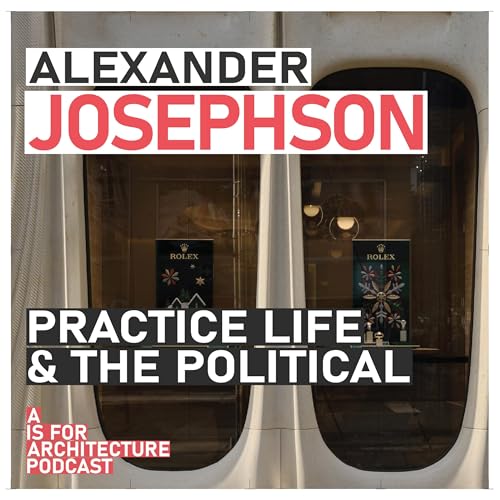
  • Alexander Josephson: Practice life and the political.
    Feb 19 2026

    For Episode 190 of the A is for Architecture Podcast, Alexander Josephson, architect, lecturer at the University of Toronto’s Daniels Faculty of Architecture, and in 2012, co-founder of PARTISANS, a Toronto-based collective of architects, designers and thinkers that, among other things, is currently collaborating on the renewal of the Hearn Generating Station, a massive decommissioned power plant on Toronto’s waterfront, projected to hold the largest gallery space in North America as part of its transformation into 'a city in a building'. The practice’s works are regularly featured in global design publications.

    Alex also founded Cumulus, a tech start-up that provides ‘an immersive digital archive of photos, videos and files in a memory cloud that clients can share with loved ones’, a sort-of archive of the virtual, a digital ossuary, if you will. For an architect, this is the ultimate Latourian-turn, I guess.

    Alex can be found on PARTISANS’ website, on LinkedIn and Instagram. Cumulus is here.

    +

    Music credits: ⁠Bruno Gillick

    #ArchitecturePodcast # #AlexJosephson #PARTISANSarchitecture #InnovativeArchitecture #TorontoArchitect

    Más Menos
    56 m