

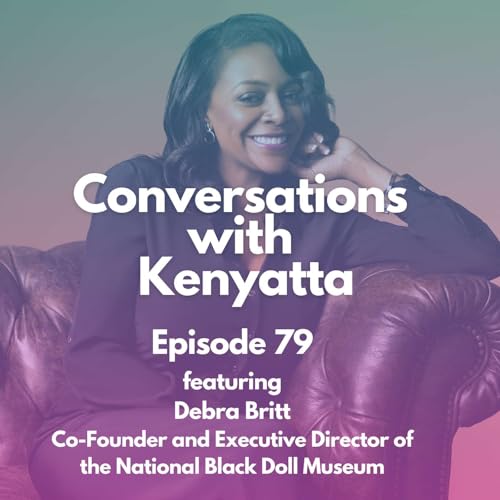
A Conversation with Debra Britt & The National Black Doll Museum
No se pudo agregar al carrito
Add to Cart failed.
Error al Agregar a Lista de Deseos.
Error al eliminar de la lista de deseos.
Error al añadir a tu biblioteca
Error al seguir el podcast
Error al dejar de seguir el podcast

A Conversation with Debra Britt & The National Black Doll Museum
-
Narrado por:
-
De:
Send us a text
In this episode of Conversations with Kenyatta, Debra Britt, founder of the National Black Doll Museum, shares her powerful personal journey and the story behind her life’s work preserving Black history and identity through dolls.
Debra describes how her passion began in childhood when her grandmother helped her create her first Black doll — a moment that sparked a lifelong mission. She reflects on the adversity she faced, the mentors and educators who shaped her path, and how cultural pride and representation fueled her calling to collect, restore, and create Black dolls.
Throughout the conversation, she explains how dolls serve as storytellers, teaching tools, and healing instruments for children and adults alike. The museum’s collection preserves heritage, affirms identity, and opens important conversations about race, history, and resilience. Debra also discusses the realities of running a community-supported museum, including the ongoing need for volunteers and financial support.
⏱️ Episode Timeline
00:00 — Introduction and Early Inspiration
Debra’s childhood and creating her first Black doll with her grandmother
02:03 — Facing Adversity and Finding Strength
Early challenges and how resilience took shape
05:38 — Family Influence and Cultural Pride
The role of family, mentors, and educators
09:29 — Storytelling and Education Through Dolls
How dolls communicate history and identity
10:11 — Dolls as Silent Historians
Material culture as historical record
13:44 — The Healing Power of Dolls
Emotional connection and therapeutic impact
17:25 — Doll-Making Traditions and History
Cultural and historical craft practices
20:30 — Doll Therapy and Community Engagement
Programs and outreach work
23:57 — Letting Go and Dealing with Bullies
Personal growth and hard lessons
25:32 — Teaching Children About Racism and Slavery
Age-appropriate truth telling
26:32 — Special Dolls and Personal Stories
Meaningful pieces in the collection
28:52 — Memorable Visitor Reactions
Moments that stand out
33:38 — Community Support and Volunteer Needs
Behind-the-scenes realities of the museum
40:52 — Acquiring and Valuing Dolls
Collection practices and preservation
44:23 — Closing Reflections
Final thoughts and message to listeners
If this conversation moved you, consider supporting the museum’s work to preserve history, representation, and cultural identity through Black dolls and storytelling. You can help by donating, volunteering, spreading the word, or planning
Conversations with Kenyatta features Kenyatta D. Berry. Music for episodes 1-76 is "Good Vibe" by Ketsa, Music for episodes 77+ is “Rheme – Afrobeat x African Instrumental x Reggae Beat,” via Pixabay.
Learn more about Kenyatta and her work at KenyattaBerry.com.
You can also connect with her on social media:
Instagram: @Kenyatta.Berry
Facebook: facebook.com/KenyattaDB
Thanks for listening, we’ll see you next time on Conversations with Kenyatta.
We are dedicated to exploring and discussing various aspects of genealogy, history, culture, and social issues. We aim to shed light on untold stories and perspectives that enrich our understanding of the world.
Disclaimer: All guest opinions expressed in Conversations with Kenyatta are their own and do not reflect the views of Kenyatta D. Berry.
.