

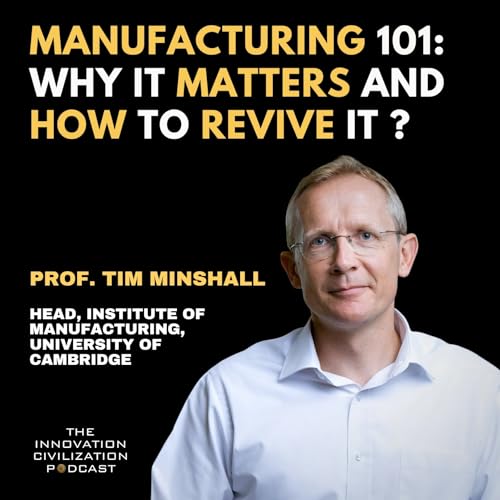
#44 - Prof. Tim Minshall : Manufacturing 101: Why It Matters and How to Revive It?
No se pudo agregar al carrito
Add to Cart failed.
Error al Agregar a Lista de Deseos.
Error al eliminar de la lista de deseos.
Error al añadir a tu biblioteca
Error al seguir el podcast
Error al dejar de seguir el podcast

#44 - Prof. Tim Minshall : Manufacturing 101: Why It Matters and How to Revive It?
-
Narrado por:
-
De:
We’re joined by Professor Tim Minshall, a leading authority on innovation and industrial strategy, and one of the most influential voices shaping how ideas move from labs into the real economy.
Tim is a Professor of Innovation at the University of Cambridge and head of the Institute of Manufacturing there, where he has spent decades working at the intersection of research, manufacturing, entrepreneurship, and policy. His work focuses on one deceptively simple question: why do so many great ideas fail to scale—and what does it actually take to turn innovation into impact?
In this episode we unpack on why advanced manufacturing still matters deeply for economic resilience, why the UK and Europe struggle to scale technologies they invent, and what policymakers, founders, and institutions consistently misunderstand about innovation systems.
We dive into:
-Why innovation fails at the scaling stage—not the idea stage
-The missing link between research, startups, and manufacturing
-Why advanced manufacturing is a strategic asset, not a legacy industry
-University spinouts: what works, what doesn’t, and why most fail
-The difference between invention, innovation, and impact
-Why “more startups” is the wrong innovation metric
-The role of systems thinking in national competitiveness
-What policymakers get wrong about industrial strategy
-How to build innovation ecosystems that actually deliver outcomes
-Lessons from Cambridge’s innovation model—and its limits
Key Takeaways from the Episode:
1. Innovation Is a System, Not a Moment: Breakthrough ideas mean little without manufacturing, supply chains, skills, and institutions that support scale.
2. Scaling Is Harder Than Inventing: Most countries are good at generating ideas—but poor at turning them into globally competitive products.
3. Manufacturing Is Where Value Is Locked In: Design, production, and integration determine who captures value—not who publishes first.
4. Universities Are Necessary but Not Sufficient: Spinouts succeed only when they’re embedded in broader industrial and financial ecosystems.
5. Startups Are Not the Whole Story: Large firms, supply chains, and incumbents play a critical role in diffusing innovation at scale.
6. Industrial Strategy Is About Capability, Not Picking Winners: Governments should focus on skills, infrastructure, and coordination—not chasing the next hype cycle.
7. Innovation Metrics Are Often Misleading: Counting patents, startups, or venture funding misses what actually drives productivity and prosperity.
8. The UK and Europe’s Structural Challenge: Strong science bases don’t automatically translate into global industrial leadership.
9. Systems Thinking Beats Silver Bullets: Sustainable innovation requires alignment across education, finance, industry, and policy.
10. Impact Is the Only Metric That Matters: Innovation should ultimately be judged by whether it improves lives, competitiveness, and resilience.
Timestamps:
(00:00) – Introduction to Tim Minshall and innovation systems (03:10) – Invention vs innovation vs impact (06:40) – Why most innovations fail to scale (11:30) – The role of manufacturing in capturing value (16:20) – University spinouts and the reality behind them (21:00) – Startups, incumbents, and innovation diffusion (26:10) – What policymakers misunderstand about innovation (31:40) – Industrial strategy without hype (36:20) – The UK, Europe, and global competitiveness (41:10) – Measuring innovation the right way (46:00) – Systems thinking and long-term resilience (50:30) – Final reflections on building innovation that lasts
This episode is a grounded, systems-level look at how innovation really works—beyond buzzwords, hype cycles, and startup mythology.
Follow (@iwaheedo) for more conversations on innovation, industry, and the future of economic progress.