Episodios

  • Day 8 The Lamp with a Low Battery
    Feb 26 2026

    DAY 8 — THE LAMP WITH LOW BATTERY

    “Even a Dim Light Still Shows the Way”

    Two hikers walked through the forest at dusk.
    One carried a bright, powerful lamp.
    The other carried a small torch whose battery was nearly dead.
    As the path grew darker, the dim lamp flickered weakly.

    Embarrassed, the second hiker said,
    “I’m slowing you down. My lamp is useless.”

    But the first hiker shook his head.
    “Your lamp doesn’t need to light the whole forest.
    It only needs to show you
    your next step.”

    Together they continued —
    one bright beam,
    one faint glow,
    both reaching the same destination.


    We often feel ashamed when our faith feels weak —
    when prayer feels dry,
    when spiritual energy is low,
    when our light seems dim compared to others.

    But God never asks you for a brilliant light.
    He asks for a faithful one.

    Even a faint prayer,
    a tired amen,
    a weary attempt to be good
    is still light enough
    for the next step.

    Lent is not about having strong faith —
    it is about walking forward
    with the faith you have.

    God does not judge the brightness of your lamp.
    He blesses your willingness
    to keep walking in the dark.

    Más Menos
    2 m
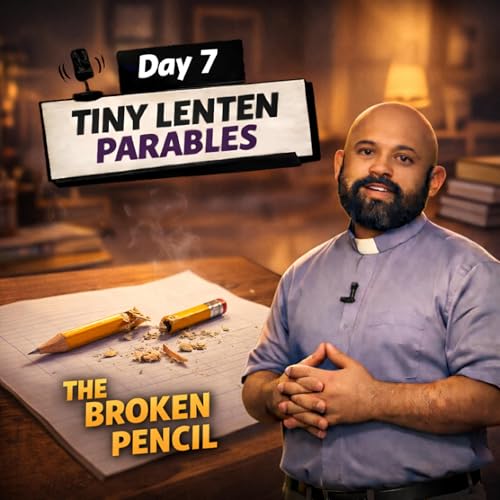
  • Day 7 The Broken Pencil
    Feb 25 2026

    DAY 7 — THE BROKEN PENCIL

    “God Never Discards You — He Reshapes You”

    In a busy classroom, a frustrated student pressed too hard on her pencil and snapped it in half.
    The graphite split, the wood cracked, and she cried out,
    “Now it’s useless!”

    Expecting her teacher to be annoyed,
    she held out the broken pencil apologetically.

    But the teacher didn’t scold her.
    He simply walked to the sharpener,
    placed the broken half inside,
    and gently turned the handle.

    A fresh point emerged — new, sharp, ready.
    He handed it back and said,
    “It’s not useless.
    It just needed a new point.”

    The girl smiled.
    A broken pencil had become a new beginning.


    So often we look at our mistakes
    and conclude we are beyond repair.
    We tell ourselves:
    “I failed — I’m done.”
    “I sinned again — I’m hopeless.”
    “I broke something — God won’t use me.”

    But God is a teacher who refuses to throw you away.
    When life snaps you in half,
    He doesn’t discard you —
    He reshapes you.

    Your brokenness is not your ending;
    it is the beginning of a deeper grace.
    Lent is the season of sharpening:
    of letting God refine your intentions,
    purify your desires,
    and shape your weaknesses
    into wisdom.

    Broken pencils still write.
    And broken hearts still love.
    And broken sinners still become saints.

    Más Menos
    3 m
  • Day 6 The Quiet Confession
    Feb 24 2026

    DAY 6 — THE QUIET CONFESSION

    “The First Step Back Is Already Grace”

    Late one evening, a man walked into a small chapel
    for the first time in many years.
    He didn’t approach the altar.
    He didn’t pick up a prayer book.
    He didn’t speak.
    He simply sat in the last pew
    with a heaviness that words couldn’t carry.

    The priest noticed him from afar
    and walked over slowly, gently.

    He didn’t ask why he had come.
    He only whispered,
    “My son…
    God has missed your voice.”

    The man’s eyes filled with tears
    as he replied quietly,
    “And I…
    I have missed His.”

    Nothing more was said.
    But something had already begun:
    The journey home.


    Confession doesn’t begin
    with words, formulas, or lists.
    It begins with returning.
    With stepping back into God’s presence,
    even if you don’t know what to say.

    God sees the moment your heart turns,
    even before your lips move.

    Lent is the season when heaven leans close —
    not to accuse,
    but to embrace.
    Not to shame,
    but to restore.
    Not to punish,
    but to bring you home.

    Grace meets you not at the confessional door,
    but at the moment you decide,
    “Maybe I should go back.”

    That first step
    is already forgiveness in motion.

    Más Menos
    2 m
  • Day 5 The Bare Tree
    Feb 23 2026

    DAY 5 — THE BARE TREE

    “God Works in Places We Cannot See”

    During winter, a child stood before a large tree
    stripped of all its leaves.
    Its branches were rigid,
    its shape lifeless,
    its beauty buried under snow.

    “Papa,” the child asked,
    “Is the tree dead?”

    The father knelt beside him and said gently,
    “No, my son.
    The tree is alive…
    just not on the outside.
    Right now it’s working underground —
    strengthening roots, saving energy,
    preparing for spring.”

    The child touched the cold bark
    and whispered,
    “So the tree is resting?”
    The father smiled.
    “Yes.
    And even in its resting,
    God is helping it grow.”


    Lent often feels like winter —
    silent, bare, stripped, empty.
    You may feel like nothing is happening,
    like your faith is stagnant,
    like your soul is as still as a bare tree.

    But God does His deepest work underground.
    In the hidden places of your heart,
    He strengthens what cannot be seen,
    purifies what cannot be measured,
    prepares fruit that will appear
    only in the right season.

    Don’t misinterpret spiritual quietness
    as spiritual death.
    Roots grow in secret.
    Holiness often begins in silence.
    Your spring will come —
    but for now,
    trust the winter.

    Más Menos
    2 m
  • Day 4 The Slow Turning of the Ship
    Feb 21 2026

    DAY 4 — THE SLOW TURNING OF THE SHIP

    “Conversion Happens One Degree at a Time”

    A tourist on a seaside pier watched a massive ship far out in the ocean.
    He noticed it was turning —
    but incredibly slowly,
    almost as if it wasn’t turning at all.

    He asked a sailor nearby,
    “Why does it move so slowly?
    It looks like nothing is happening.”

    The sailor smiled and said,
    “A ship this big can’t turn quickly.
    If it spins too fast, it breaks.
    So it turns one degree at a time.
    Give it patience…
    and soon it will be facing a completely new direction.”

    The tourist watched again —
    and realized the ship was indeed turning.
    Not with speed,
    but with purpose.


    We often expect instant conversion —
    overnight holiness,
    immediate change,
    perfect discipline from day one.

    But the human heart is not a speedboat.
    It is a large vessel
    with memories, wounds, habits, fears,
    and old patterns of sin.

    If God turned you too fast,
    you would break.
    So He turns you gently —
    one degree at a time.

    This is the grace of Lent:
    slow transformation,
    steady shifting,
    daily small obediences
    that eventually redirect the entire course of your life.

    Never despise slow change.
    Slow change is real change.

    Más Menos
    2 m
  • Day 3 The Burned Toast
    Feb 20 2026

    DAY 3 — THE BURNED TOAST

    “Love That Chooses Relationship Over Irritation”

    A young wife rushed through breakfast preparations before work.
    Distracted, she left the bread in the toaster too long.
    When she served it, the slices were black, crisp, and smoky.

    Embarrassed, she said,
    “I’m so sorry… I ruined breakfast.”

    Her husband didn’t react with frustration.
    He simply picked up the slice,
    scraped away the burnt edges,
    and ate it quietly with a smile.

    After a moment she asked,
    “You’re not upset?”

    He looked at her lovingly and said,
    “Of course not.
    I love you far more
    than I dislike burnt toast.”

    And in that simple moment,
    she felt more cherished than any perfectly prepared meal could have made her.


    Lent invites us to examine the places
    where we choose irritation over love,
    judgment over patience,
    perfectionism over relationship.

    Burnt toast moments happen every day —
    mistakes, imperfections, disappointments,
    minor frustrations that can either
    trigger anger or open the door to grace.

    God treats us just like that husband:
    He scrapes off our burnt edges
    with gentleness, not condemnation.
    He cares more about the relationship
    than the mistake.

    Lent is not a season to punish yourself;
    it is a season to encounter the patient love of God
    and to learn to offer that same patience
    to the people around you.

    Más Menos
    2 m
  • Day 2 The Sandcastle in the Tide
    Feb 19 2026

    DAY 2 — THE SANDCASTLE IN THE TIDE

    “Letting Go of What Cannot Last”

    A father and his little daughter spent an entire afternoon building a magnificent sandcastle —
    towers tall, windows carved perfectly,
    a moat filled with water from the sea.

    When they finally stepped back to admire it,
    the tide began to rise.
    Wave after wave pressed forward
    until the castle slowly dissolved into wet sand.

    The girl’s eyes filled with tears.
    “We worked so hard!
    Why did it have to disappear?”

    Her father picked her up and said,
    “We didn’t build it to last forever.
    We built it to enjoy…
    and to learn that even beautiful things
    sometimes have to return to the sea.”

    He set her down.
    “Now come —
    let’s build again.”


    Lent teaches us the art of holy letting go.
    So much of what we cling to —
    status, achievements, comfort, control, expectations —
    is just a sandcastle.

    It looks beautiful,
    but it was never meant to last forever.
    God often allows certain structures in our lives
    to be washed away
    so He can free us from what we cling to
    and make space for something deeper.

    The tide is not your enemy.
    It is God’s invitation
    to hold life with open hands.
    To stop worshiping what is temporary.
    To trust that God knows how to rebuild
    with better foundations.

    The spiritual life is not about preserving sandcastles —
    it’s about learning to start again
    with a freer heart.

    Más Menos
    2 m
  • Day 1 The Cracked Clay Pot
    Feb 18 2026

    DAY 1 — THE CRACKED CLAY POT

    “God Uses What We Hide”
    Every morning, a gardener carried two clay pots down a long path to water his plants.
    One pot was perfect — polished, smooth, flawless.
    The other had a long crack running down its side.
    Each day, water dripped through that crack until the pot was nearly half-empty by the time they reached the garden.

    One morning, the cracked pot finally spoke:
    “I’m ashamed. I’m broken. I waste your water.
    Why don’t you throw me away and use a better pot?”

    The gardener paused, smiled gently, and said,
    “My friend… look at your side of the path.”

    The cracked pot looked — and for the first time saw it:
    Bright flowers blooming in rows of yellow, pink, and violet.

    “I planted seeds on your side,” the gardener said.
    “I knew about your crack.
    So every day, without realizing it,
    you watered beauty along the way.”

    The pot wept.
    Its weakness had been its ministry.


    We spend so much energy hiding our cracks —
    our sins, weaknesses, failures, wounds, limitations.
    We try to look like the “perfect pot” everyone admires.

    But Lent invites us to a different kind of honesty:
    God doesn’t use us despite our cracks.
    He often uses us through them.

    Your weakness may be watering someone else’s healing.
    Your struggle may be teaching someone perseverance.
    Your past may be someone else’s map out of darkness.

    God is a gardener who plants seeds
    exactly along the path of your brokenness.
    And what you call “failure,”
    He calls “fertile ground.”

    Lent is not about becoming flawless —
    it’s about letting God make your cracks fruitful.


    Ask yourself today:
    “What crack in my life have I been ashamed of…
    that God may be trying to use for good?”

    Whisper this prayer:
    “Lord, I place my broken places in Your hands.
    Use them to water what I cannot see.”

    Más Menos
    3 m