Episodios

  • Vampires, Witchcraft, and the Dangerous Dead in Folklore and Ritual: Professor John Blair
    Apr 1 2026

    Oxford historian Professor John Blair explores vampire beliefs, predatory corpses, and the deep connections between witchcraft and folklore in medieval and early modern Europe — and colonial New England.

    What do vampires, witch trials, and shroud-chewing corpses have in common? More than you might think.

    In this episode of The Thing About Witch Hunts, hosts Josh Hutchinson and Sarah Jack sit down with Professor John Blair, Emeritus Professor of Medieval History and Archaeology at the University of Oxford and Fellow of The Queen's College, Oxford. Professor Blair is the author of the book Killing the Dead: Corpses, Vampires, and the Unquiet Dead in Medieval and Early Modern Europe — a landmark study of how premodern communities understood the body, fear, and the threat of the dangerous dead.

    This conversation goes deep into the history of vampire beliefs and folklore, including:

    • The origins of the word "vampire" and the many names given to predatory corpses across cultures

    • Corpse execution practices in medieval and early modern Europe

    • Sleep paralysis and its role in shaping beliefs about the unquiet dead

    • The Malleus Maleficarum and its connections to vampire and witchcraft lore

    • Shroud-chewing, witch cakes, and vampire cakes — and what these practices reveal about community fear

    • Striking parallels between vampire beliefs and witchcraft accusations in colonial New England, including the Salem Witch Trials

    Whether you're interested in medieval folklore, the history of witchcraft, vampire mythology, early modern European history, or the Salem trials, this episode offers essential historical context for understanding how fear, the body, and the supernatural intersected in the premodern world.

    📖 Pick up Killing the Dead at bookshop.org/shop/endwitchhunts https://bookshop.org/a/90227/9780691224794

    🎥 Watch more on YouTube: youtube.com/@aboutwitchhunts

    🌐 Learn more about our work on historical and contemporary witchcraft accusations at endwitchhunts.org

    If this episode was valuable to you, please leave a review and share it with someone who loves history, folklore, or the early modern world. It helps others find the show and keeps this important work going.


    HASHTAGS: #VampireHistory #VampireFolklore #MedievalHistory #WitchcraftHistory #TheDangerousDead #SalemWitchTrials #EarlyModernEurope #Folklore #UnquietDead #MalleusM aleficarum #SleepParalysis #HistoryPodcast #WitchHunts #OxfordHistory #TheThingAboutWitchHunts #KillingTheDead #ProfJohnBlair #ColonialNewEngland #HistoricalFolklore #WitchTrials

    Más Menos
    49 m
  • Salem Witch Trials Daily Covers the Witchcraft Panic of 1692 in Real Time
    Mar 30 2026

    Check out Salem Witch Trials Daily, our new podcast that follows the 1692 Salem Witch Trials in real time, day by day, court date by court date, through the documented record. In Salem, Massachusetts, 19 people were executed, one man was pressed to death for refusing trial, and more than a hundred others were accused and imprisoned, leaving a lasting mark on American history. Building on the extraordinary listener response to this series when it launched within The Thing About Salem, the show now has its own dedicated feed, available wherever you get podcasts. Each micro-episode is tied to the actual calendar of 1692 and draws directly from primary sources like court documents, examination transcripts, petitions, letters, and contemporary accounts, alongside established scholarship and our own research. We also provide weekly companion blog posts and downloadable worksheets on aboutsalem.com for deeper, self-paced learning.

    ⁠Salem Witch Trials Daily – The Thing About Salem Podcast

    Más Menos
    3 m
  • Scottish Witch Trials: The Story of the Peebles Witch Trials Comes Alive in Rope and Flame Play
    Mar 25 2026

    In 1629, 27 men, women, and a 15-year-old child were executed in Peebles, Scotland — and their ashes cast into the River Tweed. For centuries, their names were largely forgotten. Now, a community theater production called Rope and Flame is bringing their stories back to life, just steps from the river where they were lost.

    Josh Hutchinson and Sarah Jack sit down with the creative team behind this remarkable project: director and co-writer Clare Prenton, playwright and co-writer Anita John, actor Scott Noble, and historian Mary Craig, whose book Borders Witch Hunt laid the foundation for the script.

    This conversation will take you into the Scottish Borders, into the streets and kirk of a 17th-century market town under pressure from famine, religious upheaval, and the reach of Edinburgh's legal machinery. Listeners will come away with a richer understanding of how witchcraft accusations spread through a community, why both accusers and accused deserve to be understood as full human beings, and what a commemorative plaque on Tweed Green sparked in a modern Scottish town.

    You'll also hear how three women writers intentionally pushed back against the framing of female fear and coercion as irrational, how a 15-year-old girl was pressured into naming names, and why one local historian argues that boots on the ground matter more than books when it comes to understanding the past.

    From generational trauma to the parallels between 17th-century gossip and why the mechanics of a whisper spreading through a 17th-century Scottish market town are not as distant from our own moment as we might like to think. this episode connects the Scottish witch trials to questions that are urgently alive right now.


    In This Episode

    • The history of the 1629 Peebles witch trials and what made the Scottish Borders a hotbed of witchcraft prosecutions

    • How the 2022 memorial on Tweed Green sparked a community theater production

    • The role of Calvinism, political turmoil under Charles I, and economic hardship in fueling accusations

    • Why Rope and Flame portrays accusers as complex, frightened human beings rather than simple villains

    • The story of Isabel Haddock, the 15-year-old accused whose testimony changed everything

    • How community theater is doing what history books alone cannot

    If this episode moved you, share it. These stories survive because people carry them forward. Josh Hutchinson and Sarah Jack are descendants of Salem witch trial victims who helped build End Witch Hunts nonprofit to educate about witch hunts past and present, advocate for the accused, and support the communities doing that work. Subscribe to The Thing About Witch Hunts wherever you listen, and visit endwitchhunts.org to learn more and donate.

    Links

    Play Podcast Episode: A History of Scottish Witches with Mary W. Craig

    Play Podcast Episode: Scottish Witch Trials with Mary W. Craig

    Duns Play Fest

    East Gate Arts Theatre

    Buy Books Mentioned in this Episode

    Sign the Petition to Exonerate the Boston 8

    The History of Witch Trial Exonerations in Massachusetts

    About the MA Witch Hunt Justice Project


    Purchase a MA Witch Hunt Justice Project Memorial Pin

    Más Menos
    53 m
  • Podcasthon 2026: The Anatomy of a Moral Panic — Salem, McCarthyism, and the Satanic Panic
    Mar 18 2026

    What's in This Episode

    Podcasthon is a global event where thousands of podcasters use their platforms to raise money for a cause they believe in. This year, The Thing About Witch Hunts is participating to support End Witch Hunts, the only US nonprofit dedicated to raising awareness about witchcraft accusation violence past and present. If this episode moves you, donate at endwitchhunts.org/donate. Every contribution goes directly to the work.

    The Salem Witch Trials ended in 1693. We know what went wrong. And yet the pattern keeps showing up, different century, different accusation, same structure. This episode names that structure.

    Josh Hutchinson and Sarah Jack step back from individual cases to look at what moral panics are actually made of: how they get built, who builds them, who gets targeted, and why the fear feels so real and so righteous from the inside. The history moves from colonial Massachusetts through the Red Scares, McCarthyism, and the Satanic Panic of the 1980s and 1990s, connecting to witchcraft accusation violence happening in communities around the world right now.

    What You'll Learn

    Why the same panic keeps working across centuries. How institutions transform fear into prosecution. Who gets chosen as the target, and why that choice is never random. What genuine fear has to do with other agendas operating underneath it. And perhaps most importantly: what the people who actually disrupted witch hunts throughout history had in common.

    The dissenters are always in the record. This episode finds them.

    Why It Matters

    Every person who can recognize a moral panic in progress becomes a potential dissenter. That is not a small thing. Support End Witch Hunts at endwitchhunts.org/donate.

    Keywords: moral panic, witch hunts, Salem witch trials, Satanic Panic, McCarthyism, Red Scare, witchcraft accusation violence, folk devils, spectral evidence, historical exoneration, End Witch Hunts, Podcasthon 2026, Dr. Leo Igwe, Maimunat Mohammed, Thomas Brattle, Cotton Mather, Massachusetts Bill H.5154

    Links

    Buy the Book: Folk Devils and Moral Panics by Stanley Cohen

    Buy the Book: The Enemy Within, A Short History of Witch Hunting

    Listen to Podcasthon: When Children are Accused of Witchcraft

    Listen to the Episode:Fearing the Devil: A Cultural History of America’s Satanic Panic with Scott Culpepper

    Article by Dr. Leo Igwe Give to Gain: Justice for Women Accused of Witchcraft in Africa

    Advocacy for Alleged Witches (AfAW)

    End Witch Hunts

    UN Human Rights Council Resolution 47/8

    Más Menos
    39 m
  • Give to Gain: Raising Voices for Women Accused of Witchcraft in Nigeria
    Mar 11 2026

    In honor of International Women's Day 2026, End Witch Hunts hosted a powerful panel discussion bringing together advocates, legal experts, journalists, and survivors to raise awareness about witchcraft accusations targeting women in Nigeria and across Africa. This conversation is part of the global "Give to Gain" initiative — the theme of International Women's Day 2026 — calling on individuals, organizations, and governments to give resources, empathy, legal support, and voice so that women accused of witchcraft can gain justice, safety, and dignity.

    Witchcraft accusations disproportionately target women, especially those who are poor, widowed, elderly, or otherwise vulnerable. Accusation can mean social ostracism, physical violence, displacement, imprisonment, and even death. Our panelists shared firsthand experience, legal expertise, and on-the-ground advocacy work illuminating what is happening in Nigeria today and what all of us can do about it.

    • How witchcraft accusations specifically harm women and compound existing inequality

    • The psychological toll of accusation, including self-doubt and mental health impacts

    • Legal protections that exist in Nigeria and why they are not being used

    • How women can seek justice through courts, NGOs, and community channels even without financial resources

    • The role of patriarchy, poverty, and community silence in perpetuating accusation

    • Why empowerment and financial independence are protective factors

    • How diaspora communities outside Nigeria are funding witchcraft accusations back home

    • What governments, international organizations, media, and individuals can give to create real change

    • The critical importance of reaching rural communities in local languages

    Dr. Leo Igwe is the director of Advocacy for Alleged Witches (AfAW), an initiative working to end witch hunts in Africa by 2030, and the Critical Thinking Social Empowerment Foundation. A board member of Humanist International and the Humanist Association of Nigeria, Dr. Igwe earned his doctoral degree from the University of Bayreuth, Germany, where he wrote his thesis on witchcraft accusations.

    Chief Magistrate Safiya Musa Salihu is a Chief Magistrate in Bauchi State, Nigeria, and Vice Chairman of the International Federation of Women Lawyers (FIDA), Bauchi branch. She has trained paralegals across multiple communities and works fearlessly to ensure that accused women have access to justice.

    Hauwa Mundi is a broadcast journalist with Radio Nigeria — the largest radio network in Africa with over 40 million listeners — a social media influencer, and a member of Advocacy for Alleged Witches. She uses her platform to challenge belief in witchcraft and amplify the stories of the accused.

    Maimunat Mohammed is an Information Officer at a university in Minna and representative of the Niger State Branch of Advocacy for Alleged Witches. She shared her own experience of being accused alongside her mother following her father's death, and her years of advocating for her family in the face of community hostility.

    Dr. Barrister is the National President of the Association of Women against Gender-Based Violence and founder of the ADI Foundation in Bayelsa State, Nigeria, working for justice and security for vulnerable persons.

    • Article by Dr. Leo Igwe Give to Gain: Justice for Women Accused of Witchcraft in Africa

    • Advocacy for Alleged Witches (AfAW)

    • End Witch Hunts

    • International Federation of Women Lawyers (FIDA)

    • Association of Women against Gender-Based Violence

    • Radio Nigeria

    • UN Human Rights Council Resolution 47/8

    Más Menos
    57 m
  • Salem Witch Trials: Tituba in Two Centuries of Literature with Samaine Lockwood
    Mar 4 2026
    What does American literature reveal about how a society imagines justice, belonging, and the power of women? Samaine Lockwood, Associate Professor of English at George Mason University and the 2026 Fenwick Fellow, has spent years tracing that question through one of the most enduring stories in American culture: the Salem witch trials. Her fellowship project, Tituba Indian: The History of an American Cultural Figure follows Tituba Indian from the historical record of 1692 through two centuries of novels, plays, and reimaginings to ask what her story has been made to carry and why.In This EpisodeHow the Salem witch trials became one of the most reimagined episodes in American literary historyWhy Tituba Indian sits at the center of debates about race, gender, and civic belonging across two centuries of American cultureHow culture reuses the pastHow Ann Petry's Tituba of Salem Village broke from literary tradition decades before most readers noticedWhy Arthur Miller's The Crucible remains complicated and how teachers are beginning to challenge it in the classroomThe real significance of the witch as a figure in literature, from colonial revival to contemporary young adult fictionWhere to find the vast archive of Salem witch trial literature that predates copyright, freely available onlineAbout Samaine Lockwood Samaine Lockwood is an Associate Professor of English at George Mason University, specializing in 19th century American literature and gender and sexuality studies. She is the 2026 Fenwick Fellow, a research fellowship funded by the George Mason Fenwick Library supporting her book in progress, Tituba Indian and the History of an American Cultural Figure. Her previous book, Archives of Desire: the Queer Historical Work of New England Regionalism, was published by the University of North Carolina Press in 2015.Authors and Works Mentioned in This EpisodeAnn Petry: Tituba of Salem Village; The Narrows; Biography of Harriet Tubman. First black woman to write a bestselling novel in the United States.Maryse Conde: I, Tituba: Black Witch of SalemHenry William Herbert: The Fair Puritan (written 1850s, published 1870s)Elizabeth Gaskell: Lois the WitchCharlotte Perkins Gilman (with Grace Ellery Channing): Untitled Salem play, 1890, held at the Schlesinger Library, HarvardPauline Elizabeth Hopkins: Fiction writer, first Black woman editor of a magazine, key figure in the Boston African American community at the turn of the 20th centuryArthur Miller: The CrucibleMarian Starkey: The Devil in MassachusettsMatilda Joslyn Gage: Woman, Church, and State (1890s)Saidiya Hartman: Venus in Two ActsGretchen Adams: The Specter of SalemHenry James: The Turn of the Screw and Other Ghost StoriesKimberly Bellflower: John Proctor is the Villain (Broadway, 2024)Samaine Lockwood: Archives of Desire: the Queer Historical Work of New England Regionalism Keith Clark: The Radical Fiction of Ann PetryWhere to Find These Works Most works published before 1923 are in the public domain and freely available through Open Library and Internet Archive. For titles still in print, support this podcast and End Witch Hunts by purchasing through our Bookshop.org storefront: bookshop.org/shop/endwitchhuntsEvery purchase (of any title) through Bookshop.org supports independent bookstores and helps fund the work of End Witch Hunts when you purchase through our affiliate link.LinksPublications by Samaine LockwoodUniversity Libraries has named Samaine Lockwood, associate professor of English, the 2026 Fenwick FellowBuy Books Mentioned in Today's Episode Sign the Petition to Exonerate the Boston 8 The History of Witch Trial Exonerations in Massachusetts About the MA Witch Hunt Justice ProjectPurchase a MA Witch Hunt Justice Project Memorial Pin
    Más Menos
    49 m
  • Salem Witch Trials on Stage: Nicole Brooks on Obeah Opera
    Feb 25 2026

    Most people meet Tituba through Arthur Miller. Nicole Brooks met her differently. The Canadian artist, producer, composer, and performer spent over a decade creating Obeah Opera, a fully sung a cappella theatrical work that centers Tituba and the other women of Salem as healers, wise women, and people who loved and were loved. In this conversation Nicole opens up about the research, the music, the controversy, and the story she believes America is ready to hear.


    What You Will Learn

    • Who Tituba was beyond The Crucible

    • Why Nicole positions every woman in the story as a healer

    • How the word Obeah appears in Puritan records and what that tells us

    • The love story at the heart of Obeah Opera

    • How the girls who made accusations were themselves silenced and powerless

    • What Tituba's name means in Yoruba

    • Why an all-female cast changes how the story lands

    • How music makes the heaviest history bearable

    Guest Nicole Brooks, creator of Obeah Opera

    Resources and Links

    Sign the Petition to Exonerate the Boston 8

    The History of Witch Trial Exonerations in Massachusetts

    About the MA Witch Hunt Justice Project

    Purchase a MA Witch Hunt Justice Project Memorial Pin

    Más Menos
    39 m
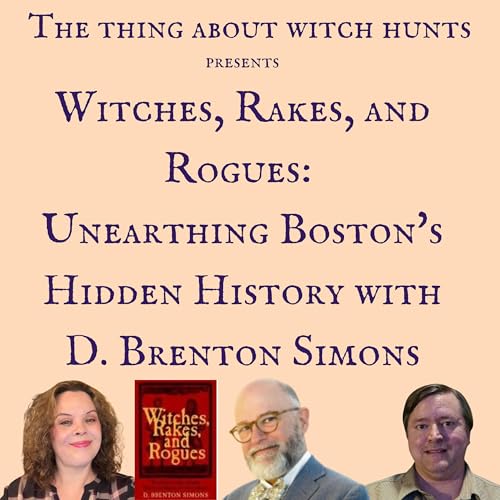
  • Witches, Rakes, and Rogues: Unearthing Boston's Hidden History with D. Brenton Simons
    Feb 18 2026

    About This Episode

    What if Boston's colonial past held witch trial stories just as gripping as Salem's but almost entirely overlooked? This week, Sarah and Josh sit down with D. Brenton Simons, President Emeritus and former CEO of American Ancestors (New England Historic Genealogical Society), to uncover the witches, criminals, and scandal-makers that Boston's official history left out.


    D. Brenton Simons spent 18 years leading American Ancestors, one of the world's foremost genealogical organizations with over 500,000 members in 139 countries. He is the author of Witches, Rakes, and Rogues, a collection of true Boston stories spanning 1630 to 1741, and was honored by King Charles III for his contributions to Anglo-American history.

    Boston had a witchcraft period spanning over a century, and the stories from it look nothing like what popular culture has taught us. Brenton walks us through cases that defy every stereotype, including a wealthy, well-connected woman whose "disagreeable" personality made her a target after her husband's death, an Irish Catholic servant whose foreign language and customs terrified a Puritan community, and women whose only real crime was practicing folk medicine and refusing to be pushed around.

    The research behind this book took five years and required digging through court records, personal diaries, and archives. The result is a portrait of real people navigating a world where the devil felt as immediate and dangerous as a neighbor's grudge.

    • The woman who appears as a background character in The Scarlet Letter and the real, devastating story behind her name

    • How the Goodwin children's afflictions during the Goody Glover case reveal something very human about fear and attention

    • The connection between Mercy Short's post-traumatic experiences and the Salem trials

    • Why the discovery of a black cat may have saved Boston from a second wave of witch hunting

    • What happened to accusations that never became trials, and why those stories matter just as much

    For descendants of Boston and Connecticut witch trial victims, this episode is essential listening. Brenton discusses his research connecting Mary Hale, Winifred Benham Sr., and the Benham family line across generations and colonies. If you have colonial New England ancestry, you may have more connections to these stories than you realize.


    • American Ancestors / New England Historic Genealogical Society

    • American Ancestors on YouTube

    • Witches, Rakes, and Rogues by D. Brenton Simons

    • End Witch Hunts

    The Thing About Witch Hunts is produced by End Witch Hunts, the only U.S. nonprofit dedicated to witchcraft accusation awareness. Find us wherever you listen to podcasts and on YouTube.

    If you enjoyed this episode, please leave a review and share it with anyone who loves colonial history, genealogy, or untold American stories.

    Más Menos
    51 m