

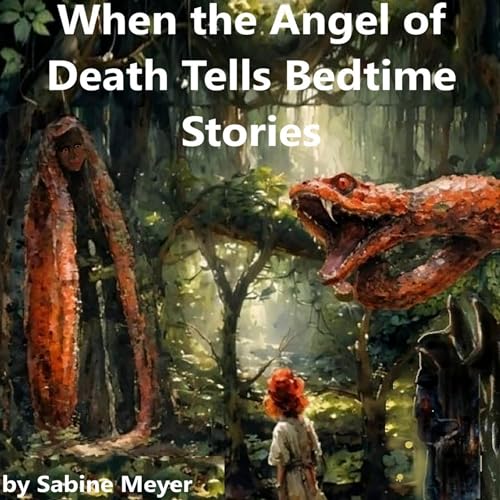
When the Angel of Death Tells Bedtime Stories
A Collection of Modern Fairytales
No se pudo agregar al carrito
Add to Cart failed.
Error al Agregar a Lista de Deseos.
Error al eliminar de la lista de deseos.
Error al añadir a tu biblioteca
Error al seguir el podcast
Error al dejar de seguir el podcast
 Exclusivo para miembros Prime: ¿Nuevo en Audible? Obtén 2 audiolibros gratis con tu prueba.
When the Angel of Death Tells Bedtime Stories
Compra ahora por $19.95
-
Narrado por:
-
Benjamin Powell
-
De:
-
Sabine Meyer
Michael, the Angel of Death, is the loneliest of all creatures. No mortal can see or hear the Grim Reaper, and all those he touches must die.
One day, though, a family adopts him as their own Godfather Death. From that day on, Michael tells bedtime stories to their youngest child. These are fairy tales from the angel's ten-thousand-year-old mind, dark, magical, whimsical, and tender.
Told with warmth, wit, and an undercurrent of ancient magic, each story touches upon themes of longing and loneliness, love and sacrifice, courage, loss, and transformation. Whether it’s a terrifying Red Snake that feeds on souls or a chicken yard hiding secrets from another world, these fairytales spark the imagination while embracing the beauty of the bittersweet. Those who are grieving or brokenhearted may find strange comfort here.
Perfect for fans of classic fairy tales, this is a book for adults and teens who enjoy feeling deeply and treading where others are scared to go.
El oyente recibió este título gratis
The premise is simple: Michael, the Angel of Death, has gone (mostly) unseen for ten thousand years. One girl could see him when he was still new at the job, and her descendants have also had the ability. When we start out, it’s quite literal to the title in that the Angel of Death is telling rather age-inappropriate bedtime stories to Fanny. Inappropriate in that while they’re fables, they are far from gentle.
They feel ancient, heavy with symbolism, and just a little bit deranged. Very Grimmesque in their morals and general strangeness. Some are oddly funny, like the little dog that eats so much it becomes a volcano after eating intruders one night, along with basically anything else it can find.
Others lean into quiet horror, like The Bad Mom, which only seems to refer to the mother as “Bad Mom”… felt a little more like “the gaslighting of mom” if we’re being technical.
I couldn’t quite tell what moral it was trying to land on, and like many of the stories the endings are a bit abrupt at times. Each one feels like it’s trying to teach something, though what that something is changes every time.
There’s Veritas, the girl so ugly that looking at her is like staring into the infinite void, and The Multidimensional Boy, a strangely fascinating thought experiment about travelling between two and four dimensions. It’s all slightly surreal, told in the tone of a bedtime story that knows it’s not for comfort. Even the language feels like a nod to Grimm: a bit formal, a bit fable-like, and unashamedly odd.
About halfway through, the stories start to fade and something different takes hold. We leave the fables behind and follow Michael himself through his history as the Angel of Death. His first collection, his confusion as a new cherub, the centuries of quietly gathering souls, it’s less whimsical and more reflective, almost melancholy.
The shift in tone caught me off guard a little. It felt like stepping from myth into memory, as if all those earlier tales were fragments of his long existence. We do circle back around but it’s then more a fusion of the two – memory and fairytale type stories twisted together.
Benjamin Powell’s is okay, though not without quirks. His tone carries a detached calm that fits the ethereal storytelling, but there are moments that trip. A few pronunciations felt off, some regional, others just slightly wrong, and it was enough that I noticed. Two in particular stood out, one being “Champs-Élysées” (the famous avenue in Paris) which was pronounced like “champs e-liss-ee” and a person I am sure was supposed to be “Genevieve” but pronounced as “Jenna vee-ev”.
The pacing is the stranger part: it sounds a bit rushed without actually being fast. Like Powell’s pressing forward before each line has time to settle. It doesn’t ruin the flow, but it does keep you aware of the performance.
The result is a strange, layered listening experience. Part storybook, part confession, part metaphysical musing. It’s full of contrasts: gentle language paired with cruel fates, moral lessons that make you question whether you actually learned anything. It’s like someone found a lost collection of bedtime stories meant for the end of the world.
As a whole, When the Angel of Death Tells Bedtime Stories feels like a modern version of Grimms Fairy Tales. At times I forgot they weren’t modern and it wasn’t until someone mentioned a cell phone or hairspray or other such modern banality that it became more obvious. Original and quietly unsettling. The fairy-tale rhythm pulls you in, the darker stories twist it, and by the end, you’re left somewhere between comforted and disturbed.
Not every story hits the same, but parts of it do linger and made me think of what fate truly awaits us once the Angel of Death has collected our souls. Hopefully it serves the purpose like all good fairy tales should and help keep people alive a little longer by reminding us not to be tricked by witches and snakes!
Bedtime Stories
Se ha producido un error. Vuelve a intentarlo dentro de unos minutos.