

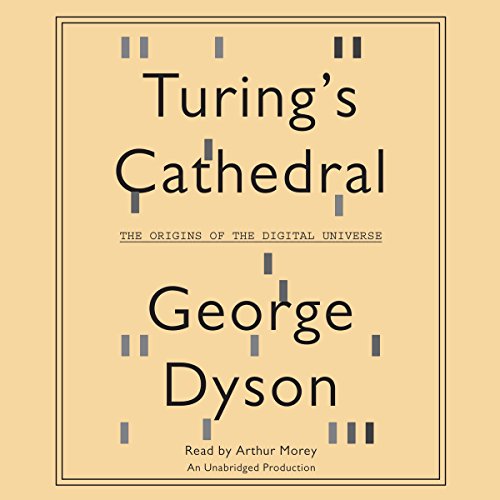
Turing's Cathedral
The Origins of the Digital Universe
No se pudo agregar al carrito
Add to Cart failed.
Error al Agregar a Lista de Deseos.
Error al eliminar de la lista de deseos.
Error al añadir a tu biblioteca
Error al seguir el podcast
Error al dejar de seguir el podcast
Prueba gratis de 30 días de Audible Standard

Turing's Cathedral
Compra ahora por $21.60
-
Narrado por:
-
Arthur Morey
-
De:
-
George Dyson
“It is possible to invent a single machine which can be used to compute any computable sequence,” twenty-four-year-old Alan Turing announced in 1936. In Turing’s Cathedral, George Dyson focuses on a small group of men and women, led by John von Neumann at the Institute for Advanced Study in Princeton, New Jersey, who built one of the first computers to realize Alan Turing’s vision of a Universal Machine. Their work would break the distinction between numbers that mean things and numbers that do things—and our universe would never be the same.
Using five kilobytes of memory (the amount allocated to displaying the cursor on a computer desktop of today), they achieved unprecedented success in both weather prediction and nuclear weapons design, while tackling, in their spare time, problems ranging from the evolution of viruses to the evolution of stars.
Dyson’s account, both historic and prophetic, sheds important new light on how the digital universe exploded in the aftermath of World War II. The proliferation of both codes and machines was paralleled by two historic developments: the decoding of self-replicating sequences in biology and the invention of the hydrogen bomb. It’s no coincidence that the most destructive and the most constructive of human inventions appeared at exactly the same time.
How did code take over the world? In retracing how Alan Turing’s one-dimensional model became John von Neumann’s two-dimensional implementation, Turing’s Cathedral offers a series of provocative suggestions as to where the digital universe, now fully three-dimensional, may be heading next.
Los oyentes también disfrutaron:




Las personas que vieron esto también vieron:


The recording was so slow I increased the speed to 1.25
A Book Better in Print for Non-Coders
Se ha producido un error. Vuelve a intentarlo dentro de unos minutos.
The metaphor of cathedral is apt, since like the peasants, craftsmen and nobility in a medieval town we all now live and work in the shadow of what Gödel, Turning, Johnny and Klari von Neumann, and the others began constructing.
If you want to know why the modern world is the way it is, you’ll want to read tbos
Se ha producido un error. Vuelve a intentarlo dentro de unos minutos.
Tremendous
Se ha producido un error. Vuelve a intentarlo dentro de unos minutos.
The narration was awful. I feel bad criticising Arthur Morey, who sounds like a nice guy, especially since I would probably be an awful narrator myself. But I am disturbed by the number of interesting books that use him as narrator here on Audible. He sounds equal parts indifferent and puzzled by what he reads. His voice is grating, tired, monotone. He seems to misplace the emphasis nearly every other sentence. On its face, such a miss rate makes spoken English nearly unintelligible, unless I make the conscious effort of guessing what he was trying to say. I listen to audiobooks so that I can read in distracting circumstances such as commuting or lunch. I do not welcome this additional source of distraction. I have come to think twice before spending a credit on book narrated by him. I wish they would redo all of them with someone who seems to care about and understand the text.
Good history, strange theories, terrible narration
Se ha producido un error. Vuelve a intentarlo dentro de unos minutos.
What did you love best about Turing's Cathedral?
It gave an interesting perspective about how and why the modern day computer was invented, including some amusing insights to some of the brightest minds of the 20th century.What did you like best about this story?
That it was real :)What about Arthur Morey’s performance did you like?
I thought it was well executed, as the book doesn't really feature any dialog or characters the "neutral" delivery was appreciated.Was there a moment in the book that particularly moved you?
Nothing in particular, but there were a lot of little chuckles when it came to some of these people's behaviour. In no small part because it makes these mythical people human.Any additional comments?
I wish there would have been a bit more attention being paid to other pioneers in the computing field, but having said that, their legacy really lives on by the technology I use right now to write these words so: *raises glass*A fascinating look at the people behind it all
Se ha producido un error. Vuelve a intentarlo dentro de unos minutos.