

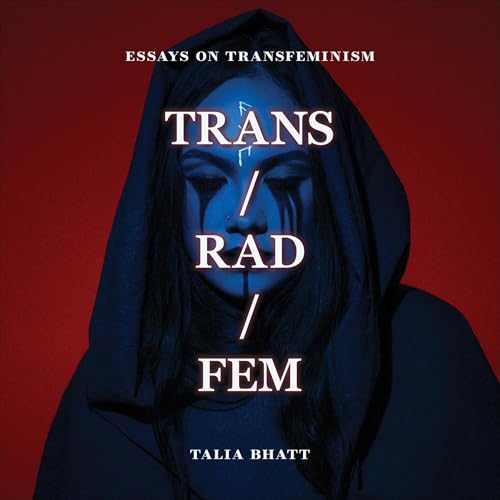
Trans/Rad/Fem
Essays on Transfeminism, Book 1
No se pudo agregar al carrito
Add to Cart failed.
Error al Agregar a Lista de Deseos.
Error al eliminar de la lista de deseos.
Error al añadir a tu biblioteca
Error al seguir el podcast
Error al dejar de seguir el podcast
Obtén 30 días de Standard gratis
Compra ahora por $17.33
-
Narrado por:
-
Clockwork Sapphire
-
De:
-
Talia Bhatt
Can a synthesis of trans liberation and feminism be easily arrived at? This collection asserts that, as a matter of fact, we possessed the answer to that question decades ago.
Second-Wave feminism is, today, nearly synonymous with ‘transphobia’. Any mention of this era or the movement of ‘radical feminism’ conjures images of feminists allying with right-wingers and the authoritarian state, providing legal justification for outlawing gender-affirming care and spreading deeply evil caricatures of trans women to rationalize their exclusion as feminist subjects. In the ensuing struggle to reconcile trans rights with feminism, the specter of the trans-exclusionary radical feminist has often reared its head in opposition. One may be tempted to conclude that the Second Wave, as a whole, has done irreparable harm to feminist, queer and trans politics, and must be discarded entirely.
But is that truly the case?
Radical feminism also is responsible for repudiating bioessentialistic notions of gender with theories that place it as a firmly social phenomenon. It gave us the language to describe patriarchy as a regime of mandatory heterosexual existence and dared to dream of a post-gender existence long before anyone spoke the phrase “breaking the binary”. Modern transfeminism owes much to radical feminist theory, and despite all propaganda to the contrary, the two schools of thought may be far more allied than believed.
This series of essays aims to reconstruct and reintroduce the radical feminist framework that its misbegotten inheritors seem determined to forget and in doing so boldly makes the claim that transfeminism, far from being antagonistic to radical feminism, is in fact its direct descendant. It shows how a comprehensive social theory of transsexual oppression flows almost naturally from radical feminist precepts and dares to declare that a materialist, radical transfeminism is the way forward to seize the foundations of patriarchy at the root.
©2025 Talia Bhatt (P)2025 Talia BhattLos oyentes también disfrutaron:


Las personas que vieron esto también vieron:


While the chapters may be individual essays, I greatly appreciated that each one builds on the others and do not feel like repeats of the same material by either her or other authors.
When it comes to the writing, Bhatt does not water down her criticisms in tone, detail, or obfuscating word choice. It was deeply refreshing to hear the rage in her voice during an era when feminism and trans rights advocacy are softened in order to faun for a general audience that wants us discarded, desecrated, and dead. If I read another article in which a trans woman is referred to exclusively as a “trans person” and sentences are carefully constructed to avoid the use of any pronouns by a so-called “liberal” news source, I will go insane.
I look forward to reading her other books and sub stack articles 🖤
Insightful, Thorough, and Powerful
Se ha producido un error. Vuelve a intentarlo dentro de unos minutos.