

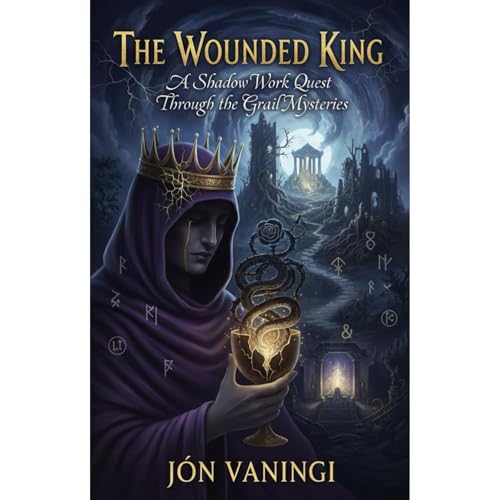
The Wounded King
A Shadow Work Quest Through the Grail Mysteries
No se pudo agregar al carrito
Add to Cart failed.
Error al Agregar a Lista de Deseos.
Error al eliminar de la lista de deseos.
Error al añadir a tu biblioteca
Error al seguir el podcast
Error al dejar de seguir el podcast
 Exclusivo para miembros Prime: ¿Nuevo en Audible? Obtén 2 audiolibros gratis con tu prueba.
The Wounded King
Compra ahora por $7.49
-
Narrado por:
-
Virtual Voice
-
De:
-
Jón Vaningi

Este título utiliza narración de voz virtual
Here's the wild thing about the Holy Grail: it's not a cup.
I mean, sure, it looks like a cup in all the stories. But that's the joke. The medieval writers were pulling a fast one, hiding revolutionary spiritual teachings inside adventure stories about knights and magic castles. They had to. The Church was burning people for less.
This book cracks the code. It shows you how the Grail legends are actually an elaborate instruction manual for shadow work, written in story form so it could survive centuries of religious oppression.
Start with the Fisher King. Poor guy's got a wound that won't heal (usually in the groin, because medieval writers were not subtle), and his whole kingdom turns into a wasteland because of it. That's you, by the way. We're all walking around with unhealed wounds, wondering why our lives feel barren. The secret? The wound doesn't heal until someone asks the right question. Not answers it. Asks it.
Then there's Percival, the kid who sees the Grail procession but stays silent because he's following the rules about being polite. He fails the test. And here's the twist: that failure is perfect. You can't win the Grail quest by being good. You win it by being real.
Or take Lancelot, the best knight in the world, who can't achieve the Grail because he's too busy sleeping with his best friend's wife. Sometimes being excellent at everything else becomes the wound itself.
The book digs into the hidden history too. Joseph of Arimathea catching Christ's blood in a cup and bringing it to Glastonbury. Mary Magdalene's supposed pregnancy and the sacred feminine the Church tried to erase. The Knights Templar encoding esoteric knowledge into romances. And the 536 AD climate catastrophe that actually happened, when volcanic ash blocked the sun and kingdoms collapsed, birthing the wasteland imagery that haunts every Grail story.
But here's where it gets practical. The wasteland isn't just medieval France. It's your own life when you're avoiding your shadow. The Fisher King isn't some distant legend. He's the part of you that's wounded and won't admit it. The Grail quest isn't about finding some magical object. It's about asking the question nobody wants to ask: "What really happened? What's really wrong?"
The Gnostic Christians knew this. For them, the Grail wasn't about believing correct doctrine. It was about direct spiritual experience, personal gnosis, the kind of knowing that comes from doing the inner work. That's why the Church hated them.
Every chapter connects the medieval myths to modern psychology, showing you how to use these stories as maps for your own transformation. Shadow work prompts. Practical exercises. Ways to find your wound, ask your question, and heal your wasteland.
Because here's the final secret: you don't find the Grail. You become it. The cup that holds the divine blood? That's you, learning to contain your own wholeness. The question that heals the king? That's you, getting brave enough to face what you've been avoiding.
The quest never ends. But it gets way more interesting.